Mutual funds vs stocks for beginners: a decision table
Mutual funds vs stocks for beginners, side by side: time, knowledge, diversification, costs and minimums. Both carry market risk. Updated 19 Nov 2026.
Summarize this article with AI





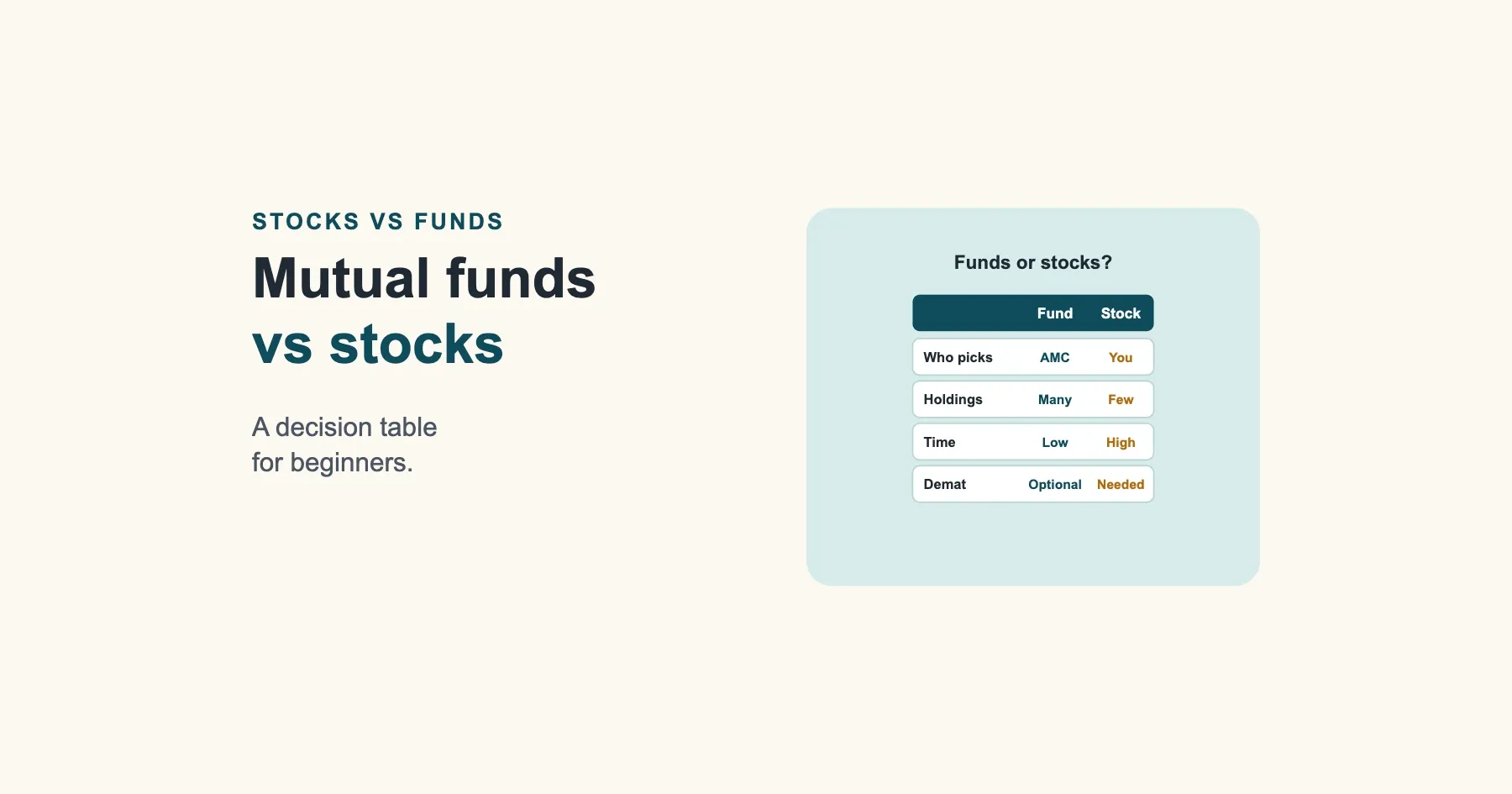
The short version
- A mutual fund gives you units in a pooled, professionally managed portfolio; a stock makes you part-owner of one company.
- Both carry market risk. Diversification lowers single-company risk, not market risk.
- Compare time, knowledge, diversification, costs, behaviour risk and minimum amount, not "which is safer".
- Fund holdings sit in a SEBI-registered trust structure; shares sit in your demat account with NSDL or CDSL.
- Many people do both in order: emergency fund, then goals, then a small learning portion.
As of 19 November 2026: a mutual fund pools money from many investors and a SEBI-approved asset management company (AMC) invests it across many securities; you own units. A stock is part-ownership of one company you pick yourself, held in your demat account. Both carry market risk. They differ in who decides, how spread out you are, and what you pay. Shares carry market risk too: their prices can fall, and you can lose part of the money you put in.
Vikram, 25, in Raipur, has just started a salaried job and keeps asking "which is safer?" The more useful question is "which fits the time, knowledge and temperament I have right now?" This page is a decision table for that question, not a verdict.
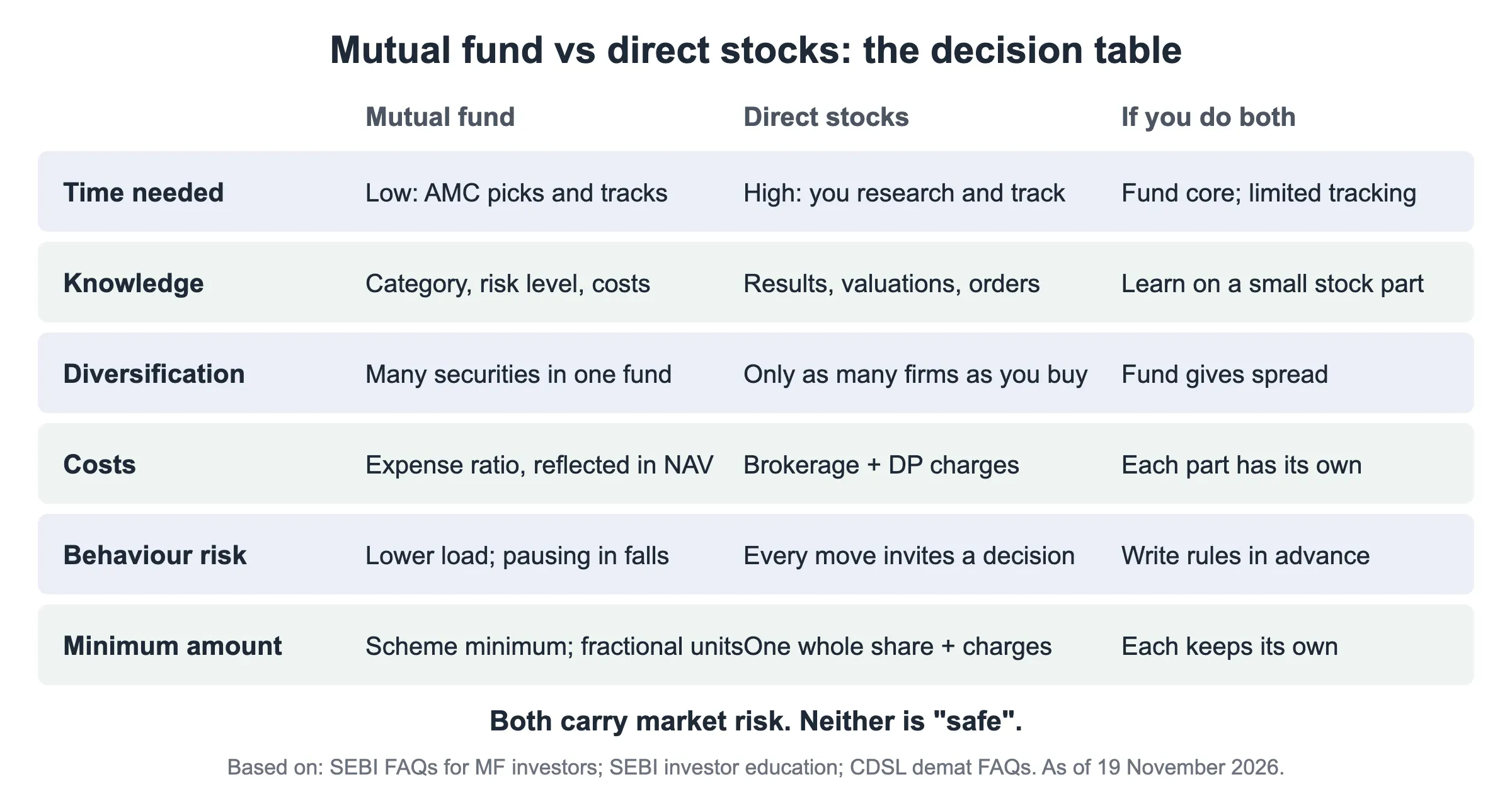
The decision table: mutual funds vs stocks for beginners
| What you compare | Mutual fund | Direct stocks | If you do both |
|---|---|---|---|
| Time needed | Low: the AMC picks and tracks the securities; you review the fund now and then | High: you research, choose and keep tracking each company | Fund for the core; limit stock tracking to what you can actually follow |
| Knowledge needed | Understanding the fund's category, risk level and costs | Reading company results, valuations and news, plus how orders work | Learn on a small stock portion while the fund runs |
| Diversification | One fund holds many securities across companies and sectors | You get only as much spread as the number of companies you can afford | The fund supplies the spread; stocks add concentration |
| Costs | Expense ratio, taken from the fund's assets and reflected in NAV | Brokerage and depository charges, set by your broker and DP | Both sets of costs apply to their own portion |
| Behaviour risk | Lower decision load, but stopping an SIP in a fall is still a risk | Higher: every price move invites a buy or sell decision | Rules written in advance help with both |
| Minimum amount | Set by each scheme; stated in its documents. Units can be fractional | The price of one whole share, plus charges | Each route keeps its own minimum |
Are mutual funds safer than stocks?
Neither is "safe". SEBI's own FAQ for mutual fund investors says investors "are neither offered any guaranteed/indicated returns nor any guarantee on repayment of capital by the scheme." A share carries what SEBI's beginner guide calls the "entrepreneurial risk of the business venture": your returns depend on how that company does.
What a diversified fund changes is which risk you carry. SEBI describes how in a mutual fund, investments are "spread across a wide cross-section of industries and sectors and thus the risk is diversified". That lowers the damage one company's bad year can do to you. It does not remove market risk: when the whole market falls, a diversified equity fund usually falls with it. So the honest line is this: diversification reduces single-company risk, not market risk. Both carry market risk.
The other difference is who decides. In a fund, a professional team makes buying and selling decisions within the scheme's stated rules. With stocks, every decision, including when to sell, is yours.
Where your money sits: AMC, trustee and custodian vs your demat account
Mutual fund. SEBI's FAQ explains that a mutual fund "is set up in the form of a trust, which has sponsor, trustees, Asset Management Company (AMC) and custodian." The trustees "hold its property for the benefit of the unitholders", the AMC manages the investments, and the custodian, which must be registered with SEBI, holds the scheme's securities. All mutual funds must register with SEBI before launching a scheme. Your units appear in a statement of account, or in your demat account if you choose that form.
Stocks. Shares you buy through a broker on an exchange such as NSE or BSE are credited to your demat account, held with a depository (NSDL or CDSL) through a depository participant (DP). CDSL's investor FAQ advises choosing a DP "based on his convenience and the DP's charges", so charges vary by provider. Our explainer what a demat account is covers how a demat account differs from a trading account.
How much do you need to know before buying stocks?
More than most first-time buyers expect. At a minimum, you would want to be able to:
- Read a company's quarterly results and annual report at a basic level.
- Explain why you are buying, in one sentence, without quoting a tip or a price target from social media.
- Decide in advance what would make you sell, and what would not.
- Understand how an order travels from your phone to the exchange and into your demat. Our guide how the stock market works in India follows one order step by step.
- Know your broker's and DP's charges, because on small orders they can be a noticeable share of what you invest.
If you cannot yet do these, that is information about where to start, not a reason to feel behind.
Can you do both? A sequence, not a split
Many people hold both, but in an order rather than a fixed ratio. A simple sequence:
- Emergency fund first. Keep several months of essential expenses somewhere easy to reach before investing in either. See how much emergency fund to keep.
- Goals next. Money for goals several years away is where many people look at a diversified fund through an SIP, after checking its category, risk level and costs. Our guide what an SIP is explains how an SIP works.
- Learning last. Once the first two run on their own, a small amount set aside for learning about individual companies lets you build stock knowledge without putting your goals at stake.
If you want a regular habit in shares too, compare the two habits in stock SIP vs mutual fund SIP.
Worked example: ₹3,700 a month (hypothetical, not a recommendation)
Assume Vikram has ₹3,700 a month to invest. No return rate is assumed: prices and NAV are held flat so you can see the mechanics only. Charges and taxes are ignored.
Mutual fund route. At a hypothetical NAV of ₹47.30, ₹3,700 buys 78.224 units of one diversified fund. Every rupee is invested, because units can be allotted in fractions. That money is already spread across all the fund's holdings, and the expense ratio is already reflected in the NAV.
Direct-stock route. At a hypothetical share price of ₹1,250, ₹3,700 buys 2 whole shares of one company (₹2,500), and ₹1,200 waits as cash.
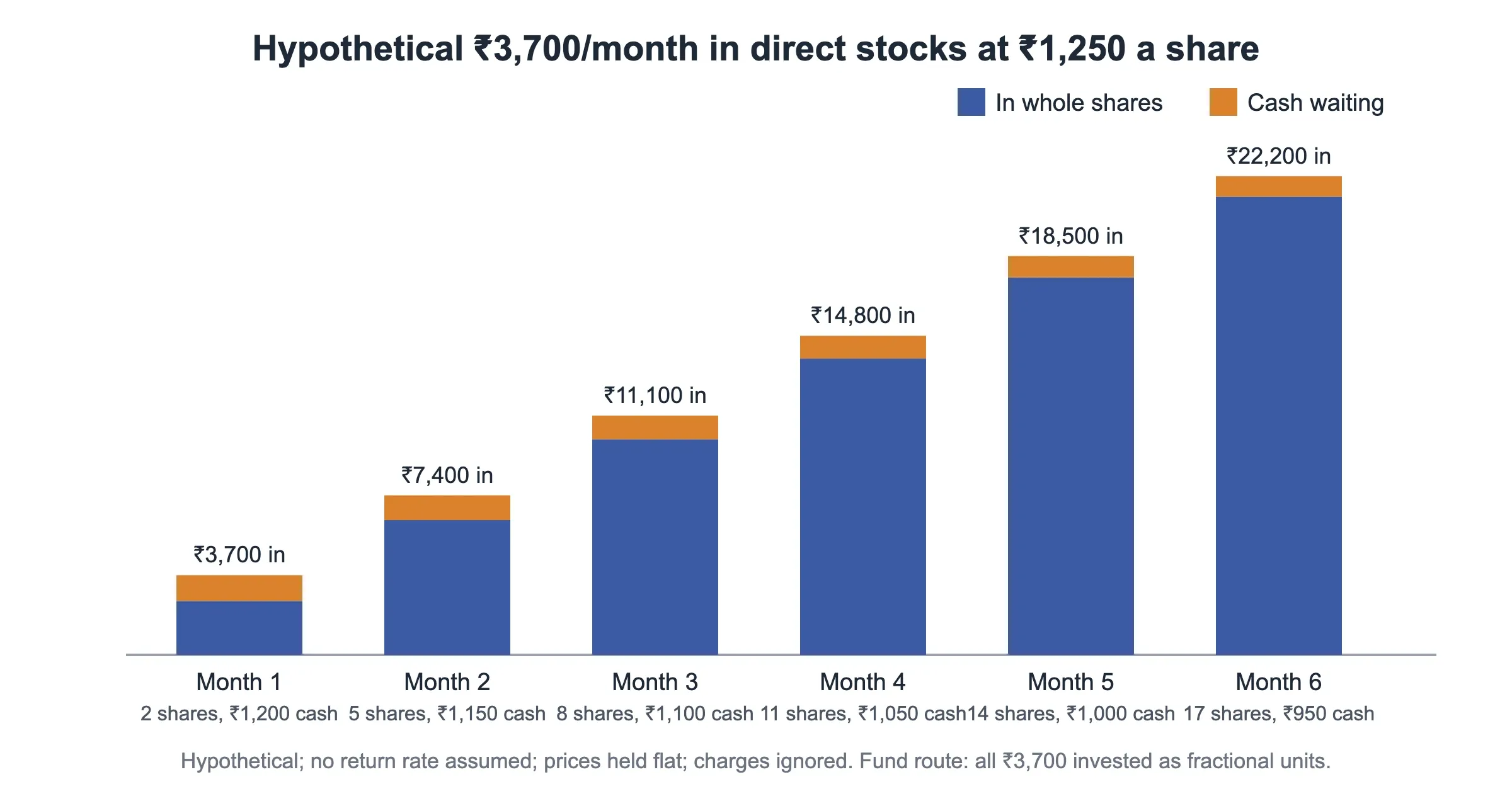
| Month | Total put in (₹) | Shares owned | Value in shares (₹) | Cash waiting (₹) |
|---|---|---|---|---|
| 1 | 3,700 | 2 | 2,500 | 1,200 |
| 2 | 7,400 | 5 | 6,250 | 1,150 |
| 3 | 11,100 | 8 | 10,000 | 1,100 |
| 4 | 14,800 | 11 | 13,750 | 1,050 |
| 5 | 18,500 | 14 | 17,500 | 1,000 |
| 6 | 22,200 | 17 | 21,250 | 950 |
Owning even one share each of 10 companies priced at ₹1,250 needs ₹12,500, which the ₹3,700 monthly amount reaches only in month 4. Until then, the stock route is concentrated in a few companies. Brokerage and depository charges, set by your broker and DP, would also apply to each trade or debit.
Neither route wins here: small monthly amounts simply buy spread quickly in a fund and slowly in direct stocks. Hypothetical figures; no return rate assumed; not a recommendation.
Frequently asked questions
I'm 24 and just started earning. Should I start with mutual funds or direct stocks?
That depends on your time, knowledge and temperament, not your age. Use the decision table: if you cannot yet research and track companies, note that. Many people set up an emergency fund first, then goal investing, then learn stocks with a small amount.
Are mutual funds actually safer than stocks, or is that a myth?
Partly a myth. A diversified fund reduces the risk of one company hurting you badly, but it still falls when the market falls. SEBI states there is no guarantee of returns or capital in a mutual fund scheme. Both carry market risk.
Can I do a mutual fund SIP and also buy a few shares on my own?
Yes. They run independently: the SIP buys fund units, and shares go to your demat account. Track each portion's costs separately. See our guide on stock SIP vs mutual fund SIP.
How much do I need to know before I buy stocks directly?
Enough to read basic company results, explain why you are buying, decide your selling rules in advance, and know your broker's and DP's charges. See our guide on how the stock market works in India.
If I have only ₹2,000 a month, what changes between starting with a mutual fund and with stocks?
In a fund, ₹2,000 buys fractional units spread across the fund's holdings, subject to the scheme's minimum. In stocks, it buys only whole shares priced at or below ₹2,000, so your spread grows slowly and charges take a larger share of small orders.
Read next
Start with the basics of an SIP at what an SIP is, then come back to the decision table when you are ready to weigh direct stocks.
— Laabh



