When to Sell a Mutual Fund: Five Reasons That Hold Up, Three That Usually Don't, and the Check to Run Before You Redeem
When to sell a mutual fund: five reasons that hold up, three that don't, and the FIFO, exit load and tax check to run first. Updated 22 Nov 2026.
Summarize this article with AI





The short version
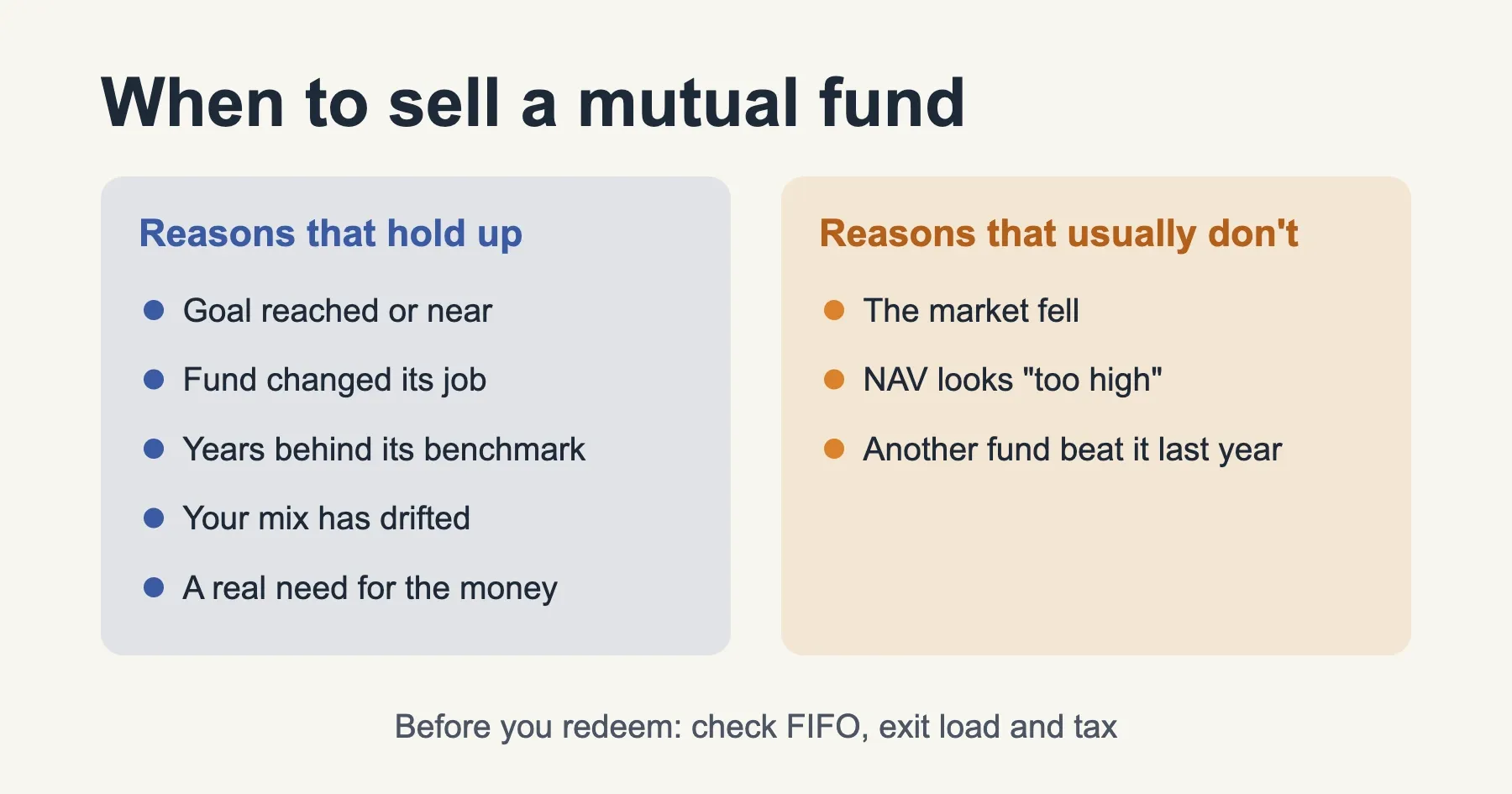
- Plan-based factors tend to hold up as reasons to sell: goal reached or near, the fund changed its job, sustained underperformance against its benchmark, a drifted mix, or a real need for the money.
- A market fall on its own usually isn't a reason to sell, unless the money is needed soon.
- Judge underperformance against the benchmark TRI over rolling 3- and 5-year periods and against same-category peers, not one year.
- Before redeeming, check which units go out first (FIFO), the exit load on recent units (capped at 3% of NAV under SEBI's 2026 Regulations) and the tax.
- For goal money, the time left before the date matters: in the hypothetical example a 20% late fall meant 40 instalments instead of 31 for the same ₹4,00,000.
As of 22 November 2026: the time to sell a mutual fund is usually set by your plan or the fund's job, not the market's mood. Five reasons tend to hold up: your goal is reached or close, the fund changed what it does, it has trailed its own benchmark for years, your asset mix has drifted, or you genuinely need the money. A market fall alone usually isn't one, and before you redeem, check which units go out first, the exit load on recent units and the tax.
Harsh, 33, a project engineer in Indore, has run a ₹10,000 monthly SIP in an equity fund for four years. His share of a home down payment, ₹4,00,000, is due next month. He has also seen headlines about a falling market and heard that a friend's fund "did better last year". Only the down payment is a plan-based factor.
When to sell a mutual fund: the decision table
| Reason | Usually | Question to ask |
|---|---|---|
| Goal reached or 1 to 3 years away | Holds up | Is this money needed on a fixed date? |
| Fund changed its job | Holds up | Does it still do what I bought it for? |
| Trailed its benchmark for years | Holds up | Is the gap sustained over rolling periods and against peers? |
| Asset mix drifted | Holds up (partial sale) | Is my equity share far above my plan? |
| Real need, no emergency fund | Holds up | Is there any other buffer? |
| The market fell | Usually doesn't | Do I need this money soon? |
| NAV looks "too high" | Usually doesn't | Am I confusing unit price with value? |
| Another fund beat it last year | Usually doesn't | One year, or a pattern? |
Five reasons that hold up
1. Your goal is reached or close
Money with a fixed date has little time to recover from a fall. In the worked example below, a 20% fall just before the deadline forces Harsh to sell far more units. That is the case for moving goal money gradually into lower-volatility options over the last one to three years, for example through a systematic transfer plan (STP), which moves a set amount between schemes on a schedule, not for selling in a panic.
2. The fund changed its job
A scheme can change its fundamental attributes, such as its type or objective; SEBI's categorisation circular of 26 February 2026 sets the category rules. Under Regulation 22(9)(c) of the SEBI (Mutual Funds) Regulations, 2026, such a change cannot be made unless each unitholder is told in writing and given an option to exit at the prevailing NAV without any exit load. If you get such a notice, ask whether the scheme still fits; the exit window is an option, not an instruction.
3. Sustained underperformance against its own benchmark
One bad year is not enough; see the test below.
4. Your mix has drifted
Say you planned 60% equity and 40% debt, and after a strong run equity is 70%. Rebalancing means selling part of what grew, or sending new money to what shrank: a partial sale, not a market view.
5. You genuinely need the money
A medical bill or job loss is what savings are for. Afterwards, build an emergency fund so the next need doesn't land on long-term money.
Three reasons that usually don't hold up
The market fell. Selling after a fall locks in the loss. Past falls in Indian equity markets have recovered at different speeds, some over several years, and there is no promise the next one will. The exception is money needed soon, which is reason 1. More in what happens to your SIP when the market falls.
The NAV looks "too high". NAV is the value of one unit, not a verdict on the fund. Two funds whose holdings gain 10% both gain 10%, whatever their NAV.
Another fund did better last year. Last year's leader often changes. A switch is a redemption plus a purchase, so the exit-load and tax checks below apply.
The underperformance test
- Right benchmark. Find it in the factsheet or scheme information document (SID), and compare with its total return index (TRI), which counts dividends as reinvested. See why TRI is the fair test.
- Rolling returns. A rolling 3-year return is measured from every starting month over a long stretch. Check how often, and by how much, the fund trailed; repeat with 5-year windows.
- Peers. Compare with funds in the same SEBI category.
- Cause. Look for a change of fund manager, strategy or category.
- Time. A gap over a quarter or one year is often noise. Trailing in most rolling 3-year windows over two to three years, with a weak 5-year record and a low peer rank, is a pattern.
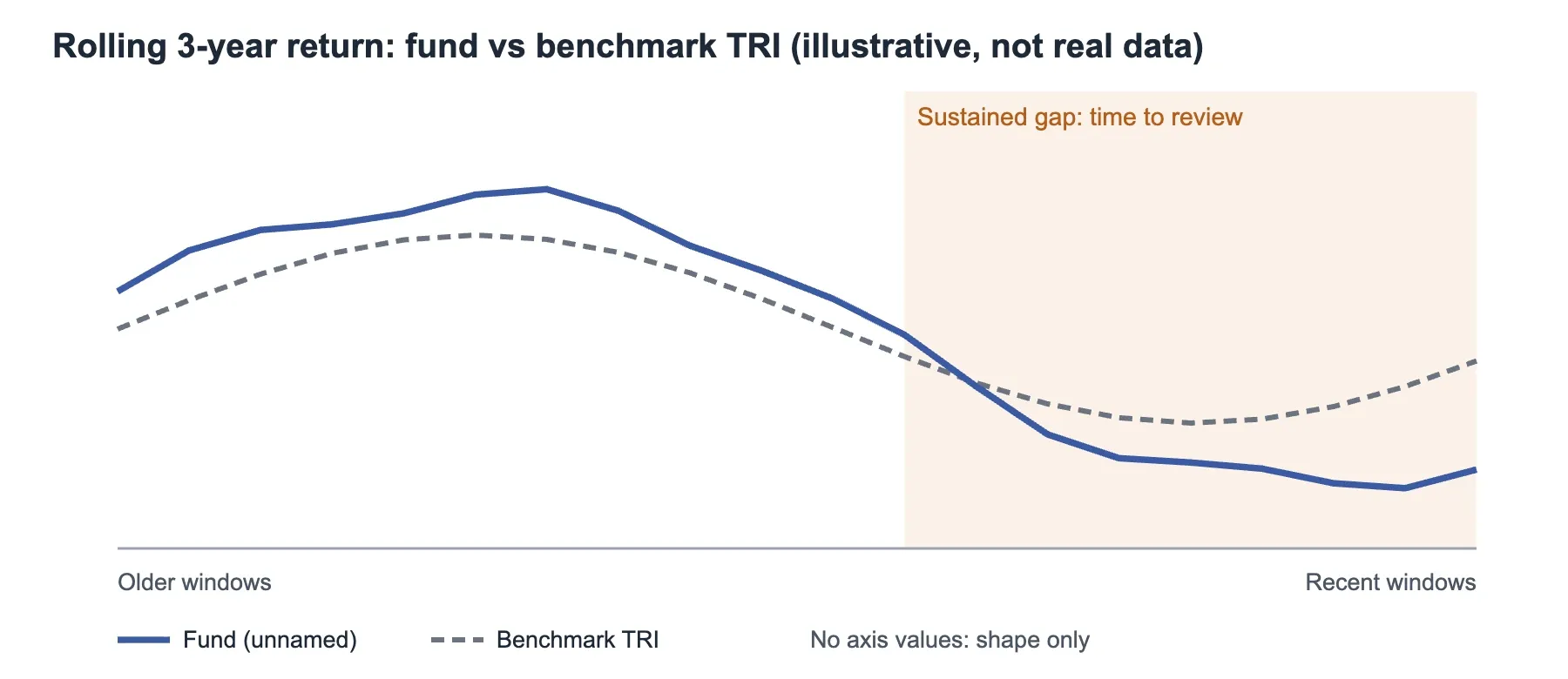
That is a review trigger, not a sell signal. For an index fund, check how closely it tracks its index.
Before you redeem: which units go out first, exit load and tax
Which units go out first. Redemptions are generally matched against your oldest units first: first in, first out (FIFO). The example below assumes this; your account statement lists each purchase date, and your registrar or SID can confirm the matching.
Exit load. AMFI gives the redemption price as applicable NAV × (1 − exit load), so a 1% load on a ₹10 NAV pays ₹9.90 a unit. It applies only to units still inside the load period in the SID or key information memorandum (KIM). Under Regulation 44(4) of the SEBI (Mutual Funds) Regulations, 2026, an open-ended scheme's exit load cannot exceed 3% of NAV, and Regulation 44(3) credits it to the scheme. Details in exit load and SEBI's 3% ceiling.
Tax on an equity-oriented fund. As of 22 November 2026, units held 12 months or less are short-term. Short-term gains are taxed at 20% under section 196 of the Income-tax Act, 2025, where securities transaction tax (STT) is charged on the redemption. Long-term gains above ₹1,25,000 in a year are taxed at 12.5% under section 198. Debt funds follow other rules.
Worked example: Harsh's goal, with and without a 20% fall
Hypothetical assumptions: ₹10,000 SIP at the start of each month for 48 months; NAV starts at ₹20 and grows at an assumed 10% a year (not a promised return); an assumed 1% exit load on units held 12 months or less (check your scheme's load); FIFO; gains after exit load; STT, surcharge and cess ignored.
Harsh invested ₹4,80,000 and holds 20,034.40 units, worth ₹5,86,647 at today's NAV of ₹29.28. The last 12 instalments are 12 months old or less.
| Scenario | Units sold | Exit load | Long-term gain | Short-term gain | Tax here | Left invested |
|---|---|---|---|---|---|---|
| A. ₹4,00,000 now | 13,660.27 (instalments 1 to 31) | ₹0 | ₹93,391 | None | ₹0 | ₹1,86,647 |
| B. Full exit now | 20,034.40 (all 48) | ₹1,264 | ₹1,00,242 | ₹5,141 | ₹1,028 | ₹0 |
| C. ₹4,00,000 after a 20% fall | 17,089.05 (instalments 1 to 40) | ₹321 | ₹8,194 | −₹5,102 (loss) | ₹0 | ₹68,997 |
In A, every unit sold (the 31st instalment only partly) is over 12 months old, so there is no exit load, and the ₹93,391 gain is within the ₹1,25,000 threshold if Harsh has no other equity gains this year. In B, selling everything pulls in the 12 recent instalments: ₹1,264 of exit load and ₹1,028 of tax (20% of ₹5,141).
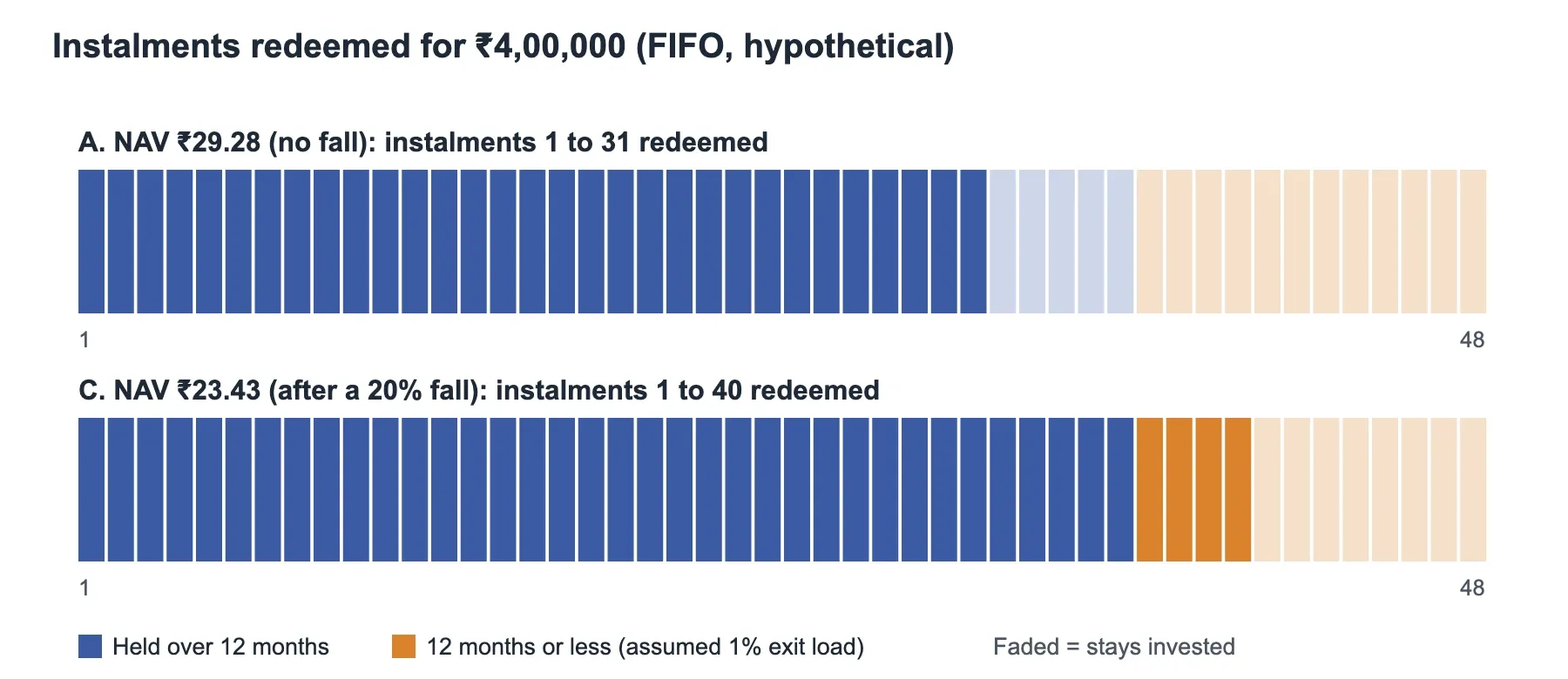
C is the warning. At NAV ₹23.43 his units are worth ₹4,69,318, so the same ₹4,00,000 needs 40 instalments instead of 31, pays exit load and leaves only ₹68,997 invested.
Sell all, sell part, or stop the SIP?
- Selling part may suit when a goal needs a set amount or your mix has drifted.
- Selling all may suit when the fund no longer fits your plan.
- Stopping or pausing the SIP stops new purchases only. Existing units stay invested and nothing is redeemed, so no exit load or tax arises. See pause or stop your SIP.
How to redeem
Per AMFI, requests received by 3:00 p.m. on a business day get that day's NAV. Payment is due within the period SEBI specifies, and Regulation 46(2) makes the asset management company liable for 15% a year interest on any delay. Redemption requests go through the fund house, its registrar, or the platform or distributor you invested through.
Frequently asked questions
When should I sell my mutual fund?
When your goal is near, the fund has changed its job, it has trailed its benchmark for years, your mix has drifted, or you genuinely need the money. A market fall alone usually isn't a reason.
Should I sell mutual funds when the market is down?
A fall alone usually isn't a reason: selling locks in a paper loss. In the hypothetical example, a 20% fall meant 40 instalments went for the same ₹4,00,000 instead of 31. If the money is needed soon, the deadline matters more.
How do I know if my mutual fund is underperforming?
Compare it with its benchmark TRI over rolling 3- and 5-year periods and with same-category peers. One bad year is not enough.
Which units are sold first when I redeem a mutual fund?
Generally first in, first out: the oldest units go first. In the example, ₹4,00,000 used instalments 1 to 31, all over 12 months old, so no exit load applied.
Mutual fund kab bechna chahiye?
Jab goal paas ho, fund ka kaam badal jaye, fund saalon se benchmark TRI se peeche ho, ya paise ki sach mein zaroorat ho. Sirf market girna aksar sahi wajah nahi. Bechne se pehle exit load aur tax dekhein.
Save this checklist
Save the decision table and five-step test for your next redemption.



