Pause or stop your SIP? What each one does to your mandate, units and tax
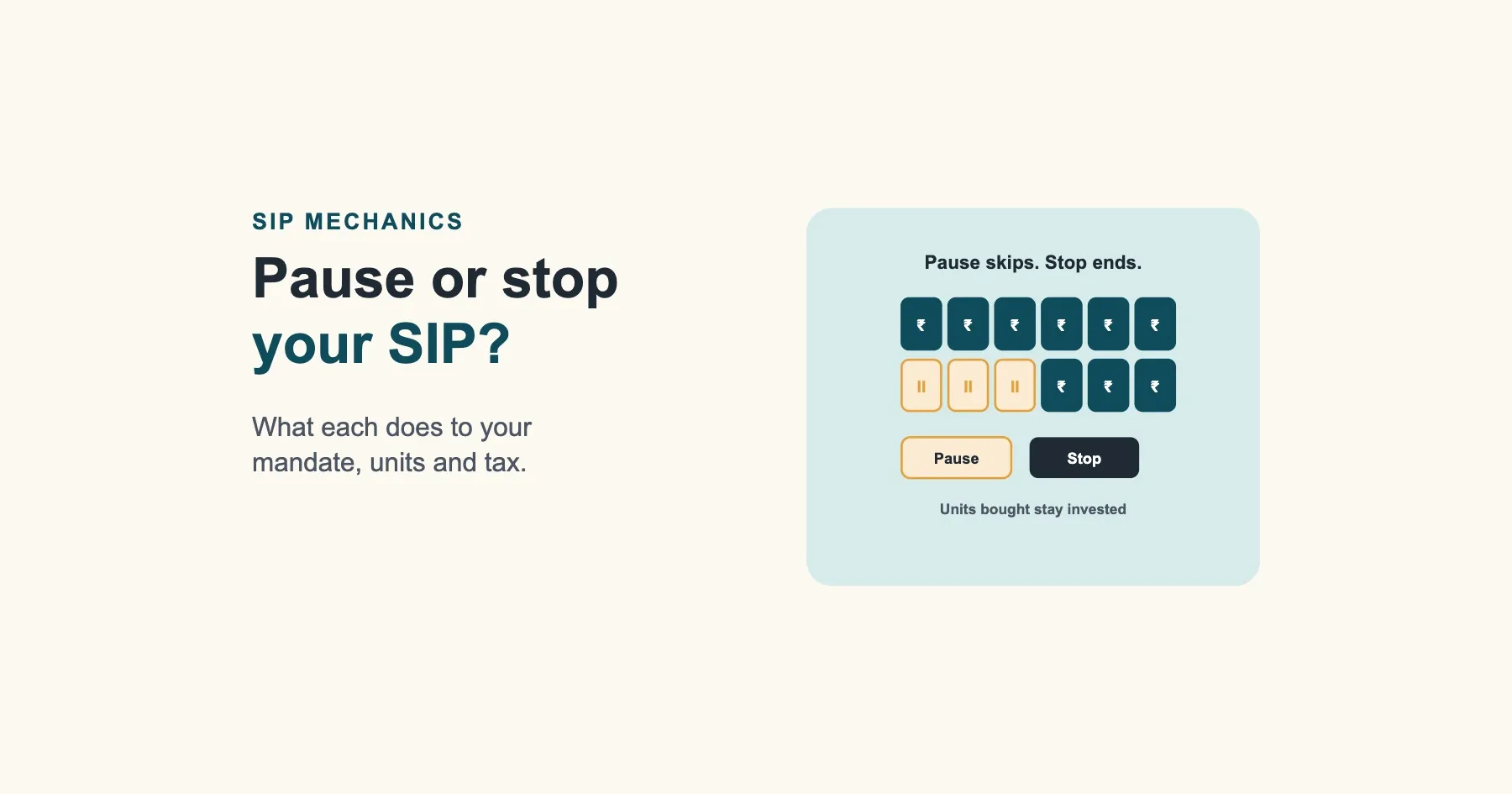
Pausing an SIP skips instalments, then resumes; stopping ends them. Units stay invested; exit load or tax applies only on redemption.
Summarize this article with AI





The short version
- Pausing skips future instalments; stopping ends them. Neither touches units you hold.
- Pause limits vary by fund house: forms we read allowed 3 months, or 1 to 6 instalments, twice per SIP.
- A paused SIP restarts by itself; a stopped SIP needs a new registration.
- Exit load and tax arise only when you redeem.
- A pause is not a missed debit.
Pausing an SIP skips your next few instalments for a set period, and the SIP then resumes. Stopping (cancelling) an SIP ends future instalments. Either way, units you already hold stay invested and keep moving with the NAV. Pausing or stopping does not by itself trigger exit load or tax; those apply only when you redeem units.
Mutual fund investments are subject to market risks, read all scheme related documents carefully.
Say Neha, 27, has run a ₹2,800 monthly SIP for 18 months. With a family wedding coming, she wants to free some cash for a few months. Pause, stop and sell are three different instructions, each with a different effect on her mandate, units and tax. Here is how to pause an SIP and how pause vs stop works, as mechanics only. Whether to keep investing through a market fall is a separate decision, covered in what happens to your SIP when the market falls.
What is the difference between pausing an SIP and stopping (cancelling) it?
An SIP has two parts: the SIP registration with the fund house (scheme, amount, date, frequency) and the bank mandate (a NACH or e-mandate, run on NPCI's systems) that lets the fund house's registrar (RTA) collect each instalment.
- Pause: the fund house skips a fixed number of upcoming instalments; the registration stays alive and debits restart after.
- Stop (cancel, or cessation): the fund house ends the registration. To invest again, you start a new SIP.
- Redeem: you sell units you hold. It is a separate transaction, and pausing or stopping redeems nothing.
Pausing changes future instalments, not what you already own.
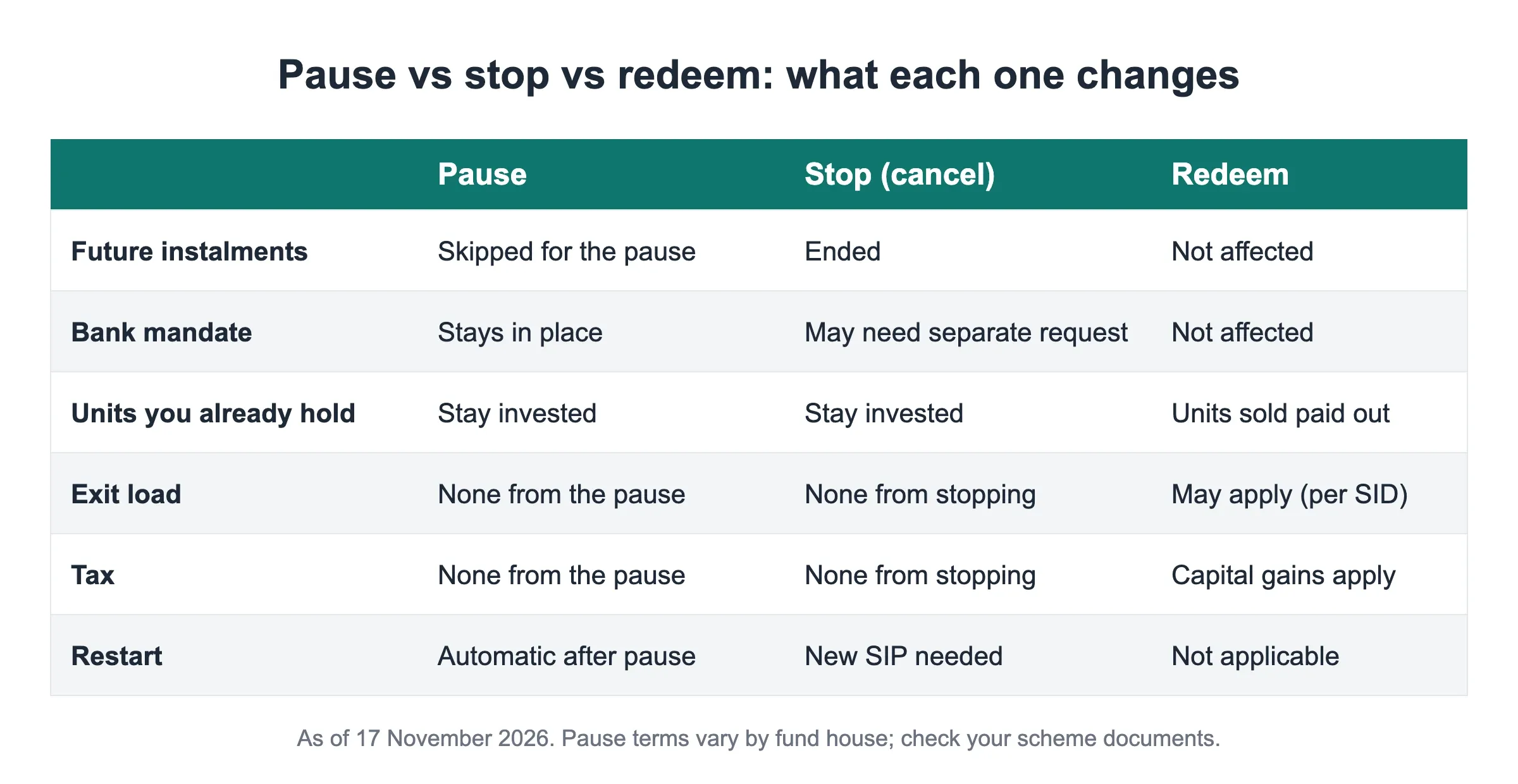
| Pause | Stop (cancel) | Redeem | |
|---|---|---|---|
| Future instalments | Skipped for the pause period | Ended | Not affected unless you also stop the SIP |
| Bank mandate | Stays in place | May need a separate request (see below) | Not affected |
| Units you already hold | Stay invested | Stay invested | Units sold are paid out |
| Exit load | None from the pause | None from stopping | May apply, per the scheme's SID |
| Tax | None from the pause | None from stopping | Capital gains rules apply to units sold |
| Restart | Automatic after the pause | New SIP needed | Not applicable |
As of 17 November 2026; pause terms vary by fund house.
For how many months can I pause my SIP, and can I pause more than once?
There is no single industry-wide limit; each fund house sets its own. Two fund-house pause forms we read on 17 November 2026 show the range:
- One allows up to 3 consecutive months; the other a minimum of 1 and a maximum of 6 instalments.
- Both allow a pause only twice in the life of an SIP, and need the request at least 10 days before the next SIP date.
- Both offer pause only on monthly SIPs of ₹1,000 or more, after about six instalments have been paid.
- Both exclude bank standing-instruction SIPs and some routes, such as exchange or MF Utility.
One form adds that a registered pause cannot be withdrawn and that the SIP's end date is not extended. These are examples, not rules; check your own scheme.
If I pause or stop my SIP, what happens to the units I already hold?
Nothing changes for them. Each instalment already bought units at its date's NAV. Those units stay in your folio whether the SIP is active, paused or cancelled, moving with the NAV until you redeem them.
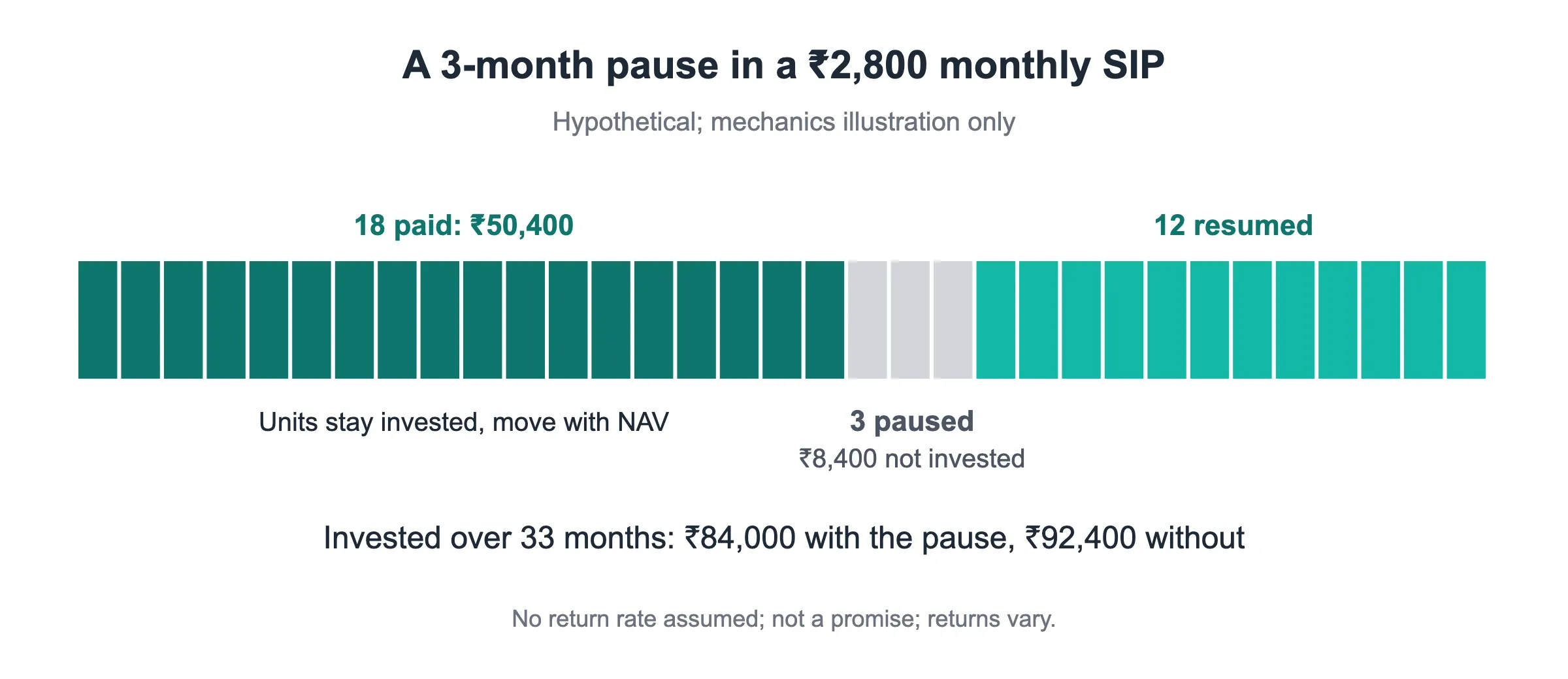
A worked example in ₹ (hypothetical)
Mechanics illustration only. No return rate is assumed; not a promise; returns vary.
- ₹2,800 a month, 18 instalments paid: ₹50,400 invested.
- A 3-month pause skips 3 × ₹2,800 = ₹8,400 of new investment.
- The ₹50,400 of units stay invested, moving with the NAV; the pause itself triggers no exit load or tax.
- If the SIP then runs 12 more months, she will have invested ₹84,000 over 33 months, against ₹92,400 without the pause. The gap is the ₹8,400 never invested.
Will my SIP restart on its own after the pause, or do I need to set it up again?
After a pause, the SIP restarts by itself; one form says it "would restart upon completion of the period specified by Investor." The next debit uses the same mandate, date and amount. After a stop, nothing restarts; you register a fresh SIP when ready.
Does stopping an SIP also cancel the bank mandate?
Not necessarily. One mandate can support several SIPs, so cancelling an SIP and cancelling a mandate can be separate requests; practice varies. If you want no further debits, confirm the mandate's status where you registered it and with your bank (as of 17 November 2026).
Is there any penalty, exit load or tax if I stop my SIP midway?
No penalty, exit load or tax comes from the pause or stop itself. They come from redeeming units:
- Exit load: a fee some schemes charge on units redeemed within a set period of purchase; each instalment's units have their own clock. The SID and KIM state the terms.
- Tax: capital gains tax applies when you redeem at a gain, at rates that depend on the fund type and how long each lot was held. Tax rules change; consult a tax professional for your situation.
ELSS units carry a three-year lock-in per instalment, and stopping an ELSS SIP does not release them early.
How to pause an SIP
Find where the SIP is registered (fund house or its RTA, a platform, or an exchange), check its pause terms, and submit the request online or on the pause form before the notice deadline. Keep the confirmation showing the pause months, and fund the account for the first debit after it.
Frequently asked questions
Does a pause cancel my mandate?
No. A pause only skips the selected instalments; the registration and mandate stay, and debits resume after the pause.
Can I lower the amount instead of pausing?
It depends on the fund house. Some offer an SIP modification form; otherwise you cancel the SIP and start a new one at the lower amount. Your existing units stay invested either way.
Is a missed debit the same as a pause?
No. A pause is requested in advance; a missed debit is a failed collection, and repeated failures can cancel the SIP.
Must I cancel the bank mandate separately?
It depends on the fund house or platform. If you want no further debits, confirm the mandate's status where you registered it and with your bank.
Read next
Check the notice period in your scheme documents. For the bigger question of how long to keep going, read how long should you continue your SIP. To understand which NAV each instalment gets, see NAV cut-off time for an SIP.
— Laabh



