Arbitrage Fund Meaning: How It Earns From Price Gaps, What Can Go Wrong, and How It's Taxed in 2026
Arbitrage fund meaning: it earns the gap between a share's cash and futures price. One trade in ₹, the risks, and 2026 tax.
Summarize this article with AI





The short version
- An arbitrage fund buys a share in the cash market, sells its future, and keeps the gap when prices converge at expiry.
- Returns depend on the size of that gap, not on the market rising.
- SEBI requires at least 65% in equity and equity-related instruments.
- It is generally taxed as equity-oriented: 20% short term, 12.5% long term above ₹1,25,000 (Income-tax Act, 2025).
- It can dip over short periods and often has an early exit load; a liquid fund does a different job.
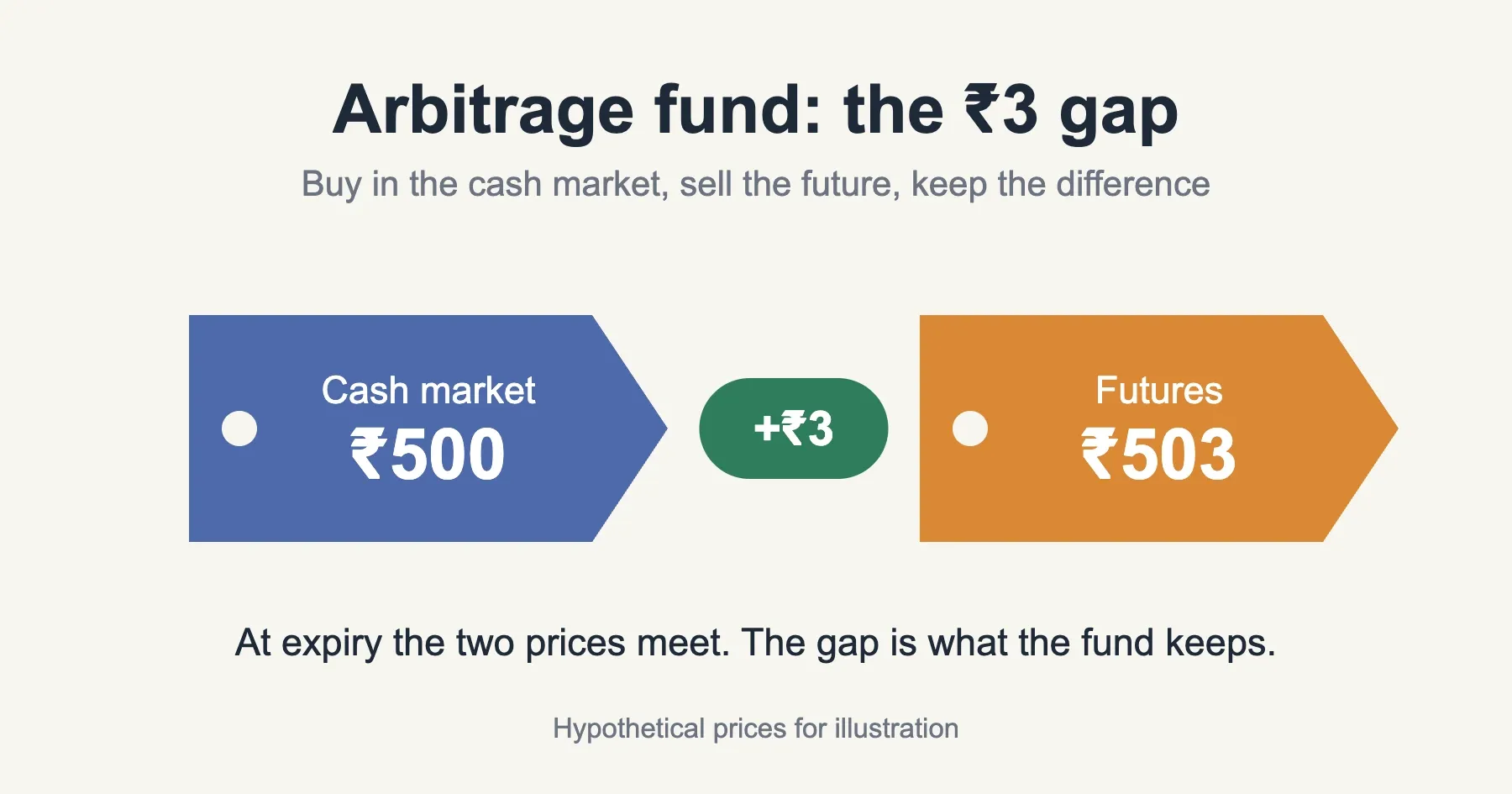
As of 22 November 2026: an arbitrage fund is a hybrid mutual fund that buys a share in the cash market and, at the same moment, sells that share's futures contract at a slightly higher price. When the contract expires the two prices meet, and the fund keeps the gap. Its return depends on the size of that gap, not on the market going up, and under current law it is usually taxed as an equity-oriented fund.
Sana, 27, in Hyderabad, has ₹2,20,000 she will need in about six months. A colleague said, "park it in an arbitrage fund, it's like a liquid fund with lower tax." This page explains the mechanics, risks and tax so she can judge that for herself.
Arbitrage fund meaning in one line
An arbitrage fund earns the gap (the basis or spread) between a share's cash market price and its futures price, holding both sides so that a rise or fall in the share largely cancels out.
That makes it hedged equity: the fund owns real shares, each paired with a short futures position on the same share. The futures leg exists only as the hedge.
One trade, step by step (hypothetical numbers)
Assume, purely for illustration, that a share trades at ₹500 in the cash market, and its near-month futures contract on the NSE F&O segment trades at ₹503. The ₹3 gap is the spread.
- Day 1. The fund buys the share at ₹500 and sells its future at ₹503.
- Until expiry. Whatever the cash leg gains or loses, the futures leg roughly offsets.
- Expiry. The futures price converges to the cash price, so both legs settle at the same price. The fund closes both and keeps ₹3.
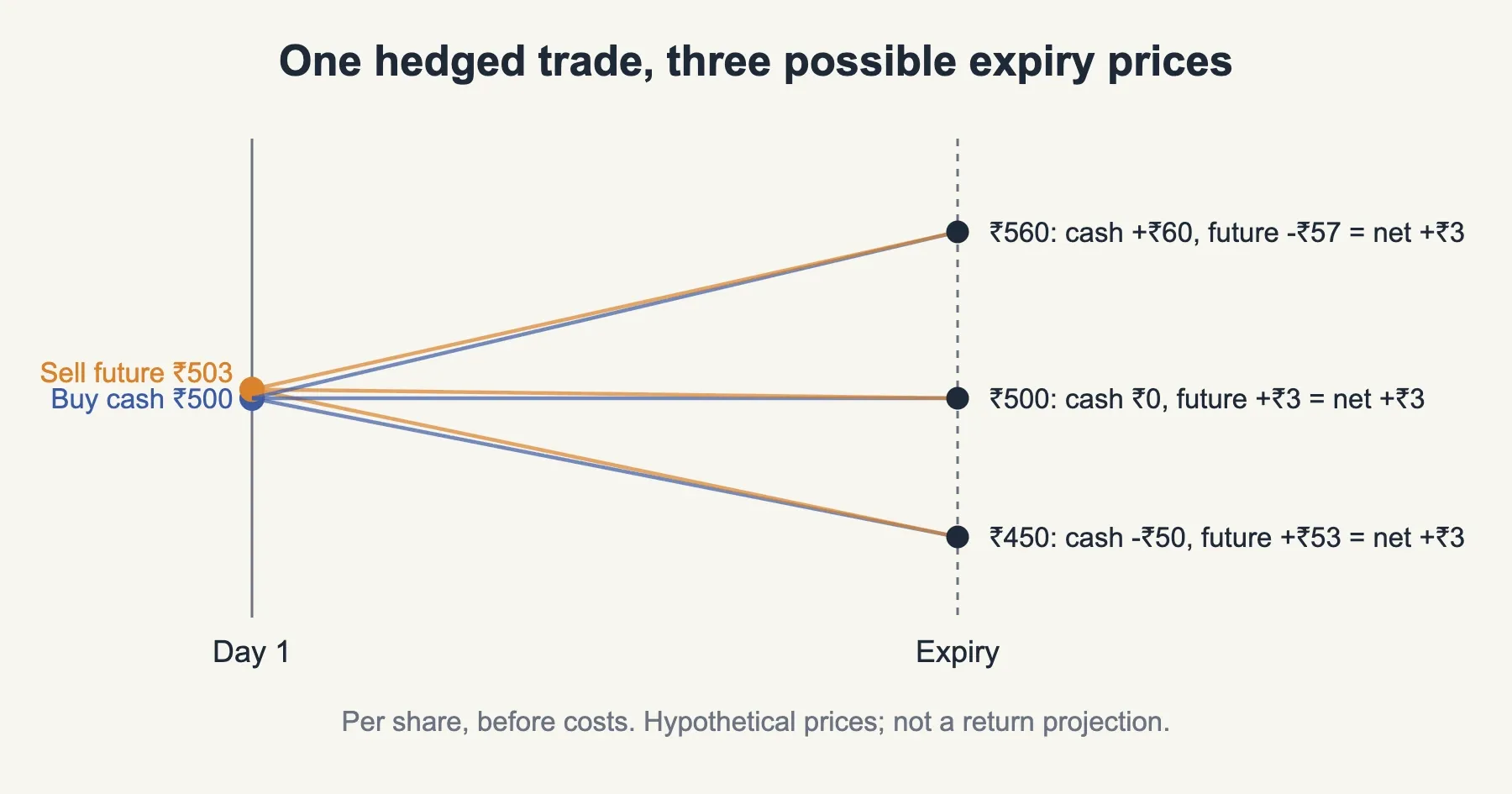
One share at three possible expiry prices:
| Price at expiry | Cash leg (bought at ₹500) | Futures leg (sold at ₹503) | Net per share |
|---|---|---|---|
| ₹450 | -₹50 | +₹53 | +₹3 |
| ₹500 | ₹0 | +₹3 | +₹3 |
| ₹560 | +₹60 | -₹57 | +₹3 |
Fall, flat or rise, the net is ₹3, or 0.6% of ₹500.
Scaling it to Sana's amount. If ₹2,20,000 went into this one trade, it would buy 440 shares, capturing 440 × ₹3 = ₹1,320, before costs and fund expenses. This is a scale illustration, not a return projection: a real fund runs many pairs, holds some money in other permitted instruments, and next month's spread can be larger, smaller or near zero. Hypothetical figures; no return rate assumed.
What SEBI's category rule requires (as of 22 November 2026)
SEBI places arbitrage funds among hybrid schemes. Its circular "Categorization and rationalization of mutual fund schemes" (26 February 2026) revised the framework, which SEBI first set out in its circular of 6 October 2017. Under it:
- An arbitrage fund is an open-ended scheme investing in arbitrage opportunities, with at least 65% in equity and equity-related instruments.
- What else it may hold, and in what limits, is set out in each scheme's SID.
The SEBI (Mutual Funds) Regulations, 2026, in force from 1 April 2026, cap the exit load of any open-ended scheme at 3% of NAV (Regulation 44(4)).
What drives returns, and what can go wrong
What drives returns. The cash-futures spread tends to move with short-term interest rates and demand for futures positions. In busy, volatile markets spreads can widen; in calm markets they can shrink. So returns depend on market activity, not direction. This describes the mechanism; it is not a forecast.
What can go wrong:
- Spread compression. When many funds chase the same gaps, or markets go quiet, spreads thin out and costs take a bigger bite.
- Short-period negative returns. Before expiry, both legs are valued daily. If the spread widens after the fund locks in a trade, it shows a temporary paper loss, which normally reverses by expiry if the trade is held. Expenses also reduce NAV. We quote no figures because they vary by scheme and period.
- Exit load. Many schemes charge one if you redeem within a short window; the rate and window are in the SID and KIM. SEBI's ceiling is 3% of NAV.
- Short holding. Returns build as trades reach expiry, so a few days or weeks can capture little spread and still pay an exit load.
How an arbitrage fund is taxed now (as of 22 November 2026)
The Income Tax Department's published text of the Income-tax Act, 2025 defines an "equity oriented fund" as one investing at least 65% of its total proceeds in equity shares of domestic companies, measured as an annual average of monthly averages (section 198(8)). Arbitrage funds stay above that line because their cash-market holdings are equity shares, so they are generally taxed as equity-oriented. Check the scheme's documents.
For equity-oriented fund units, with securities transaction tax (STT) paid on transfer:
| Holding period | Type | Rate (as of 22 November 2026) | Where |
|---|---|---|---|
| Up to 12 months | Short-term capital gain | 20% | Section 196, Income-tax Act, 2025 |
| More than 12 months | Long-term capital gain | 12.5% on gains above ₹1,25,000 in a year | Section 198, Income-tax Act, 2025 |
Surcharge and cess apply on top. Sana's six-month holding falls in the short-term row. For other fund types, see how mutual funds are taxed in India.
Arbitrage fund vs liquid fund: what each is for
Both are often mentioned for parking money. They do different jobs; neither is "better" in general.
| What you compare | Arbitrage fund | Liquid fund |
|---|---|---|
| What it holds | Hedged equity, plus some short-term debt (see SID) | Short-maturity money market and debt instruments |
| Where returns come from | Cash-futures spread | Interest on short-term debt |
| Main risks | Spread compression, short dips, exit load | Interest-rate and credit risk |
| Tax | Usually equity-oriented: 20% short term, 12.5% long term above ₹1,25,000 | Treated as a debt fund; see our liquid fund guide |
| Exit load | Often within a short window; check SID | Usually small, first few days only; check SID |
| Horizon often used for | A few months or more | Days to weeks |
| Redemption timing | As stated in the SID | As stated in the SID |
Our guide on what a liquid fund is covers liquid fund payouts and tax. For another hybrid category, see balanced advantage fund meaning.
Is an arbitrage fund suitable for an emergency fund?
An emergency fund's job is to be there quickly, at close to full value. An arbitrage fund may charge an exit load early on, can dip over short periods, and pays out on its stated timeline. Check those before using it for money you might need tomorrow. Size the fund first with how much emergency fund you need.
Frequently asked questions
What is an arbitrage fund in simple words?
A mutual fund that buys a share and sells its futures contract at a slightly higher price at the same time. At expiry the prices meet, and the fund keeps the difference.
Can arbitrage funds give negative returns?
Yes, over short periods. Before expiry the spread can widen, showing a temporary paper loss, and expenses reduce NAV. Over a full expiry cycle the locked-in spread usually comes through, but no positive return is promised.
How are arbitrage funds taxed?
As of 22 November 2026, they are generally taxed as equity-oriented funds under the Income-tax Act, 2025: 20% on short-term gains (section 196) and 12.5% on long-term gains above ₹1,25,000 a year (section 198). Tax rules change; consult a tax professional for your situation.
Arbitrage fund vs liquid fund: which is for what?
A liquid fund holds short-term debt and is commonly used for days to weeks. An arbitrage fund earns a cash-futures spread, is taxed as equity-oriented and often has an early exit load, so it is usually considered for a few months or more. Compare each scheme's documents.
Is an arbitrage fund safe for an emergency fund?
It carries little market-direction risk, but not no risk: it can dip briefly, may charge an early exit load, and pays out on the scheme's stated timeline. Check all three against how fast you might need the money.
Learn more
Save this checklist for the next time someone says "just park it in an arbitrage fund": spread, exit load, holding period, tax.



