Balanced advantage fund meaning: how it shifts between equity and debt, and what it can't protect you from
A balanced advantage fund shifts between equity and debt using its own model. See how net equity, tax and falls work, and what it can't do.
Summarize this article with AI





The short version
- A balanced advantage fund is SEBI's dynamic asset allocation category: equity and debt managed dynamically, with no fixed equity band.
- Each fund house runs its own allocation model, described in the scheme's SID; two funds in the same category can hold very different equity levels.
- Watch net equity (the unhedged part), not gross equity. Net equity drives how much the fund moves with the market.
- Tax treatment depends on whether the scheme meets the equity-oriented test, which looks at gross equity including hedged shares. Check each scheme's tax disclosure.
- It may soften a fall; it can't stop it. Losses still happen, and the model can be at high equity when a fall arrives.
A balanced advantage fund is a hybrid mutual fund that changes how much it holds in equity and debt using its own rules, such as market valuations. SEBI's category lets this mix be managed dynamically. It may reduce the size of a fall but cannot prevent one, and its tax treatment depends on its equity exposure.
Mutual fund investments are subject to market risks, read all scheme related documents carefully.
Divya, 29, from Bhilai, has ₹1,20,000 she wants to invest, and the sharp market falls she has read about make her nervous. A friend says a balanced advantage fund "handles the ups and downs for you". Here is what the category is, how its equity level is set, how it is taxed and what it cannot do. No schemes are named.
What is a balanced advantage fund in plain language?
It is a hybrid fund with no fixed split between shares and bonds. When SEBI first categorised mutual fund schemes in October 2017, it named this category "Dynamic Asset Allocation or Balanced Advantage Fund", with investment in equity and debt "managed dynamically (0% to 100% in equity & equity related instruments; and 0% to 100% in Debt instruments)", as AMFI's categorisation page records.
SEBI revised the categories in a circular dated 26 February 2026. The category is now called Dynamic Asset Allocation Fund: "Investment in equity/ debt that is managed dynamically", described as "an open ended dynamic asset allocation fund investing in debt and equity instruments only". Existing schemes had six months to align. "Balanced advantage" remains the everyday name. In short: a stated model decides how much equity the fund holds.
How does a balanced advantage fund decide how much to keep in equity?
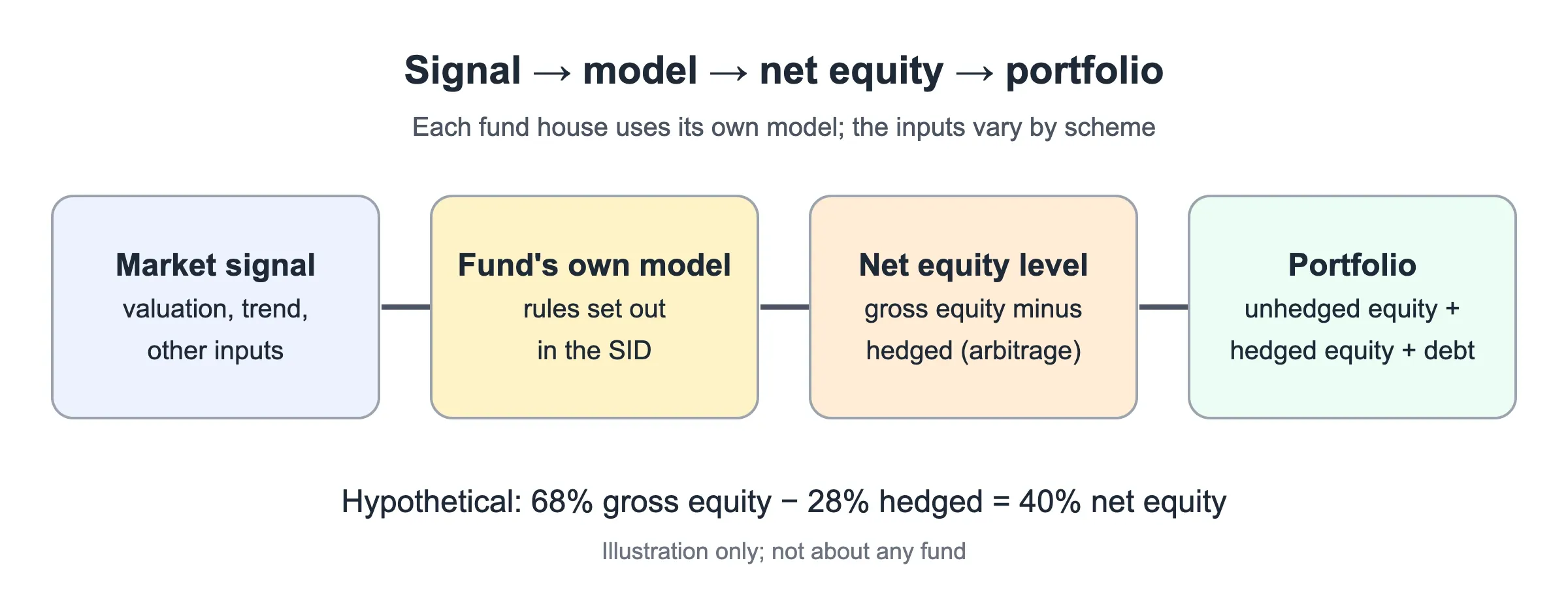
Each fund house uses its own model, described in the scheme's SID. Common inputs are valuation measures (such as an index's price-to-earnings ratio) and market trend. The usual logic: less equity when markets look expensive, more when they look cheap.
Gross equity vs net equity
Many of these funds cut market exposure without selling shares: they hold shares and sell matching futures, an arbitrage position whose price moves largely cancel out.
- Gross equity: all the shares the fund holds.
- Net equity: gross equity minus the hedged part. This is what moves with the market.
A hypothetical split: 68% gross equity, 28% hedged through arbitrage, so 40% net equity. Factsheets usually show both; compare net equity.
What happens to ₹1,20,000 if equity markets fall 20%?
A simple illustration (hypothetical; simplified; not about any fund; not a promise or a prediction; returns vary). It looks only at the equity part and ignores any movement in debt or arbitrage returns.
| Equity exposure | Fall on equity part | Hypothetical value after the fall |
|---|---|---|
| Pure equity fund (100%) | ₹24,000 | ₹96,000 |
| Balanced advantage at 70% net equity | ₹16,800 | ₹1,03,200 |
| Balanced advantage at 40% net equity | ₹9,600 | ₹1,10,400 |
For example, ₹1,20,000 × 70% × 20% = ₹16,800. But the model, not you, picks the level, and it may be at high equity when the fall comes. In a rising market, lower net equity usually means a smaller gain.
Is a balanced advantage fund taxed like an equity fund or a debt fund?
It depends on the scheme. As of FY 2026-27, under the Income-tax Act, 2025, a fund is treated as equity-oriented when more than 65% of its money is invested in equity shares of listed domestic companies, measured on an average basis over the year. Hedged arbitrage positions are still shares the fund owns, so a scheme with 40% net equity can still meet the test if its gross equity stays above the threshold.
For units of equity-oriented funds, the Income Tax Department states that a holding of more than 12 months is long-term, and long-term gains above ₹1,25,000 a year are taxed at 12.5% (as of FY 2026-27, under the Income-tax Act, 2025). Other cases are covered in how mutual funds are taxed in India. Check each scheme's own tax disclosure. Tax rules change; consult a tax professional for your situation.
What should someone worried about market falls know before considering it?
- Falls still happen. Equity falls with the market; debt can lose value when rates rise or a borrower defaults.
- You hand over the timing. The model, set out in the SID, decides the equity level.
- Net equity moves over time. Read the latest factsheet.
- The riskometer still applies. Each scheme has a riskometer level that can change; see what the riskometer levels mean.
- Your time horizon matters more than the label. For money needed soon, see our debt fund explainer what a debt mutual fund is.
Also read what happens to an SIP when the market falls.
Balanced advantage vs aggressive hybrid fund: what is the actual difference?
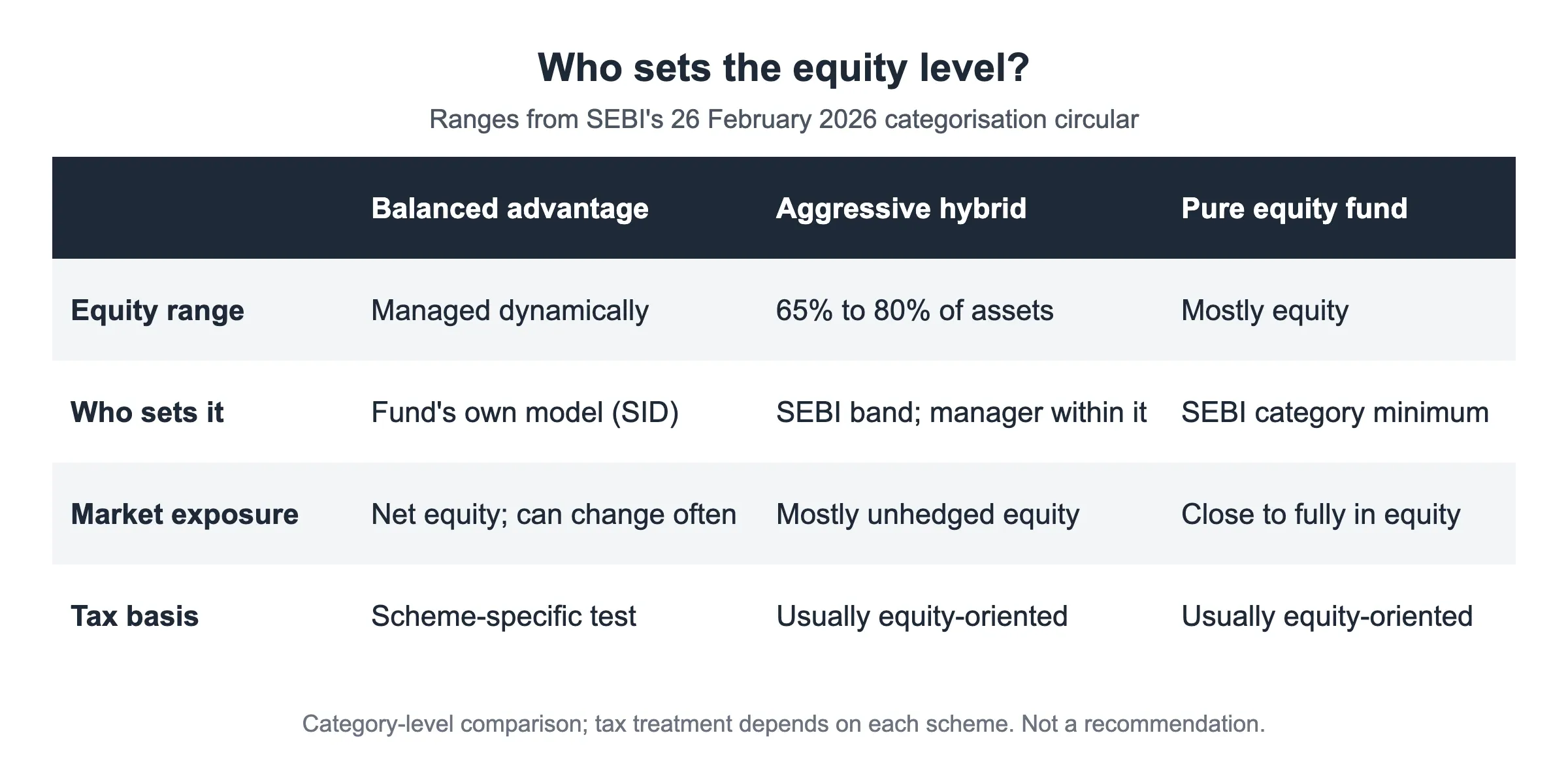
Who sets the range. SEBI fixes an aggressive hybrid fund's band at 65% to 80% equity and 20% to 35% debt. A dynamic asset allocation fund has no fixed band; its model moves it.
| Balanced advantage (dynamic asset allocation) | Aggressive hybrid | Pure equity fund | |
|---|---|---|---|
| Equity range | Managed dynamically; 0% to 100% under the 2017 framework | 65% to 80% of total assets | Mostly equity; minimum set by its SEBI category |
| Who sets it | The fund's own model, within the SID | SEBI's band; manager chooses within it | SEBI category; manager picks stocks |
| Market exposure | Net equity, can change often | Mostly unhedged equity, within the band | Close to fully in equity |
| Tax basis | Scheme-specific: equity-oriented only if the test is met | Usually aims to meet the equity-oriented test; check the scheme | Usually equity-oriented; check the scheme |
What a balanced advantage fund can't do
- It can't guarantee you won't lose money in a crash.
- It can't time the market perfectly; its model can be early, late or wrong.
- It can't make its debt portion free of interest-rate or credit risk.
- It can't keep the same equity level you saw when you invested.
Frequently asked questions
What is the difference between net equity and gross equity in a balanced advantage fund?
Gross equity is all the shares held; net equity is the unhedged part that moves with the market. Hypothetically, 68% gross minus 28% hedged is 40% net.
Why does a balanced advantage fund hold arbitrage positions?
It lowers market exposure without selling shares. Hedged shares still count as equity holdings, which can help a scheme meet the equity-oriented tax test; that is scheme-specific.
Where is a balanced advantage fund's allocation model disclosed?
The Scheme Information Document (SID) sets out the approach and ranges; the monthly factsheet shows where the fund stands, often including net equity.
Can a balanced advantage fund fall in a market crash?
Yes. Its equity portion falls with the market, and the model may be at high equity just before a fall. It may soften a fall; it can't stop it.
Is a balanced advantage fund the same as a multi asset allocation fund?
No. Under SEBI's February 2026 categorisation, a dynamic asset allocation fund invests in debt and equity instruments only. A multi asset allocation fund must invest in at least three asset classes with at least 10% in each.
Read next
Compare hybrid with other categories in which type of mutual fund a beginner should start with, or see life cycle funds explained.
— Laabh



