Best date for an SIP: why the days after your salary matter more than the date
No SIP date reliably gives better returns, past-data studies find. Pick one a few days after salary and bills so your SIP is less likely to bounce.
Summarize this article with AI





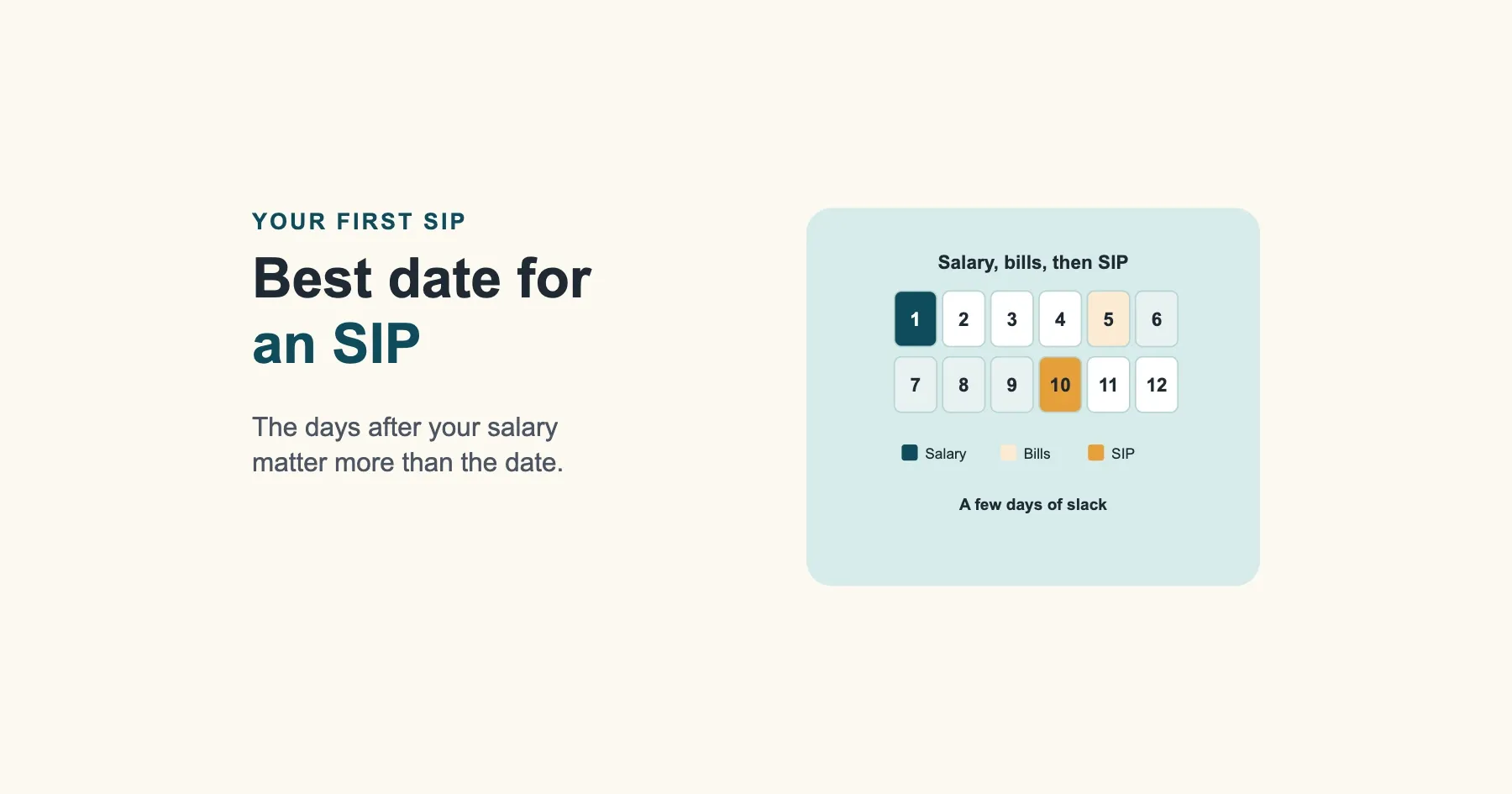
The short version
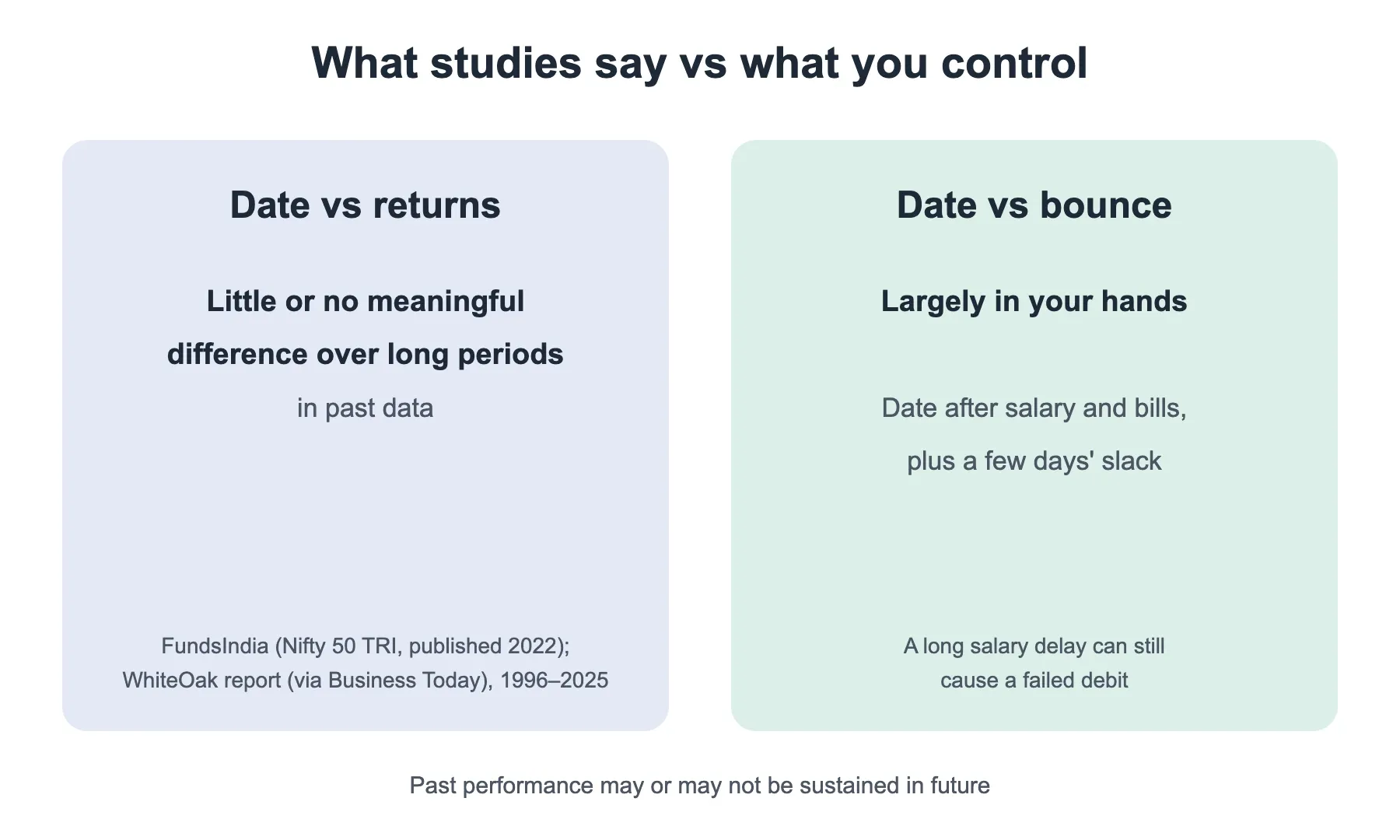
- Past-data studies (FundsIndia on the Nifty 50 TRI; a WhiteOak Capital report via Business Today) found little or no meaningful difference between SIP dates over long periods.
- No date can be relied on to improve future returns.
- The date that matters is one your cash flow can keep: after salary credit and fixed bills, with a few days' slack.
- Holiday handling and start timelines are set by the fund house; check your scheme's documents.
There is no SIP date that reliably gives better long-term returns. Studies of past SIP data that compare dates of the month, such as FundsIndia's on the Nifty 50 TRI and a WhiteOak Capital Mutual Fund report on index data from August 1996 to August 2025 (as reported by Business Today), found little or no meaningful difference over long periods. The practical "best" date is one a few days after your salary usually arrives, once your fixed bills have cleared, so the money is there when the instalment is due.
In other words: for returns, the date barely matters. For your bank balance, it matters a lot. What derails a first SIP is often more ordinary than the market: a debit that comes the day before the salary does, or the day after the rent goes out.
Does the SIP date change your returns?
Two widely read analyses looked at this question with past data.
- FundsIndia (published 20 October 2022). It modelled a ₹10,000 monthly SIP in the Nifty 50 TRI over the last 10, 15 and 20 years and compared dates of the month. Its conclusion: "Over long periods of time, your SIP date does not make much of a difference." It adds that "The returns are almost similar even if you had invested on the 2nd, 3rd, 4th, or 5th of the month!"
- WhiteOak Capital Mutual Fund's SIP Analysis Report, as reported by Business Today (17 September 2025). After "assessing index data from August 1996 to August 2025" across large-cap, mid-cap and small-cap indices, "the report finds no meaningful difference in average annualised returns for SIPs started on different dates", "provided the investment horizon is sufficiently long."
Both are secondary sources, not regulatory findings, and both look backwards: past performance may or may not be sustained in future. Neither claims to tell you which date will do better over your next ten years.
Why would the date matter so little? Here is our reading. Over a long SIP you make well over a hundred purchases. Moving each one from the 3rd to the 25th shifts it by a few weeks. Sometimes the market is higher on the later date and sometimes lower, and over many months those differences tend to even out. What moves your result far more is how long you stay invested and whether every instalment actually goes in.
That is also why a "magic date" is the wrong thing to search for. It turns a cash-flow decision into a market-timing one.
The real cost of a bad date: a failed instalment
If your account is short on the SIP date, the debit fails. That month's units aren't bought, so that month's money never starts working for you. Your bank may also charge you for the failed debit, as per its own schedule of charges. Repeated failures can lead the fund house to stop the SIP registration altogether. Unlike returns, this part is largely in your hands.
The detailed rules, including what AMFI's investor-education page says and how many failed attempts a fund house allows, are in our guide: missed an SIP instalment? What your bank and your fund house each do next.
Salary on the 1st? How to pick a date your salary can cover
Use your month, not the calendar's. Four steps:
- Note when your salary usually lands. Not the date on your offer letter, the date it has actually reached your account in recent months. If it sometimes slips to the 2nd or 3rd, use the latest of those.
- List your fixed outflows and their dates. Rent, EMI, credit-card due date, school fees, insurance premiums, any other auto-debits.
- Pick an SIP date after both. A few days after the last large fixed outflow gives the money time to settle and shows you what is really left.
- Leave slack. Allow a few days for a late salary credit, a weekend or a bank holiday.
Worked example: a ₹6,500 monthly SIP
Illustration only; no return rate is assumed.
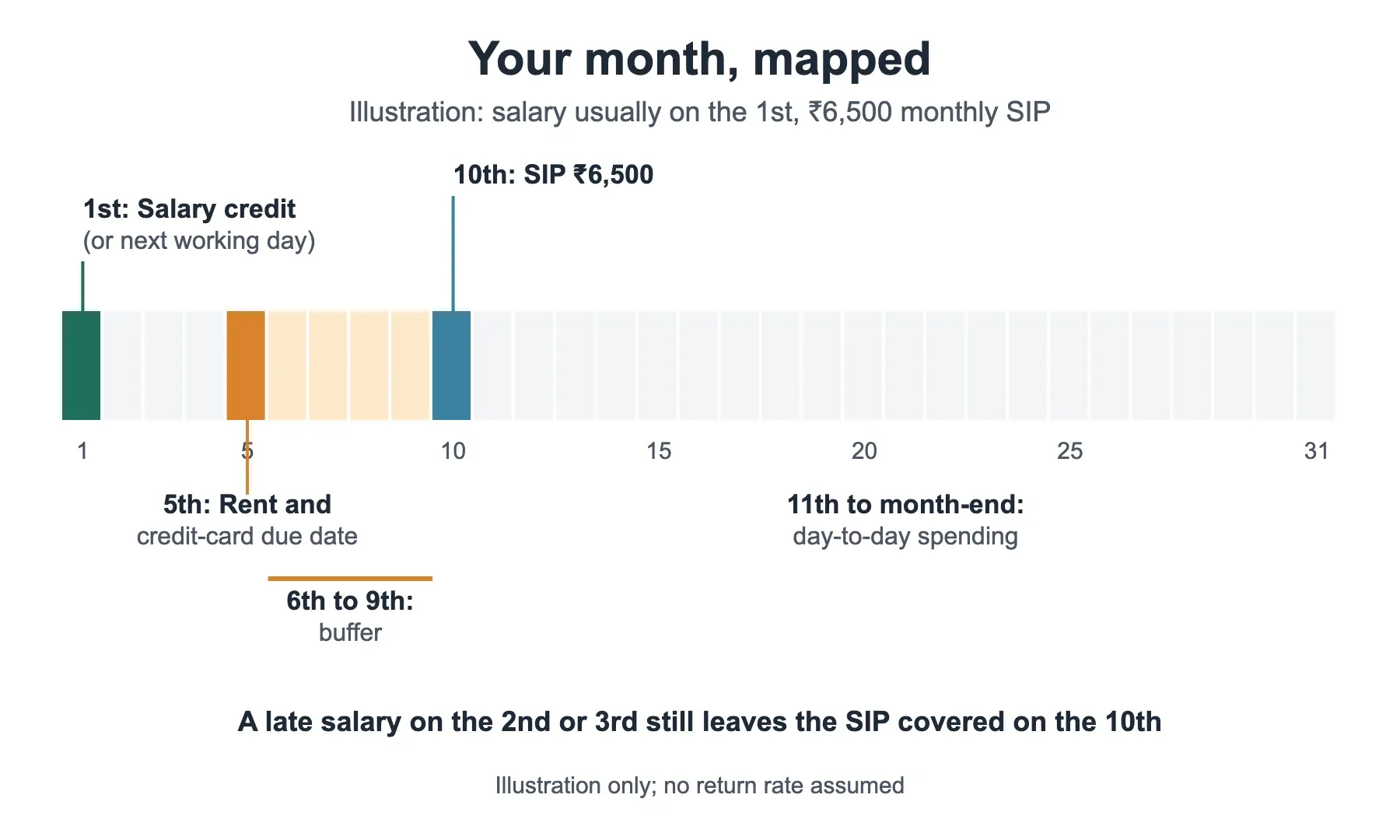
Suppose your salary is usually credited on the 1st. Rent and your credit-card bill go out on the 5th. You want to invest ₹6,500 a month.
| Day | What happens |
|---|---|
| 1st (usual) | Salary credit; sometimes the next working day if the 1st is a holiday or weekend |
| 5th | Rent and credit-card due date |
| 6th to 9th | Buffer: room for a late salary or a holiday |
| 10th | SIP instalment of ₹6,500 |
| 11th to month-end | Day-to-day spending |
Choosing the 10th means that even if the salary arrives on the 3rd, the rent and card bill have gone out and ₹6,500 is still there on the 10th. Choosing the 2nd would leave no room at all.
When salary is late or the 1st is a holiday
Even a well-chosen date can fail if your salary is delayed. That is the honest limit of any date. If your employer's credit date moves around, pick an SIP date with more slack, not less.
You may have seen the suggestion to set the SIP on salary day itself. WhiteOak's report, as quoted by Business Today, says "the best SIP date is when the investor usually gets their salary credited to their bank account". It's a sound "pay yourself first" idea. Our view, which is about cash flow rather than returns, is to give a first SIP a few days' cushion so a one-day delay doesn't turn into a failed debit. Both approaches are reasonable; which suits you depends on how reliably your salary arrives.
Keep a small buffer in the debit account
Leaving a little extra in the account the SIP is debited from absorbs a late salary or an unexpected bill. That buffer is separate from your emergency fund; see how much emergency fund should you have?
Right after salary day or at month-end?
There is no return difference to claim here. The trade-offs are about habit and cash flow.
| Right after salary (2nd to 4th) | Mid-month (8th to 12th) | Month-end (25th to 28th) | |
|---|---|---|---|
| Bounce risk if salary is late | Higher | Lower | Lowest from late salary; higher if month-end spending drains the account |
| Habit / "pay yourself first" | Strong | Good | Weaker |
| Risk of spending the money first | Low | Medium | Higher |
Editorial judgement, not data.
For many salaried first-time investors, a mid-month date after fixed bills balances these. If your bills fall later in the month, shift the SIP accordingly.
Should you split one SIP across two dates?
It can suit you if your money arrives on two dates, for example a salary on the 1st and freelance income around the 15th. Each SIP can then sit after the income that funds it.
The cost is tracking: two debits to keep funded and two registrations to manage. Splitting is a cash-flow choice, not a way to improve returns.
What if the SIP date falls on a holiday?
How a non-business day is handled is set by the fund house and the scheme's terms. As one example, a fund house's SIP application form (dated May 2025) states that if the SIP date "falls on non-business day, it will be triggered and processed on the next business day". The same form notes the debit may happen "after the specific SIP date due to local holidays or any other reason".
So a debit can arrive a day or two later than your chosen date. Check the SID (scheme information document) or SIP form of your own scheme, or ask the fund house.
Can you change your SIP date later?
Generally, yes, but the process varies. Depending on the fund house or platform, it may mean modifying the existing SIP, or cancelling it and registering a new one, sometimes with a new mandate. Check with your fund house or platform first, so you don't miss a month or pay twice.
New registrations also take time to start. The same form notes that SIP auto-debit "will start after mandate registration which takes 10 to 21 days depending on NACH modalities". Your fund house's timelines may differ, so allow for a gap before the first debit.
Your SIP date checklist
- Salary date written down, using its latest usual arrival.
- Fixed outflows listed with dates.
- SIP date set a few days after both.
- A small buffer left in the debit account.
- Holiday and start-date rules checked in your scheme's documents.
Remember the bigger lesson from the studies: the date matters less than staying invested, including when markets fall. Our guide on whether to stop your SIP when the market falls covers that.
Frequently asked questions
What is the best date of the month to start an SIP?
There is no date that reliably gives better returns. Choose a date a few days after your salary usually arrives and after your fixed bills, so the money is there when the instalment is due.
Does choosing the 1st, 10th or 28th change my SIP returns?
Studies of past data, including FundsIndia's on the Nifty 50 TRI and a WhiteOak Capital report covering August 1996 to August 2025 (as reported by Business Today), found little or no meaningful difference over long periods. Past performance may or may not be sustained in future.
I get my salary on the 1st. Which SIP date should I choose so the debit is less likely to fail?
Pick a date after your rent, EMI and card dues, with a few days' slack for a late credit or holiday. In the illustration above, with bills on the 5th, the 10th works. No date can protect against a long salary delay, so keep a small buffer.
Should I pick an SIP date right after salary day or at month-end?
Right after salary builds a "pay yourself first" habit but leaves little room if salary is late. Month-end gives more time but more chance the money is spent first. A date just after your fixed bills often balances the two.
Can I change my SIP date later?
Generally, yes. The process varies: some fund houses or platforms let you modify the SIP, while others need you to cancel and register again. Check with yours first so you don't miss or double an instalment.
What happens if my SIP date falls on a holiday?
The fund house's terms decide. One fund house's SIP form, for example, says the SIP is processed on the next business day. Check your scheme's SID or SIP form, or ask the fund house.
Your next step
Before you set up an SIP, write down the date your salary usually arrives and your fixed bills. Pick a date after both.
Linking a first SIP to your salary is a good habit; see how much SIP to start with your first salary.
— Laabh



