How to Build a Credit Score From Scratch With Your First Salary (Without Borrowing More Than You Need)
No credit history (NH/-1)? Start with one small reported credit line paid in full, and check RBI's free annual report. A neutral first-salary guide.
Summarize this article with AI





The short version
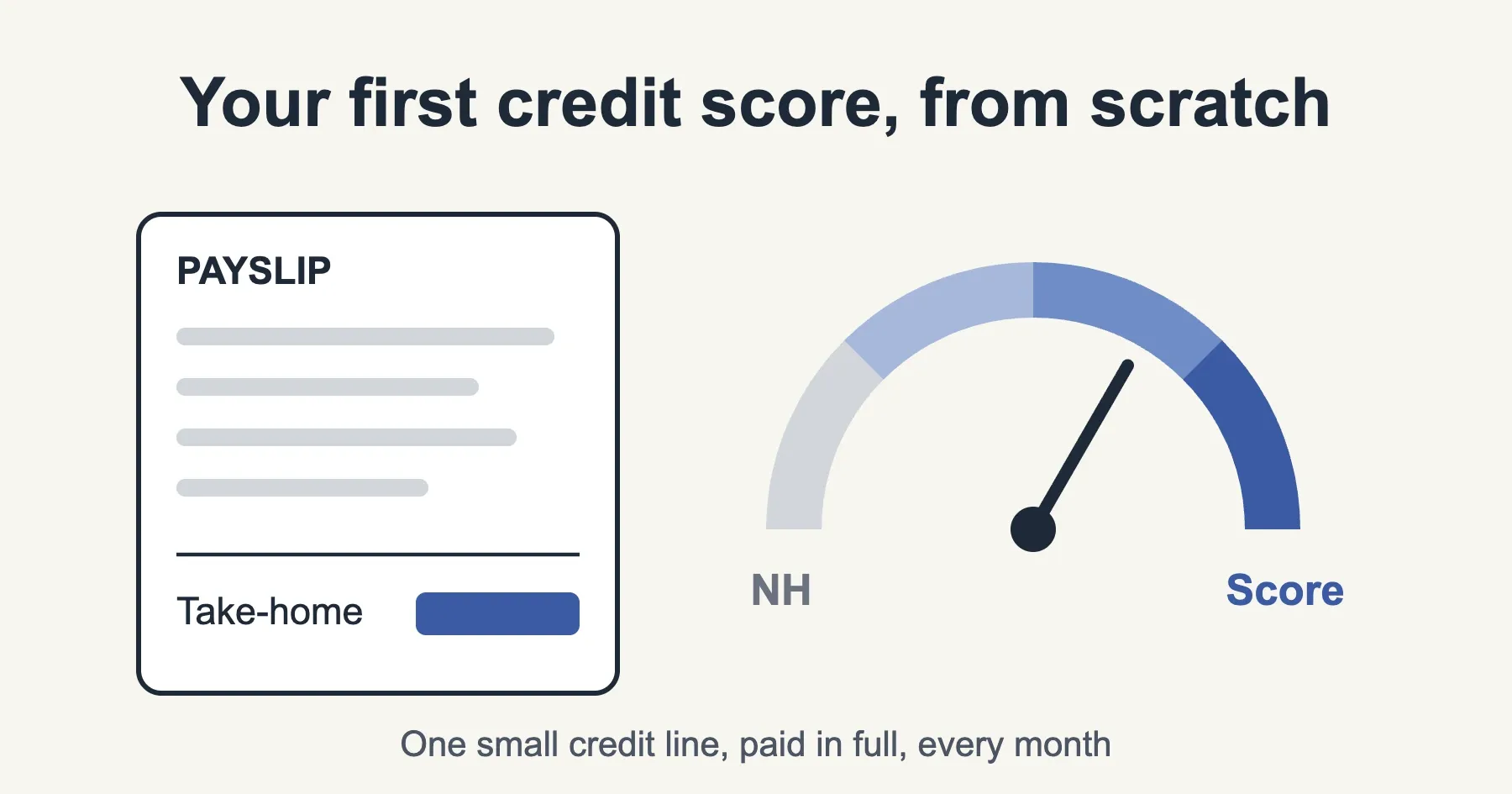
- No score (NH or -1) usually means no reported credit history, which is different from a bad history.
- A common start is one small credit line reported to the CICs, used for planned spending and repaid in full.
- Keep utilisation modest (about 30% or less is a rule of thumb, not an RBI rule) and apply for credit rarely.
- Salary credits, UPI payments and rent paid from your own account do not create credit history.
- RBI gives you one free full credit report a year from each CIC and a 30-day dispute timeline, with ₹100 a day compensation for delays beyond 30 days.
As of 25 November 2026: you build a credit score from scratch by opening one small credit line that a lender reports to India's credit information companies (CICs), using a modest part of it for expenses you would pay anyway, and repaying the full amount by every due date. Your salary, UPI payments and savings are not credit, so on their own they do not create a score. RBI rules let you check what each CIC records about you with one free full credit report a year.
Neha, 24, has just started work in Pune with a take-home salary of ₹38,000. A colleague told her that "no score is a bad score" and that she should get a card quickly. Here is the calmer order: need first, lowest-risk start, steady habits, then a report check.
Why you have no score yet (NH or -1, explained)
A credit score is calculated from your credit history: your loans and cards, their limits, balances and repayment record. If no lender has reported a credit account in your name, the bureau has nothing to score. Bureaus commonly show this as "NH" (no history), "NA" or "-1" instead of a number; the label depends on the bureau.
No history is not bad history. A lender simply cannot see how you have handled credit, so it may offer a smaller limit or ask for more documents.
How credit bureaus get your data
CICs are regulated by the Reserve Bank of India under the Credit Information Companies (Regulation) Act, 2005. Banks, NBFCs and other credit institutions report your accounts to them. Three RBI rules matter:
- Reporting frequency. Lenders used to report fortnightly. RBI's December 2025 amendment to its Credit Information Reporting Directions moved them to weekly incremental reporting from 1 July 2026, so your repayments now reach the bureau sooner.
- Loading and alerts. Under RBI's October 2023 customer-service directions, a CIC must load data within seven calendar days of receiving it and send you an SMS or email alert when your credit report is accessed, where it has your contact details.
- Free full report. Since 1 January 2017, each CIC must give you one free full credit report, including your score, once a calendar year on request. It must match the most detailed version lenders see. Because the duty applies to each CIC, you can get one free report from each of them every year.
Ways to start, from lowest risk
Check two things first: a starter emergency fund, so a surprise bill does not land on a card, and a real reason to want a score soon, such as a loan you expect to need. Without one, there is no rush. See how much emergency fund you need.
| Starting option | How it works | In favour | Watch out for |
|---|---|---|---|
| Secured credit card against an FD | You open a fixed deposit; the issuer gives a card with a limit linked to it and holds the FD as security | Often easier to get with no history; your own deposit caps the limit | The FD stays locked while the card is open; unpaid balances still attract interest. Confirm the issuer reports to CICs |
| Entry-level unsecured card | A modest limit based on your income | No deposit locked | Easier to overspend; fees vary |
| Small consumer loan (an EMI on something you planned to buy) | A fixed loan repaid in instalments | Builds instalment history | Interest and processing costs; borrowing only to build a score adds cost without a need |
These are product categories, not a recommendation of any issuer.
Worked example: Neha's first six months (hypothetical)
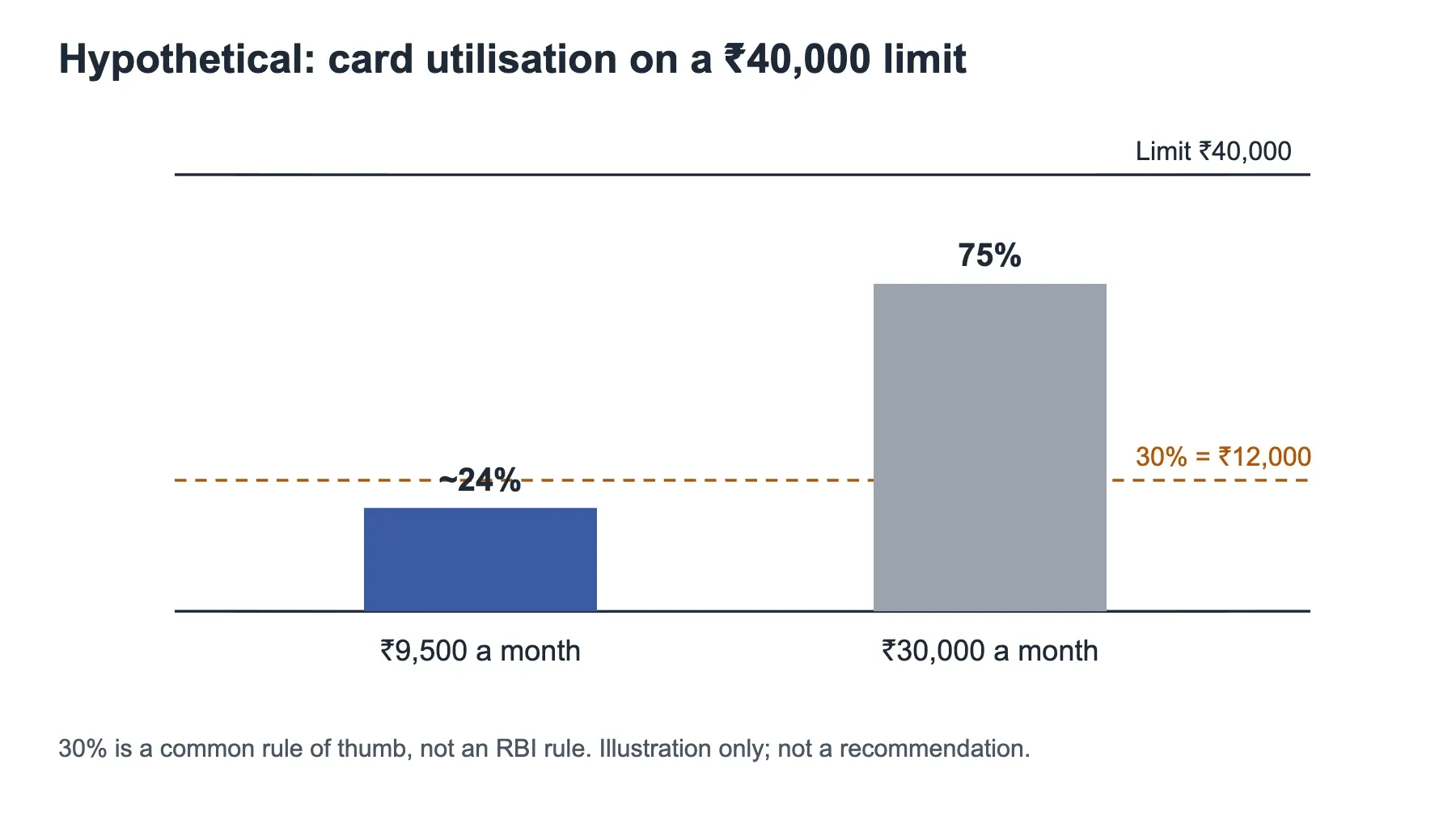
Hypothetical: Neha opens an FD-backed card with a ₹40,000 limit. She puts only predictable spending on it, about ₹9,500 a month of groceries and bills, and pays the full statement amount by each due date.
- Utilisation: ₹9,500 ÷ ₹40,000 = 23.75%, about 24% of the limit.
- That ₹9,500 is 25% of her ₹38,000 take-home: spending she already budgets for.
- Six months: ₹9,500 × 6 = ₹57,000 spent and repaid in full, so no interest on purchases.
| Month | Statement amount | Paid in full by due date | Utilisation | New credit applications |
|---|---|---|---|---|
| 1 | ₹9,500 | Yes | ~24% | 1 (the card itself) |
| 2 | ₹9,500 | Yes | ~24% | 0 |
| 3 | ₹9,500 | Yes | ~24% | 0 |
| 4 | ₹9,500 | Yes | ~24% | 0 |
| 5 | ₹9,500 | Yes | ~24% | 0 |
| 6 | ₹9,500 | Yes | ~24% | 0 |
There is no score column on purpose: a score usually appears only once the bureau has enough history, and each bureau uses its own model. What Neha controls is the record in the table.
At ₹30,000 a month, utilisation would be 75%; even repaid in full, that is generally read as heavier reliance on credit.
Habits that build the score
- Pay the full statement amount, not the minimum due. The minimum keeps the account current, but interest is charged on the rest, and card interest is high. An auto-debit for the full amount helps.
- Keep utilisation modest. Many bureau and lender guides suggest about 30% of the limit or less. That is a rule of thumb, not an RBI rule. On a ₹40,000 limit, 30% is ₹12,000.
- Apply rarely. Each application is recorded as an enquiry on your report; several close together can look like credit hunger. An unexpected access alert is worth checking.
- Keep the first account open. Length of history counts, so closing your first card early shortens your record.
What does not build credit
Credit information under the CIC Act covers credit facilities from lenders. So:
- Salary credits are income, not credit.
- UPI payments from your savings account move your own money; they are not a credit account.
- Rent paid by bank transfer is a payment to a landlord, not a loan.
If you pay rent or bills with a credit card, it is the card account and your repayment that get reported, not the rent.
Checking your first report and disputing errors
After a few statements, request your free full report from each CIC through the link on its home page. Check:
- Your name, date of birth, PAN and contact details.
- That the account is yours, with the right limit and open date.
- That months you paid on time show no days past due.
- That every enquiry matches an application you made.
If something is wrong, raise a dispute with the lender or the CIC. Under RBI's October 2023 compensation framework, a complaint should be resolved within 30 calendar days: the lender gets 21 days to send corrected data and the CIC the remaining 9. Past 30 days, you are entitled to ₹100 for each calendar day of delay, paid by whichever party caused it.
Credit-building vs investing: in what order
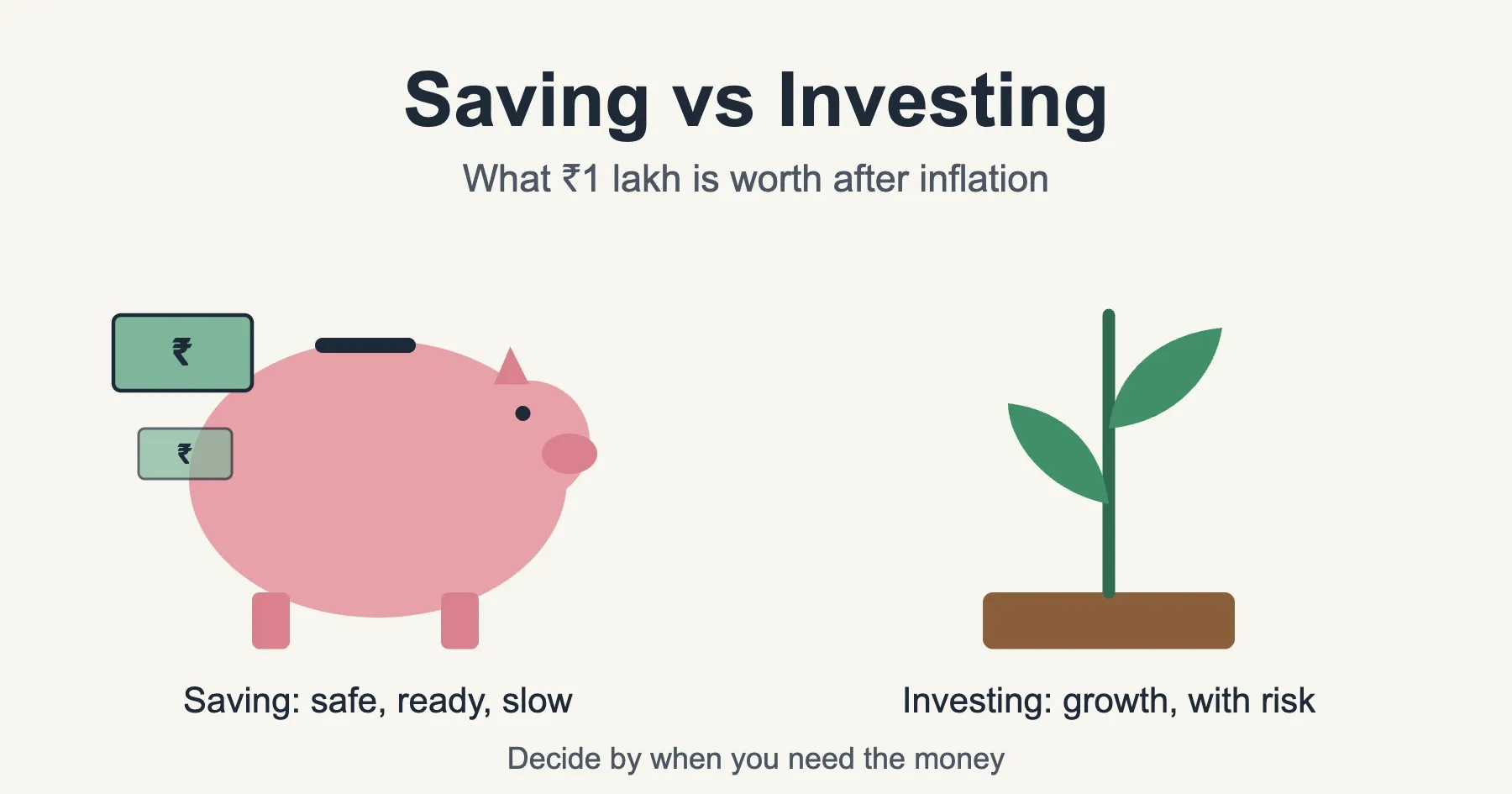
A credit score helps you borrow later; it does not grow your money. For most first-salary budgets, a sensible order is an emergency fund, then tracking spending, then investing for goals. A secured card fits alongside because it uses planned spending; a loan taken only to "build a score" competes with those goals. On expensive debt versus investing, see pay off a loan or start an SIP. For where a card bill sits in your budget, see the 50/30/20 rule on an Indian salary, and for the wider first-six-months plan, the first job money checklist.
Frequently asked questions
How can I build a credit score with no credit history in India?
Open one small credit line that is reported to the CICs, such as a secured card against an FD, use it for planned expenses and pay the full amount by each due date.
What does a credit score of -1 or NH mean?
It means the bureau has no credit history on you, or not enough to calculate a score. It is not a default or a negative mark; lenders simply have no repayment record to look at.
Does paying rent or using UPI build my credit score?
Not on their own. Credit reports are built from credit facilities that lenders report to CICs, and rent paid by transfer or UPI from your savings account is not credit.
How long does it take to get a credit score after a first card?
There is no fixed timeline. Since 1 July 2026 lenders report to bureaus weekly, so data reaches them faster, but a score appears only once a bureau has enough history under its own model.
Can I get my credit report free?
Yes. Under RBI's 2016 directions, each CIC must give you one free full credit report, including your score, once a calendar year on request.
Save this checklist
Save this page for the four report checks after your first few statements.