Credit Card Interest-Free Period: Why One Purchase Gets 50 Days and Another 21, and How a Part-Payment Ends It
Why one purchase gets 50 interest-free days and another 21, and how paying part of your credit card bill can bring interest on the full amount. RBI rules.
Summarize this article with AI





The short version
- The interest-free period runs from the transaction date to the due date (para 5(16)), so early-cycle purchases get more days.
- Partial or late payment loses it, and interest may be levied from the transaction date (para 23(6)).
- In the hypothetical example, leaving ₹5,000 of ₹30,000 unpaid costs about ₹1,783.56 at 42% a year, not ₹57.53.
- Late fees and past-due reporting start only after more than three days past due, on the unpaid amount only (para 23(5)).
- You can change your billing cycle at least once (para 29).
As of 25 November 2026, a credit card's interest-free period is the time from the date of a purchase to the payment due date on your statement, so it can run from about 20 to about 50 days depending on when in the billing cycle you spend. It holds only if you pay the total amount due by the due date. Pay part of the bill, or pay late, and RBI's rules allow interest to be charged from the date of each transaction.
Nikhil, 24, got his first credit card soon after his first salary in Coimbatore. His first statement showed ₹30,000. He paid ₹25,000 on the due date and assumed interest would run only on the ₹5,000 he left. That is not how it works.
Rules quoted here are from the Reserve Bank of India (Commercial Banks - Credit Cards and Debit Cards: Issuance and Conduct) Directions, 2025, dated 28 November 2025 and updated as on 1 October 2026, which apply to commercial banks; paragraph numbers refer to them. If another type of issuer gave you the card, check its terms.
The three dates on your statement: billing cycle, statement date, payment due date
- Billing cycle. The days whose transactions land on one statement, usually about a month. Card issuers "do not follow a standard billing cycle for all credit cards issued" (para 29), so yours may run from the 16th to the 15th, or the 3rd to the 2nd.
- Statement date. The day the cycle closes and the bill is generated, showing the total amount due and the minimum amount due.
- Payment due date. The last day to pay. Issuers must give you "at least one fortnight" to pay before interest starts (para 24).
Your card's Most Important Terms and Conditions (MITC) must explain the interest-free (grace) period "illustrated with examples" (para 91).
Why purchases get different interest-free days
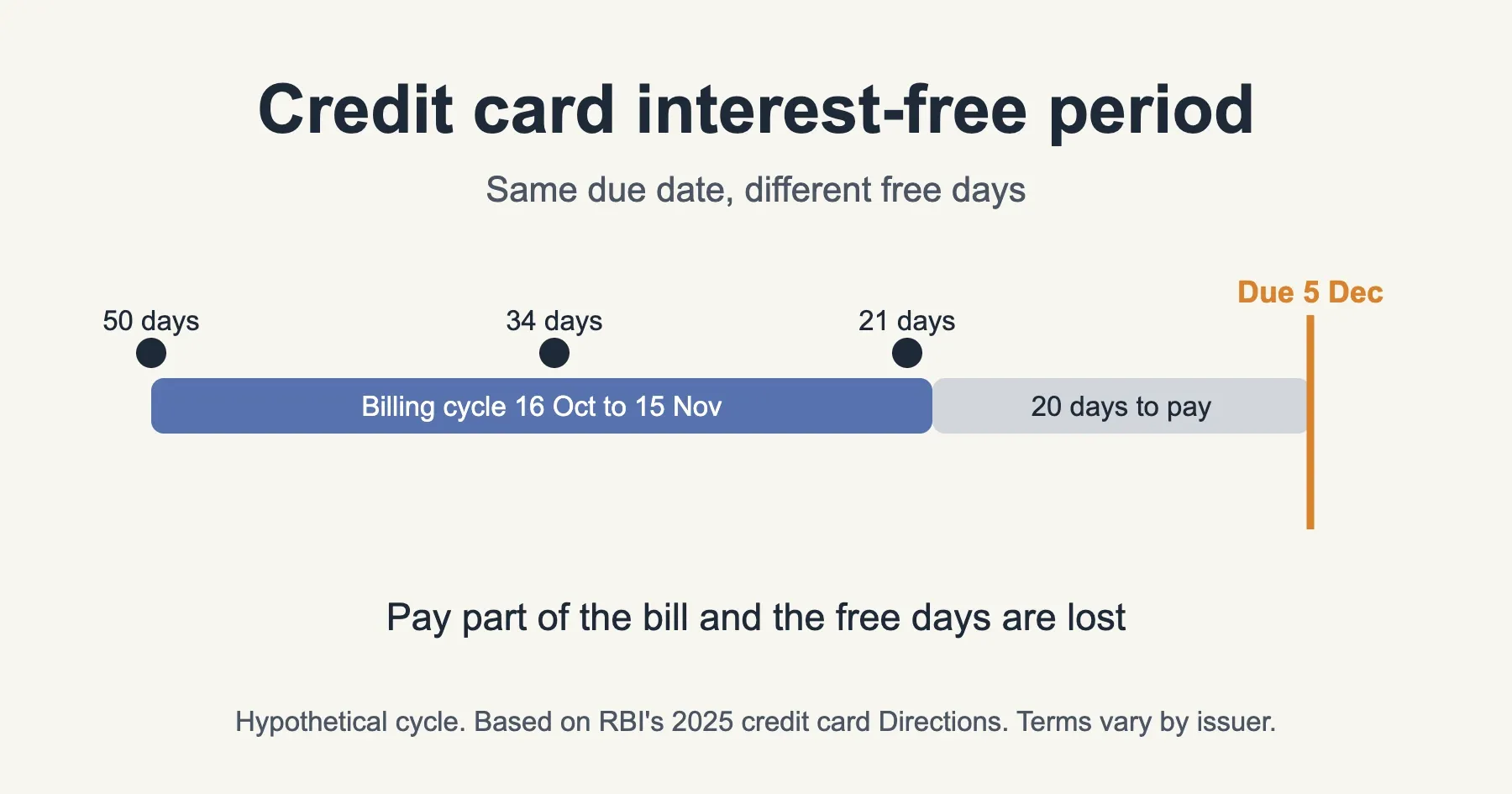
RBI defines the interest-free credit period as "the time period from the date of transaction to the due date of payment" (para 5(16)). One due date covers the whole cycle, so early purchases wait longer for their bill.
Hypothetical example, part A. Nikhil's cycle runs from 16 October to 15 November 2026. The statement comes on 15 November and payment is due on 5 December 2026, 20 days later.
| Purchase date | Statement date | Payment due date | Interest-free days |
|---|---|---|---|
| 16 October 2026 | 15 November 2026 | 5 December 2026 | 50 |
| 1 November 2026 | 15 November 2026 | 5 December 2026 | 34 |
| 14 November 2026 | 15 November 2026 | 5 December 2026 | 21 |
A purchase on 16 November falls into the next cycle; if that cycle's due date is 5 January 2027, it gets 50 days again. Issuers may count the purchase day differently, and the 20-to-50-day range belongs to this example, not every card.
What happens if you pay only part of the bill
RBI's rule (para 23(6), Explanation): "In case a cardholder makes partial payment or does not clear the total amount due within the payment due date, interest free credit period will be lost, and interest may be levied from the date of transaction."
Interest is levied "only on the outstanding amount, adjusted for payments / refunds / reversed transactions" (para 23(6)), so your part-payment reduces the balance from the day you make it. The MITC must also explain that the interest-free period "is suspended if any balance of the previous month's bill is outstanding" (para 23(3)). That can mean new purchases also attract interest until the old balance is cleared; your MITC states how your issuer applies it.
Hypothetical example, part B. Nikhil's ₹30,000 bill is one purchase made on 16 October. He pays ₹25,000 on 5 December, leaving ₹5,000. Assume a hypothetical rate of 42% a year (3.5% a month), charged daily on a simple basis from the transaction date. Actual rates are in each issuer's MITC.
| Period | Balance | Days | Interest at a hypothetical 42% a year |
|---|---|---|---|
| 16 October to 5 December 2026 | ₹30,000 | 50 | ₹1,726.03 |
| 5 December to 15 December 2026 (next statement) | ₹5,000 | 10 | ₹57.53 |
| Total on the next statement | ₹1,783.56 |
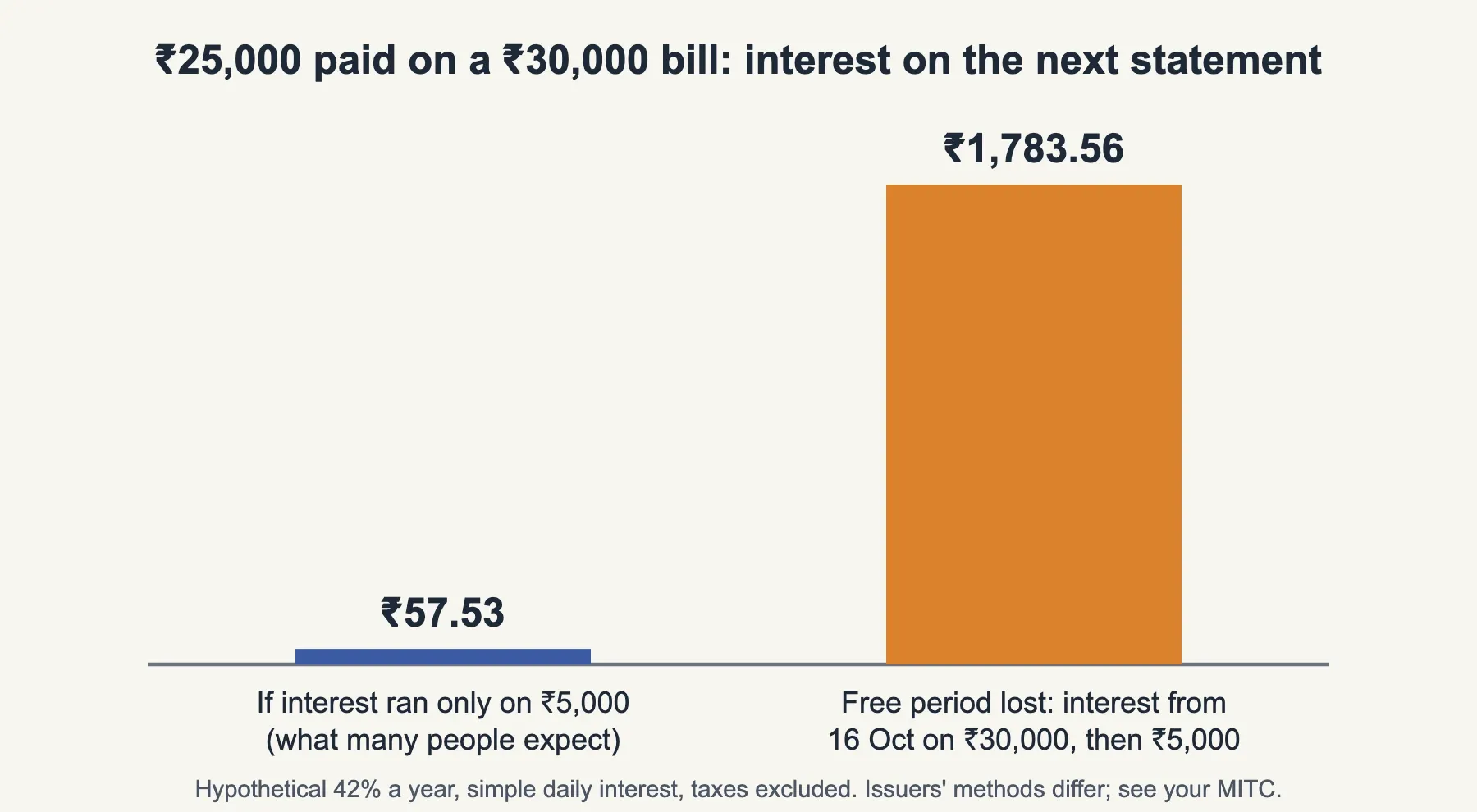
If interest ran only on the ₹5,000 from the due date, it would be ₹57.53. Because the interest-free period is lost, it runs on the full ₹30,000 from the purchase date, about 31 times as much. Paying ₹30,000 by 5 December would have meant nil interest. Figures exclude taxes and other charges.
Minimum amount due: what paying only this does
The minimum amount due (MAD) must be set "so as to ensure there is no negative amortization" (para 23(2)): paying it should not leave your balance growing. But paying only the MAD is still a part-payment, so the interest-free period is lost exactly as in part B.
Every statement must carry this warning (para 23(3)): "Making only the minimum payment every month would result in the repayment stretching over months / years with consequential compounded interest payment on your outstanding balance."
If you cannot clear the bill, pay as much as you can and pause new card spending. If you already carry card or loan debt, see paying off a loan or starting an SIP first.
Late by a day or two? The three-day rule
- Late charges and reporting. Issuers can report an account as "past due" to credit information companies, or levy penal charges, "only when a credit card account remains 'past due' for more than three days" (para 23(5)), counted from the statement's due date.
- Late fee base. Late payment charges apply only on the outstanding amount after the due date, not on the total amount due (para 23(5)).
- Interest. The three-day window does not protect the interest-free period, which para 23(6) ties to paying "within the payment due date".
Hypothetical example, part C. Nikhil pays the full ₹30,000 on 7 December, two days late. He is not past due for more than three days, so under these rules there is no late fee and no past-due report. But he missed the due date, so interest may be levied from 16 October: at the hypothetical 42% a year for 52 days, about ₹1,795.07.
On-time payment also builds your repayment history; see how to build a credit score with your first salary.
You can change your billing cycle at least once
Para 29: "cardholders shall be provided option to modify the billing cycle of the credit card at least once, as per cardholders' convenience." Ask through your issuer's official app or customer service; the issuer sets the options.
If salary arrives on the 1st and the bill is due on the 28th, you pay from last month's leftovers; a due date a few days after payday lets you clear the bill from fresh salary. Pair it with a monthly budget such as the 50/30/20 rule on an Indian salary.
Cash withdrawals, EMIs and fees: check your MITC
The MITC must list a cash advance fee, finance charges for cash advances and the cash withdrawal limit (para 91), and issuers must quote annualised percentage rates (APR) for cases such as cash advances, non-payment of the minimum amount due and late payment (para 23(1)). RBI's Directions treat cash advances as a separate rate case, so check in your MITC whether any interest-free period applies and from when interest runs before using a card at an ATM. For EMI conversions, read the offer terms before you agree.
A five-point routine for your first card
- Autopay the total amount due, not the minimum, from your salary account.
- Align the cycle to payday (para 29).
- Put the statement and due dates in your phone calendar.
- Avoid cash withdrawals on the card.
- Read the MITC illustration of the interest-free period once, when the card arrives.
Frequently asked questions
What is the interest-free period on a credit card?
It is the time from the date of a purchase to the payment due date (RBI 2025 Directions, para 5(16)). On many cards it runs from about 20 to about 50 days, depending on when you buy in the cycle. It applies only if you pay the total amount due by the due date.
Why do different purchases get different interest-free days?
All purchases in a cycle share one due date, so an early purchase waits longer than a late one. In the hypothetical example: 50, 34 and 21 days.
What happens if I pay only part of my credit card bill?
You lose the interest-free period, and interest may be levied from each transaction date on the outstanding amount, adjusted for payments (para 23(6)). In the hypothetical example, a ₹5,000 shortfall on ₹30,000 leads to about ₹1,783.56 of interest at 42% a year.
Is there a late fee if I pay my credit card bill 1 or 2 days late?
Under para 23(5), late fees and past-due reporting apply only after more than three days past due, and only on the amount unpaid after the due date. Missing the due date can still cost you the interest-free period.
Can I change my credit card billing cycle?
Yes. Issuers must let you change it at least once, as per your convenience (para 29). Ask through the issuer's official app or customer service.
Save this checklist
Save this checklist next to our first job money checklist.