EPF withdrawal rules 2026: what the new scheme allows, and when to leave PF alone
EPF Scheme 2026: partial withdrawals need 12 months' service and 25% stays in PF. See the limits, tax on early final exit, and a keep-or-withdraw check.
Summarize this article with AI





The short version
- As of 17 November 2026, EPF partial withdrawals fall into three categories: essential needs, housing and special circumstances.
- You need 12 months of service, and 25% of the balance must stay in the account.
- In Rahul's hypothetical case, up to ₹1,23,000 of ₹1,64,000 is available, and ₹41,000 stays.
- Tax and TDS mainly concern a final settlement before five years of continuous service, not a partial advance.
- EPF earns an annually declared rate for retirement; withdrawing it to start an SIP mixes up two different jobs.
Under the Employees' Provident Funds Scheme, 2026, effective 29 June 2026, partial withdrawals fall into three categories (essential needs, housing, special circumstances), open after 12 months of service, and 25% must stay in your account. A final PF withdrawal before five years of continuous service can be taxable, with TDS above ₹50,000; partial advances generally aren't.
That is the rule as of 17 November 2026; whether to use it is the second question. Rahul, 24, is in his second job in Kozhikode. His UAN shows ₹1,64,000, and a colleague told him the new EPF partial withdrawal rules let him take out "almost all of it". Here is what the rules allow, the tax, and a check before he touches the money.
How much PF can I withdraw under the new 2026 EPF rules?
The EPF Scheme, 2026 replaced the old list of purpose-by-purpose advances with a simpler structure. The change was first approved by EPFO's Central Board of Trustees (CBT) at its 238th meeting on 13 October 2025, which merged 13 separate provisions into one rule with three categories. The scheme was notified in July 2026 and took effect on 29 June 2026.
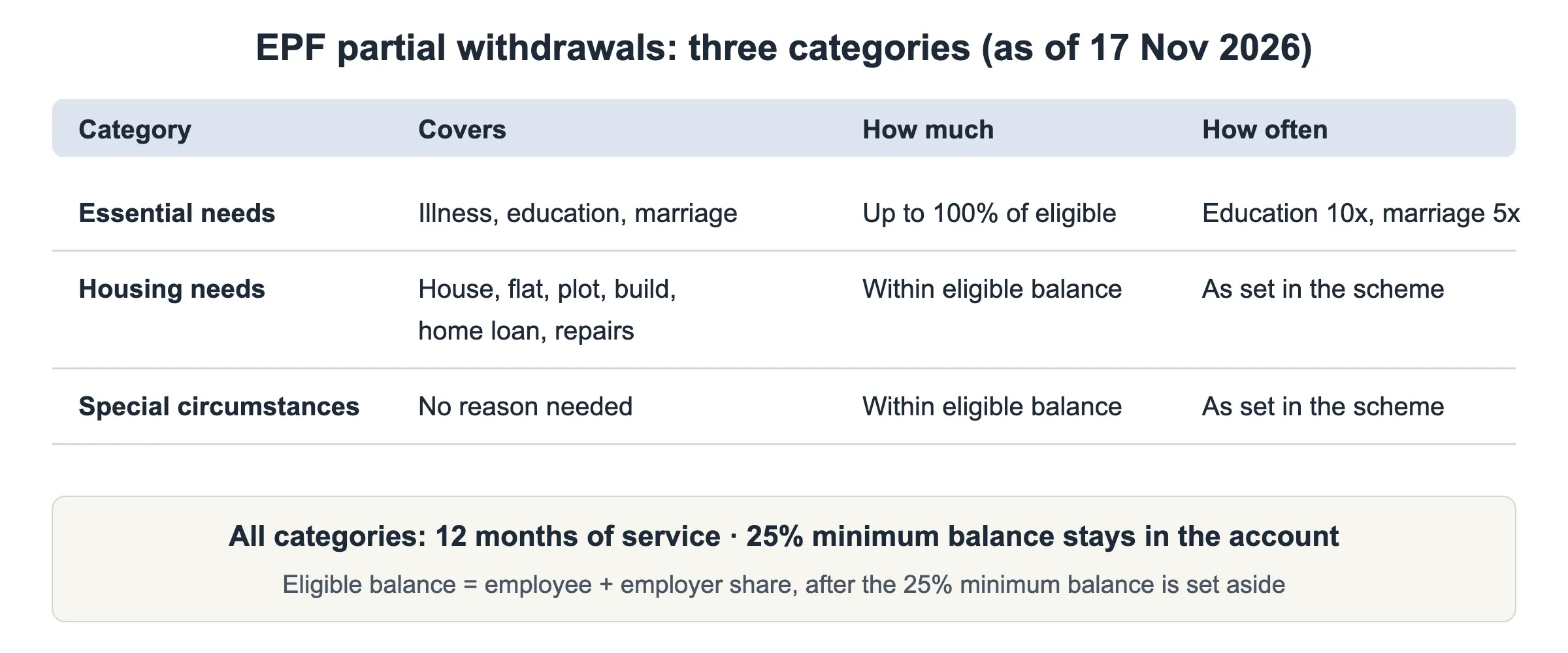
Here is how the pieces fit, as of 17 November 2026:
| Category | What it covers | How much | Service needed | How often |
|---|---|---|---|---|
| Essential needs | Illness, education, marriage | Up to 100% of the eligible balance (employee and employer share) | 12 months | Education up to 10 times; marriage up to 5 times |
| Housing needs | Buying a house, flat or plot, building, repaying a home loan, repairs | Within the eligible balance | 12 months | As set in the scheme |
| Special circumstances | Situations where no reason has to be given | Within the eligible balance | 12 months | As set in the scheme |
Three ideas carry the table:
- One service condition. The CBT set 12 months of service for all partial withdrawals, replacing the separate conditions of each old advance.
- "Eligible balance" is the key phrase. It means what is left after the minimum balance is set aside, including both your share and your employer's share.
- More room for education and marriage. The earlier combined cap was three; now it is 10 for education and 5 for marriage.
Is it true 25% of my EPF balance must always stay in the account?
Yes. A minimum balance of 25% has to stay in the account at all times. EPFO's October 2025 release describes it as 25% of the contributions in the member's account, earmarked so the balance keeps earning interest. Guides to the notified scheme describe it as 25% of the member balance, with employee and employer contributions both counted. The exact base is set by the scheme text, so check your passbook figure when you file a claim.
Rahul's numbers (hypothetical). Assume the 25% is worked out on his whole ₹1,64,000 balance:
- Must stay in the account: ₹41,000
- Available for a partial advance: up to ₹1,23,000
His figure could differ slightly if the 25% applies only to contributions. Either way, a quarter stays put and keeps earning.
Can I withdraw PF for my education, a sibling's marriage or a house?
Usually yes, once you have 12 months of service and subject to the 25% minimum balance.
- Your education, or your child's: sits in the essential needs category. Up to 10 withdrawals are allowed over your membership.
- A marriage: also essential needs, up to 5 withdrawals. The old rules allowed this for your own marriage, a child's or a sibling's; the claim form asks you to state whose. Read the claim instructions on the EPFO portal for the current list of eligible family members before you apply.
- A house: buying a house, flat or plot, building, repaying a home loan, or repairs come under housing needs.
- Anything else: the special circumstances category lets you apply without giving a reason.
Claims are filed online on the EPFO member portal using your UAN.
Will I pay tax or TDS if I withdraw PF before 5 years of service?
This section states rules as of 17 November 2026, for FY 2026-27, under the Income-tax Act, 2025. Each tax line below names the event that triggers it.
Partial advance (Rahul's case). A partial withdrawal from your EPF while you stay a member is generally not taxed, and TDS would not generally apply to it. Rahul's ₹1,23,000 advance falls here.
Premature final withdrawal. The tax question comes up if you close out (settle) your full PF before completing five years of continuous service. In that case:
- The employer's contribution and the interest on it are taxed as salary.
- The interest on your own contribution is taxed as income from other sources.
- Your own contribution is not taxed again.
- TDS applies under section 392(7) of the Income-tax Act, 2025 (the replacement for section 192A, effective 1 April 2026) when the payment is above ₹50,000: 10% if you have given your PAN, and a higher rate if you haven't.
- No TDS is deducted at ₹50,000 or less, or if you submit Form 15G or 15H where you are eligible.
Not a withdrawal at all. Transferring your PF to a new employer's account is not a withdrawal, so no tax or TDS arises. Five years of continuous service counts across jobs when you transfer.
Note also that the CBT extended the waiting period for a premature final settlement after leaving a job from 2 months to 12 months.
Tax rules change; consult a tax professional for your situation.
Should I withdraw my PF to start an SIP instead?
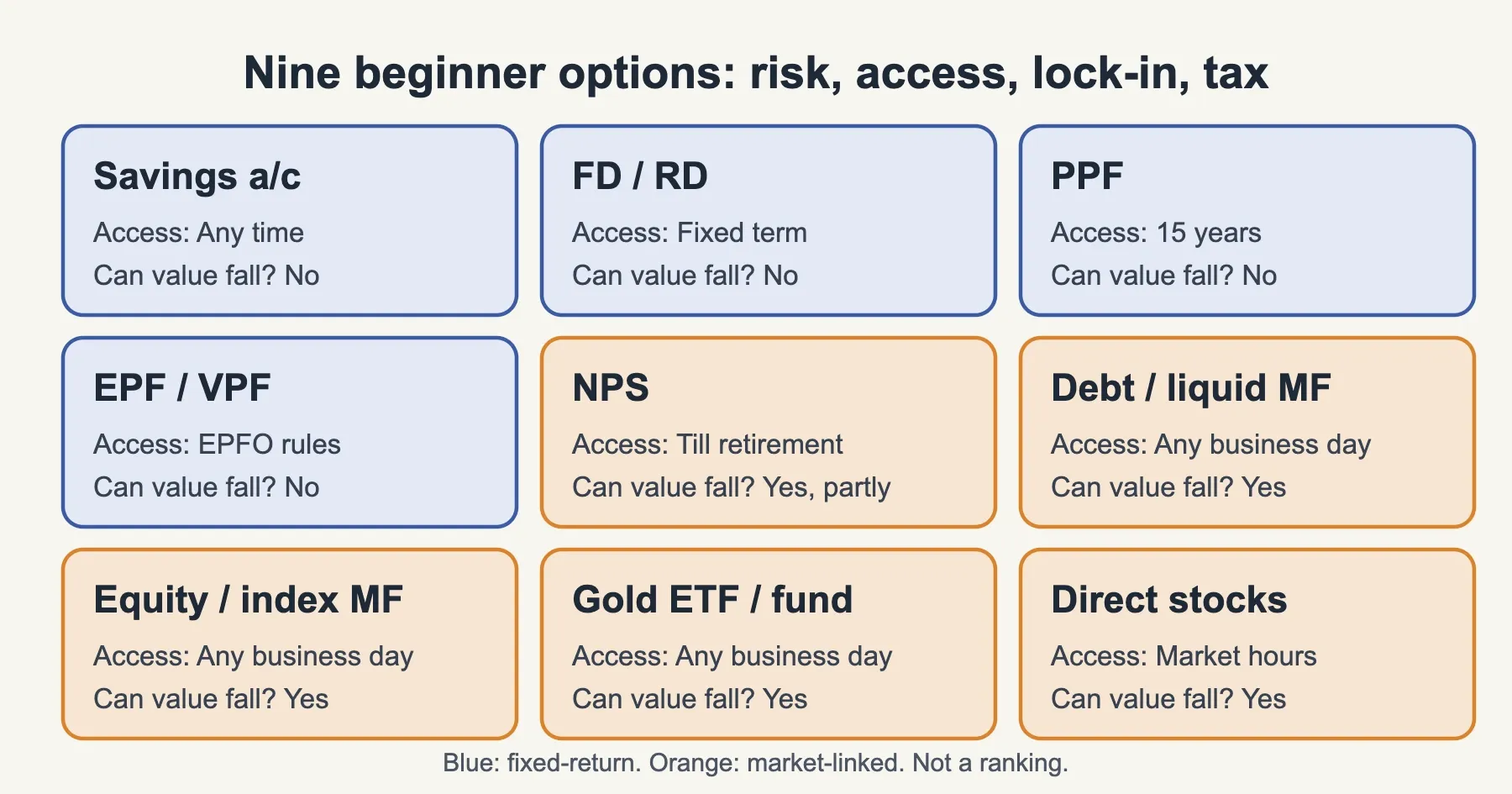
Here "can" and "should" part ways. EPF and an SIP do different jobs.
- EPF is retirement money. It earns an annually declared rate: the CBT recommended 8.25% for FY 2025-26 in March 2026. The rate is set each year and can change.
- A mutual fund SIP earns market-linked returns. They can be higher or lower than EPF in any year, and can be negative.
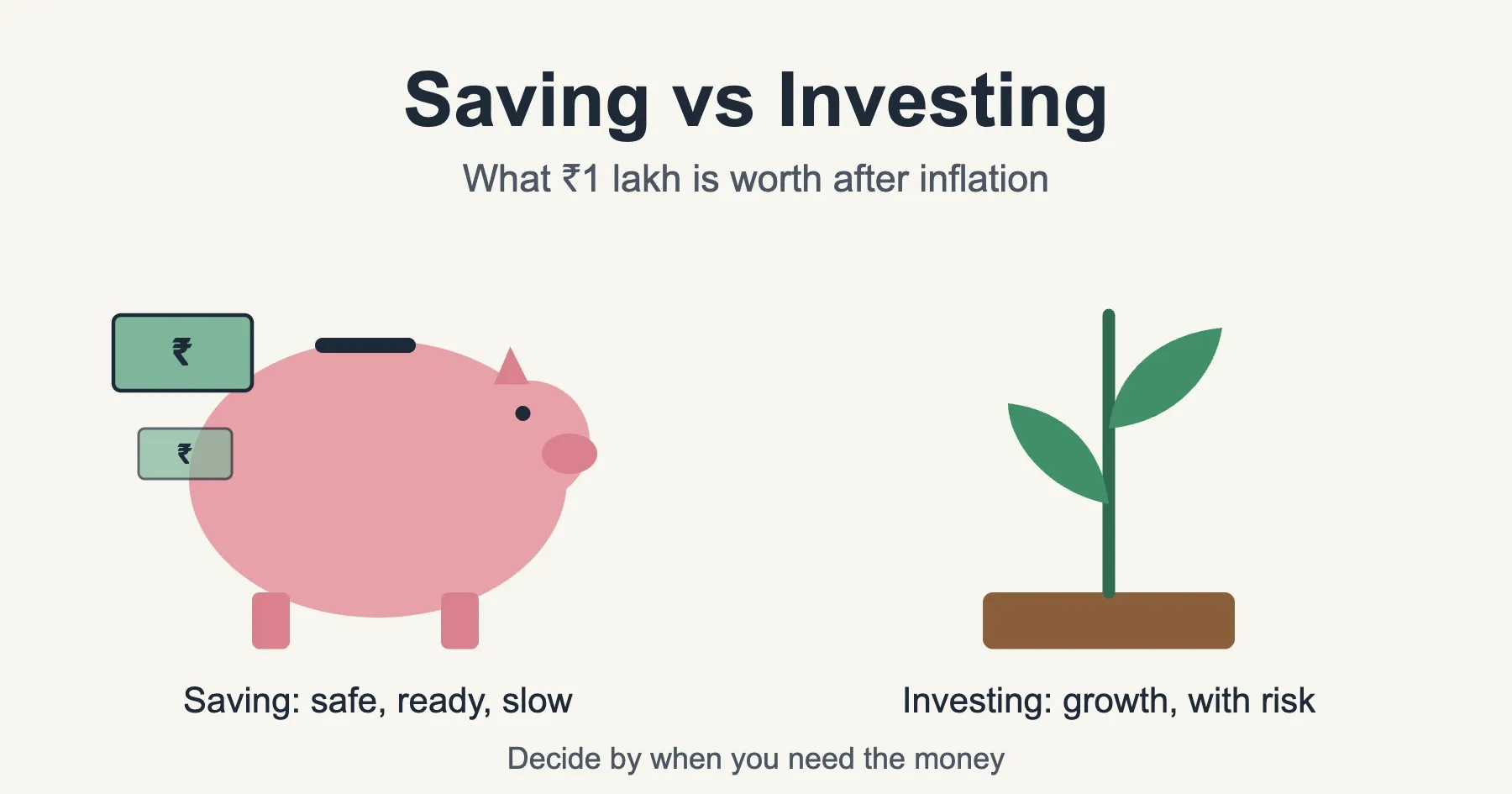
Moving money out of EPF to start an SIP swaps a declared rate for a market-linked one, and it also uses up retirement savings early. If the aim is to start an SIP, the usual path is to fund it from monthly salary, not from your PF.
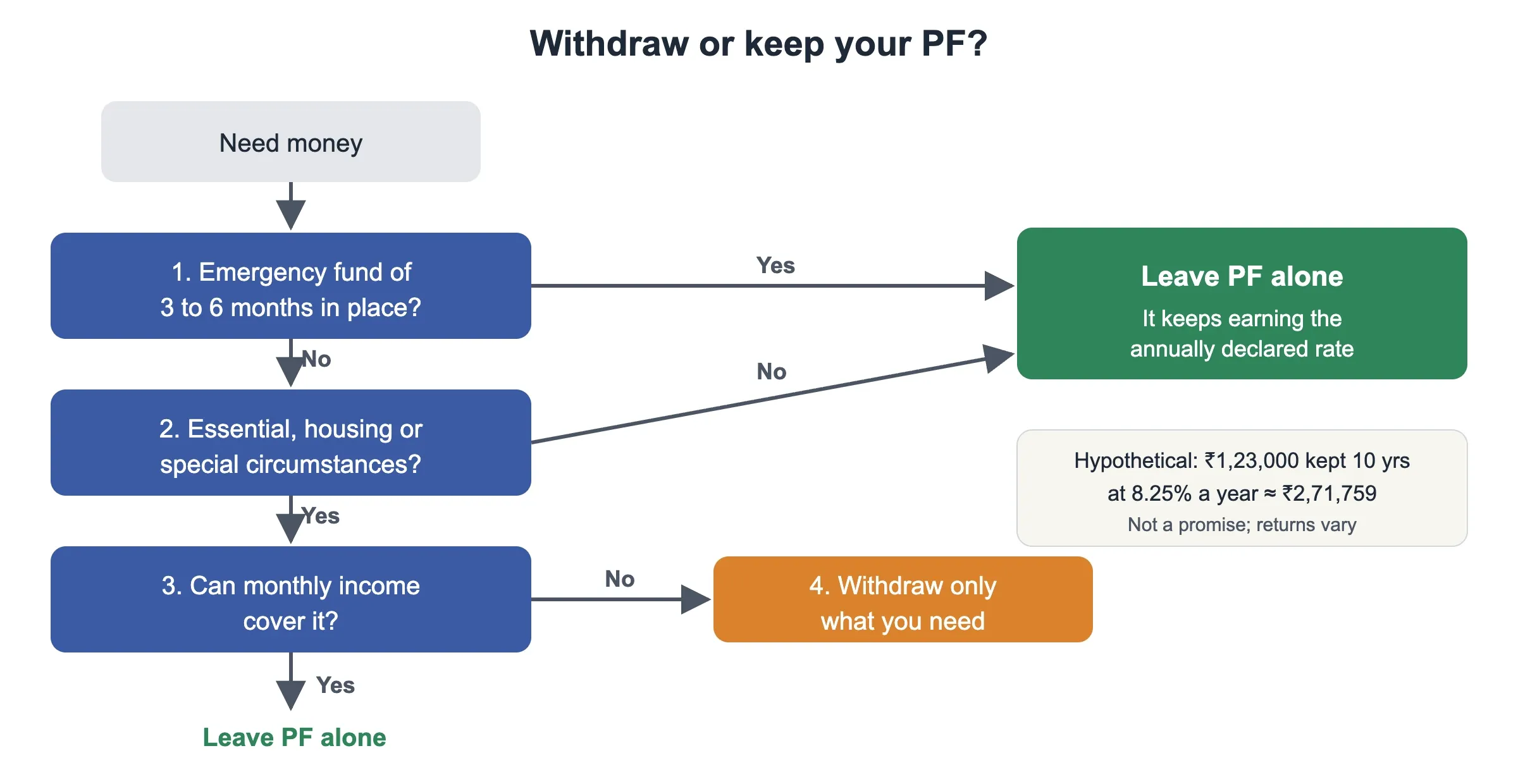
What the money could do if left alone (hypothetical). If Rahul's ₹1,23,000 stayed in EPF and earned 8.25% a year, compounded once a year, for 10 years, it would grow to about ₹2,71,759, an increase of ₹1,48,759. This assumes the rate stays at 8.25% every year, which is not a promise; returns vary, and the rate is declared each year.
A short check before any partial withdrawal:
- Is there an emergency fund? If you have 3 to 6 months of essential expenses set aside, a need can often be met without touching PF.
- Is the need one of the three categories, and real? Education, a wedding, a home or illness are what the categories exist for.
- Can monthly income cover it instead? If yes, leave PF alone.
- If you still withdraw, take only what you need, not the full eligible amount.
Frequently asked questions
Does EPS pension money count in my PF withdrawal?
No. Part of your employer's contribution goes to the Employees' Pension Scheme (EPS), which is a separate pension account. Partial withdrawals under the EPF Scheme, 2026 come from your EPF balance, not from EPS.
What happens to PF when I change jobs?
You transfer it, you don't withdraw it. With one UAN, your EPF moves to the new employer's account, your service is counted together, and no tax arises on the transfer.
Is PF interest taxable?
EPF interest is generally tax-free for most members. Interest on employee contributions above a yearly limit is taxable, and on a premature final withdrawal the interest is taxed as described above. Check the current limit with a tax professional.
What is the EPF interest rate for FY 2025-26?
EPFO's Central Board of Trustees recommended 8.25% a year for FY 2025-26 on 2 March 2026. The rate is credited once the government notifies it, and a new rate is declared each year.
How many times can I make a partial withdrawal?
Up to 10 times for education and up to 5 times for marriage over your membership, according to the CBT decision. Each withdrawal still needs 12 months of service and must leave the 25% minimum balance.
Read next
For the full first-job sequence, start with the first job money checklist. Comparing retirement accounts? Read NPS withdrawal rules in 2026. Before starting an SIP from salary, see common SIP mistakes and how much emergency fund you need.
— Laabh