Common SIP mistakes beginners make, and how to fix each one
Stopping in a fall, a debit date before salary, bounced instalments, too many SIPs, costs and exit load: 8 beginner SIP mistakes, each with a fix.
Summarize this article with AI





The short version
- Most SIP mistakes are a reaction to the market or a set-up slip, and both are fixable.
- In a fall, a fixed instalment buys more units; stop for a change in your life, not only because the market fell.
- Set the debit date after salary arrives; repeated failed debits can cancel an SIP and your bank may charge for each.
- Know your plan type, expense ratio and exit load before you need to redeem.
The most common beginner SIP mistakes are stopping only because the market fell, setting a debit date before salary arrives, letting instalments bounce, spreading money over too many small SIPs, picking a fund on last year's return, ignoring costs, never raising the amount and redeeming early into an exit load.
Most of these are either a reaction to the market or a set-up slip, and both kinds can be fixed. Say Nisha, 24, starts a ₹2,500 monthly SIP in Jaipur after her first appraisal. Within a year the market dips, her salary lands late once, and a friend forwards last year's top funds. Each of those moments is where the common SIP mistakes beginners make tend to happen. Below are each mistake, its cost and the page that goes deeper. If you are new to the basics, start with What Is an SIP in Mutual Funds?.
What are the most common mistakes people make with their first SIP?
Eight SIP mistakes to avoid, each linked to the page that covers it in full.
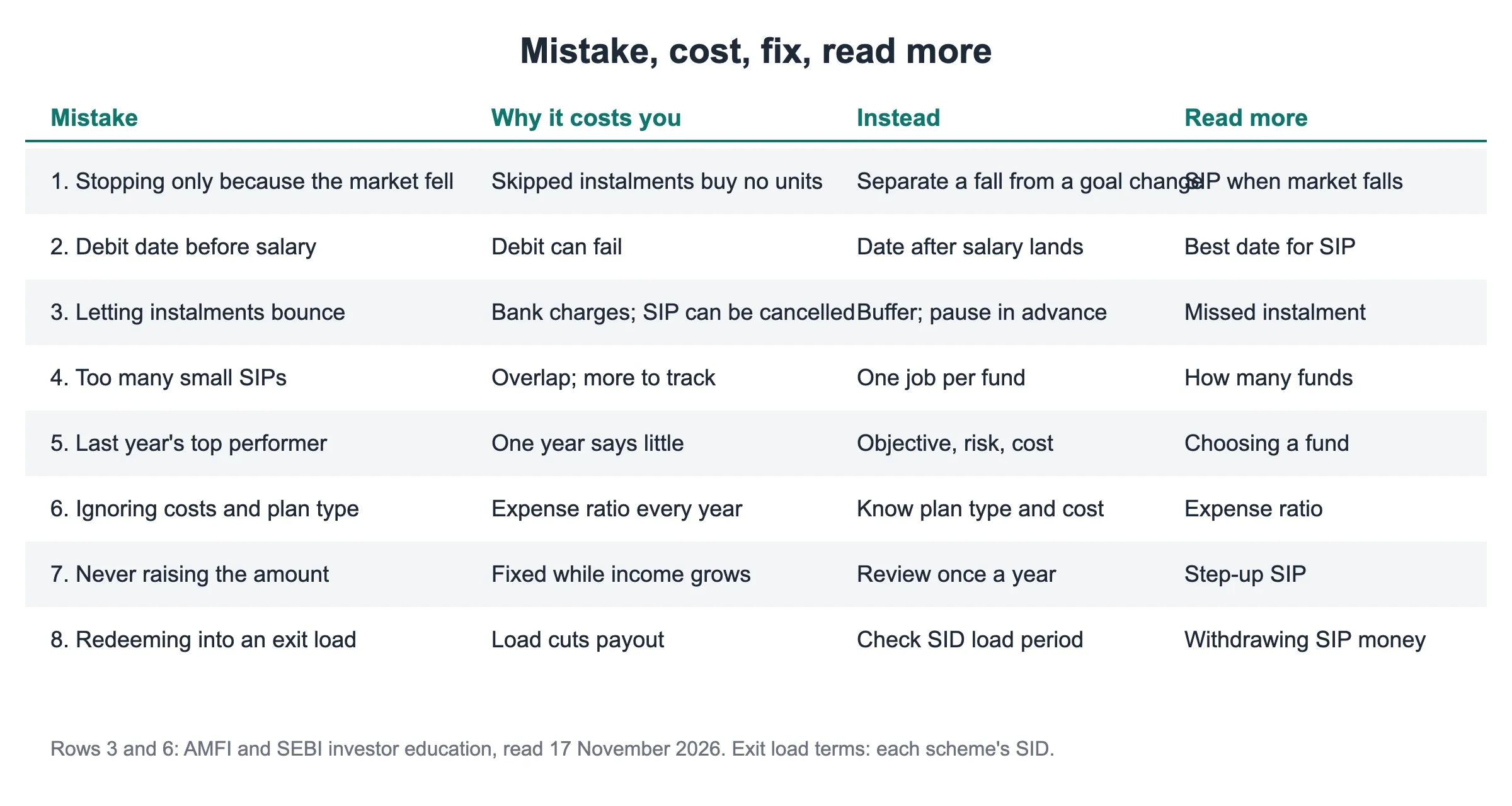
| Mistake | Why it costs you | What to do instead | Read more |
|---|---|---|---|
| 1. Stopping only because the market fell | Instalments skipped at lower NAVs buy no units; the habit breaks | Separate a market fall from a change in your goal or cash flow | what happens to your SIP when the market falls |
| 2. Debit date before salary arrives | The debit can fail if the account is short that day | Set the date a few days after salary usually lands | Best Date for SIP |
| 3. Letting instalments bounce | Your bank may charge for a dishonoured debit; repeated failures can cancel the SIP (AMFI) | Keep a small buffer; pause in advance if cash is tight | Missed an SIP Instalment? |
| 4. Too many small SIPs | Overlapping holdings and more statements to track | Fewer funds, each with a clear job | How many mutual funds should a beginner have? |
| 5. Picking last year's top performer | One year's return says little about the next | Compare objective, risk, cost and consistency | Choosing a fund |
| 6. Ignoring costs and plan type | The expense ratio is charged every year; a regular plan's includes distributor commission (SEBI, AMFI) | Know your plan type and its expense ratio | Expense Ratio in Mutual Funds |
| 7. Never raising the amount | The instalment stays fixed while income grows | Review the amount once a year | Step-up SIP |
| 8. Redeeming early into an exit load | The load reduces what you receive | Check the exit load period in the SID before redeeming | Can you withdraw your SIP money anytime? |
Rows 3 and 6 are based on AMFI and SEBI investor-education pages read on 17 November 2026; exit load terms come from each scheme's SID. The other rows are general explanation.
Markets are falling. Is stopping my SIP a mistake?
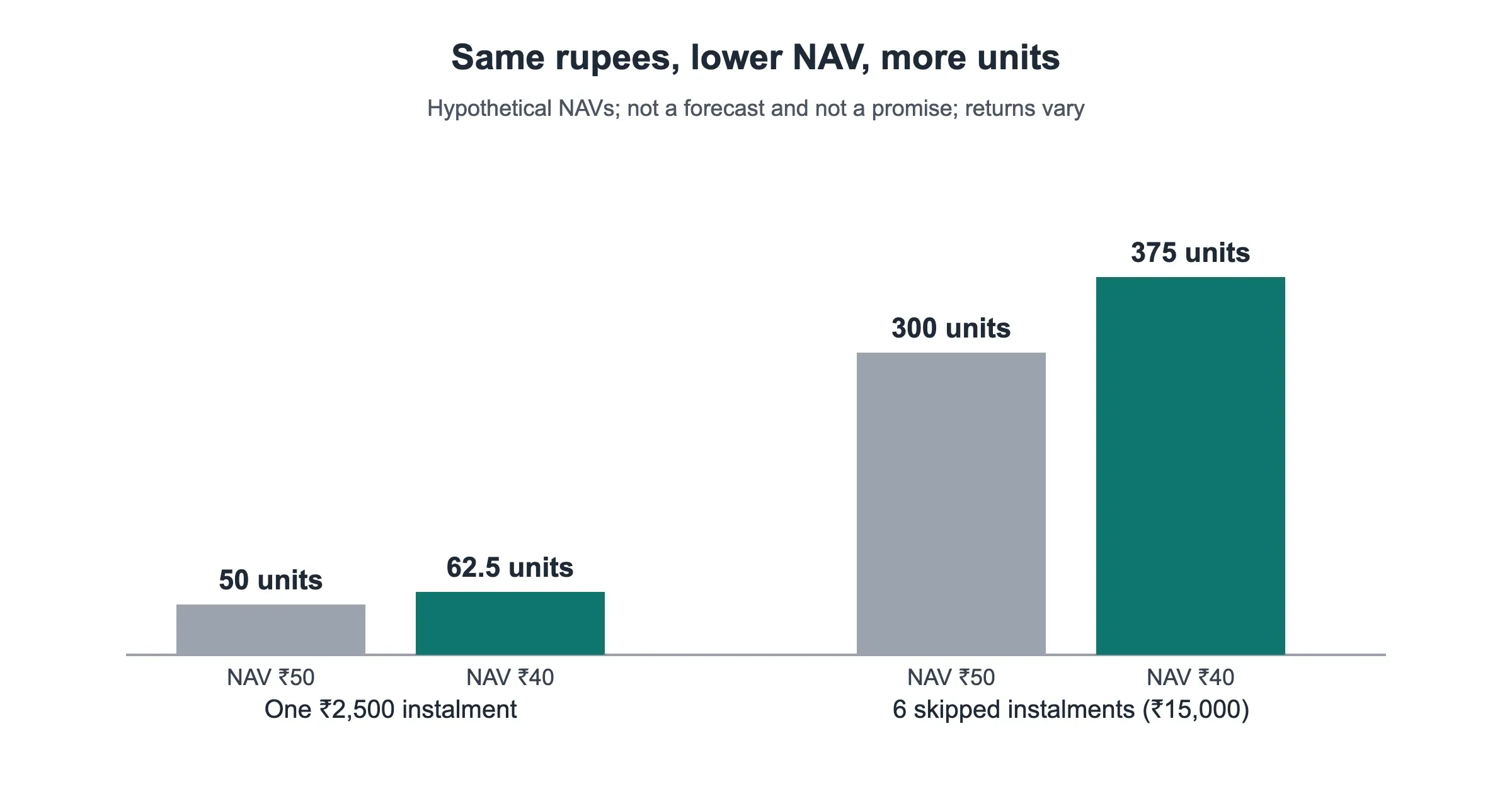
An SIP invests a fixed amount, so a lower NAV buys more units.
Take Nisha's ₹2,500 instalment. At a NAV of ₹50 it buys 50 units; if the NAV falls to ₹40, the same instalment buys 62.5 units. If she stops for 6 months while the NAV sits near ₹40, she skips ₹15,000. At ₹40 that money would have bought 375 units, against 300 units at ₹50. Hypothetical NAVs, for illustration only; not a forecast and not a promise; returns vary.
This is rupee-cost averaging. It lowers your average cost per unit when prices move, but it does not prevent losses, and units bought cheaply can fall further.
Stopping can still be the right call when your goal or cash flow changes. That is a decision about your life, not about the index. Compare the options in Pause or Stop Your SIP?.
I have 7 SIPs of small amounts. Is that too many?
Often, yes. Seven SIPs of ₹500 each is ₹3,500 a month spread over seven schemes. If several sit in the same category, they are likely to hold many of the same companies, so the extra funds add tracking work more than variety.
The fix is to give each fund one job. Ask what each scheme does that the others don't. If you can't answer, it may be a duplicate. The full reasoning is in How many mutual funds should a beginner have?.
Is it wrong to pick a fund because it topped last year's returns?
It is a weak test on its own. One year's return reflects one year's market, and last year's leader does not always lead the next. Chasing rankings can also mean frequent switching, with exit loads and tax on the way out. Look instead at:
- the scheme's objective and category
- its riskometer level
- its expense ratio
- how it did against its benchmark across several periods, not one
How to Choose a Mutual Fund Without Chasing Last Year's Returns walks through these checks without naming funds.
My SIP bounced because salary came late. What happens, and how do I avoid it?
SIP debits run through a bank mandate, usually a NACH or e-mandate on NPCI's systems. If the balance is short on the debit date, the debit fails.
AMFI's investor-education page says fund houses don't penalise a missed instalment, but "your bank will penalize you for dishonoring the auto debit payments". Charges vary by bank. The same page says "your SIP will automatically be cancelled if you fail to make the payments for three consecutive months." A fund-house FAQ on the uniform rules in force since 1 April 2024 lists three failed debit attempts before cancellation for monthly SIPs (two for bi-monthly and longer), says investors are told by email or SMS after the first failure, and does not count a pause as a failure. Units already bought stay invested.
To avoid it, set the debit date a few days after salary usually arrives, keep a buffer, and pause in advance if cash will be short. See Best Date for SIP and Missed an SIP Instalment?.
The cost slips: plan type, a fixed amount and exit load
Ignoring costs and plan type
SEBI's investor page says a regular plan's expense ratio "is higher, as it includes a commission paid to the intermediary", while "the underlying portfolio remains the same". AMFI adds that this leads to a slightly lower NAV for the regular plan of the same scheme. Choosing a regular plan is not the mistake; a distributor's help may be worth the cost to you. Not knowing which plan you hold, and what it costs each year, is. Read Expense Ratio in Mutual Funds and Direct vs Regular Mutual Fund.
Never raising the amount
An SIP set at your first salary stays at that amount until you change it. A yearly review, for example after an appraisal, keeps it in step with income. See Step-up SIP.
Redeeming early into an exit load
Many schemes charge an exit load if units are redeemed within a set period, and the SID gives the terms. In an SIP each instalment buys its own units, so the period is generally counted from each instalment's date. Suppose Nisha redeems all 12 instalments (₹30,000) within a year under a hypothetical 1% exit load, and assume the value is still ₹30,000 for simplicity. The load would be ₹300, before any tax. Hypothetical NAVs and exit load, for illustration only; not a forecast and not a promise; returns vary. Check your scheme's SID for its actual terms. More in our guide: Can you withdraw your SIP money anytime?.
A 10-minute check of your own SIP
- Put your salary date next to your SIP debit date.
- Keep a buffer above the instalment on that day.
- Write one job for each SIP.
- Find your plan type and expense ratio on your statement.
- Note the exit load period from the SID.
- Set a yearly date to review the amount.
Frequently asked questions
Should I start an SIP before I have an emergency fund?
If an unexpected bill would force you to stop or redeem early, the SIP may not survive its first emergency. Many people build a cash buffer first, or alongside a small SIP. See How much emergency fund should you have?.
Is choosing a regular plan a mistake?
Not in itself. Direct and regular plans of a scheme hold the same portfolio; the regular plan has a higher expense ratio because it includes distributor commission. It is a choice between cost and help. See Direct vs Regular Mutual Fund.
Does exit load apply to SIPs?
Yes, if the scheme has one. Each instalment's units are generally counted from their own purchase date, so recent ones can attract the load. Check the SID and Can you withdraw your SIP money anytime?.
Should I raise my SIP every year?
A yearly review is a useful habit, especially after a raise. How much to add depends on your budget and goal. See Step-up SIP.
Does a high SIP stoppage ratio mean I should stop my SIP?
No industry ratio can answer that for you. It is a market-wide number about SIP registrations ending compared with new ones, and it says nothing about your goal or cash flow.
Read next
Check your debit date against your salary date first; it is the quickest fix here. Read Best Date for SIP.
— Laabh



