Focused Fund Meaning: What a 30-Stock Limit Does to Your NAV When One Holding Falls
Focused fund meaning: max 30 stocks and 80% minimum equity under SEBI's Feb 2026 circular, plus how one stock's fall moves NAV.
Summarize this article with AI





The short version
- A focused fund can hold at most 30 stocks and must keep at least 80% of total assets in equity and equity related instruments, per SEBI's 26 February 2026 circular.
- The 80% minimum replaced the 65% minimum of the 2017 rule; the 30-stock cap did not change.
- Fewer stocks means each holding weighs more: in the hypothetical, a 40% fall in one stock costs ₹571 at 70 equal-weight stocks and ₹1,600 at 25.
- Concentration widens outcomes in both directions; it is not a return prediction.
- Read the number of holdings, top-10 weight, sector weights and riskometer in the factsheet.
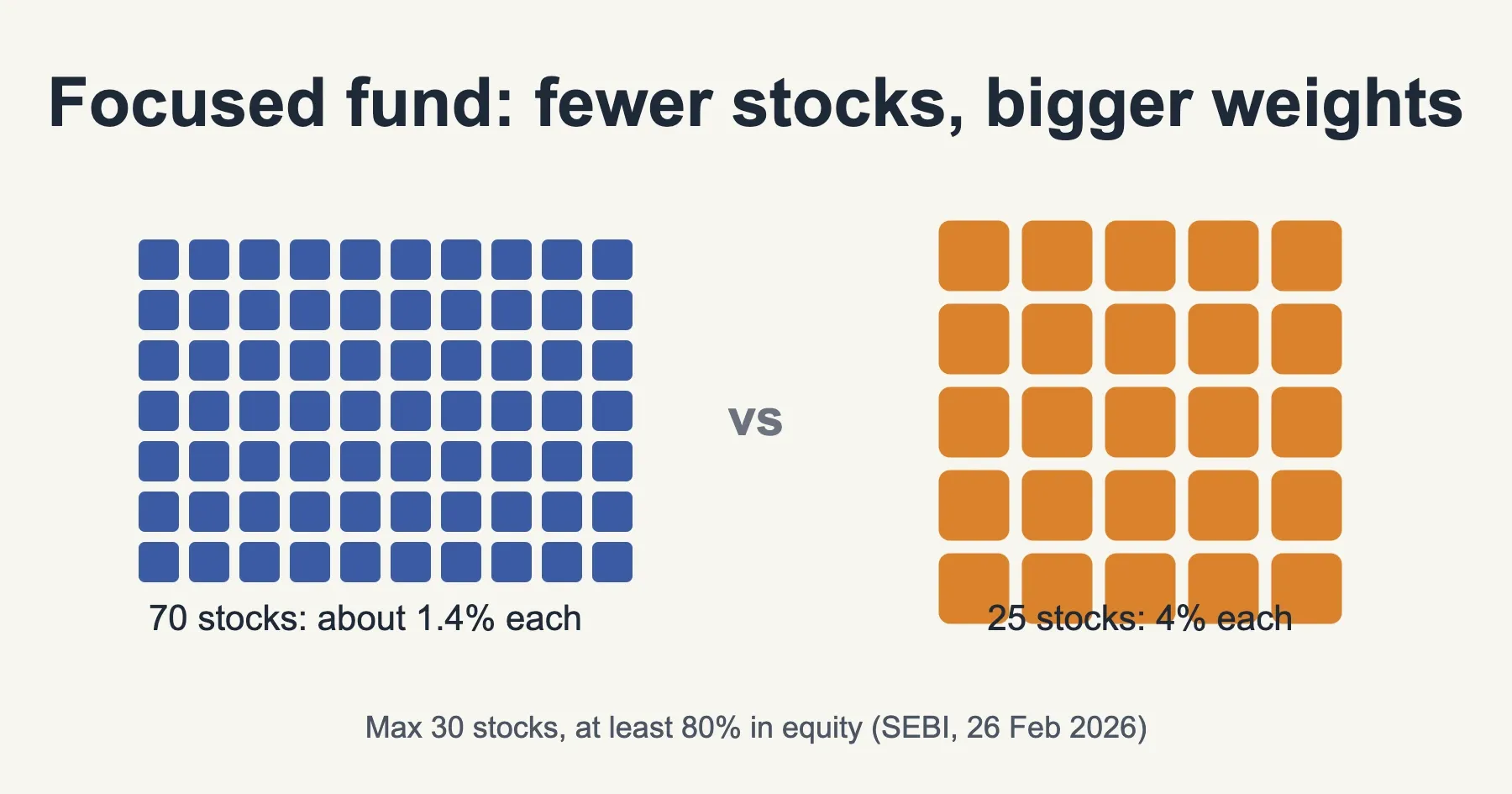
As of 22 November 2026, a focused fund is a SEBI equity mutual fund category that can hold a maximum of 30 stocks and must keep at least 80% of its total assets in equity and equity related instruments, under SEBI's 26 February 2026 categorisation circular. The scheme must also state where it intends to focus: multi cap, large cap, mid cap or small cap. Because there are fewer stocks, each one carries more weight, and that concentration is the category's defining feature. It cuts both ways.
Raghav, 31, in Pune, runs one flexi cap SIP and saw "Focused Fund" in a category list. His question was simple: what does "focused" actually change? This page answers with the rule and with numbers, not with a view on which category does better.
What SEBI's rule says
Dated rule box (verified 22 November 2026)
- Current rule: SEBI circular No. HO/24/13/15(2)2026-IMD-RAC4/I/5764/2026, "Categorization and Rationalization of Mutual Fund Schemes", dated 26 February 2026. It came into force on that date.
- Focused fund characteristics: "A scheme focused on the number of stocks (maximum 30)", with "Minimum investment in equity & equity related instruments - 80% of total assets".
- Type of scheme: "An open ended equity scheme investing in maximum 30 stocks", and the scheme must mention "where the scheme intends to focus, viz., multi cap, large cap, mid cap, small cap".
- What changed: under SEBI's 6 October 2017 circular, the focused fund minimum was 65% of total assets. The 30-stock maximum is the same in both.
- Timeline: existing schemes had six months from 26 February 2026 to comply with the circular.
- Name: the scheme name has to be the same as the scheme category.
So the label "focused fund" tells you two hard limits (30 stocks at most, 80% minimum in equity) and one disclosure (its market-cap focus). It does not tell you which stocks, which sectors or how the weights are spread. For how this category fits among the others, see the full category map in mutual fund categories explained.
Why 30 stocks matters: the concentration maths
Here is a hypothetical. You invest ₹1,00,000. The portfolio is fully in stocks, nothing else moves, and one stock falls 40%. How much does your investment fall?
| Portfolio (hypothetical) | Weight of that stock | NAV impact | ₹ impact on ₹1,00,000 |
|---|---|---|---|
| 70 stocks, equal weight | 1.43% | -0.57% | -₹571 |
| 30 stocks, equal weight | 3.33% | -1.33% | -₹1,333 |
| 25 stocks, equal weight | 4.00% | -1.60% | -₹1,600 |
| Focused portfolio with one stock at 10% | 10.00% | -4.00% | -₹4,000 |
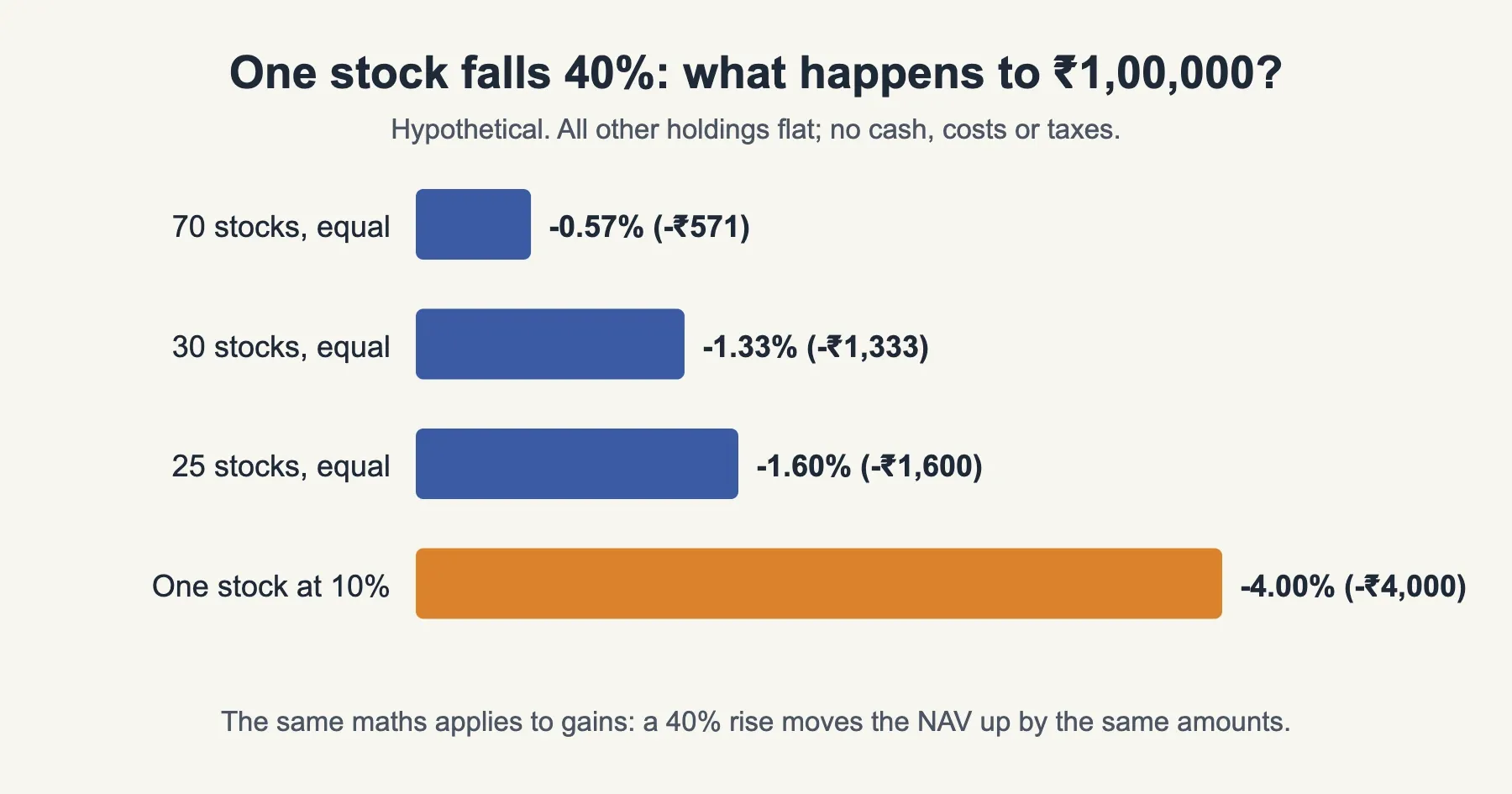
The same 40% fall costs about ₹571 in an equal-weight 70-stock portfolio and ₹1,600 in an equal-weight 25-stock one. Real funds rarely hold equal weights, so the last row matters most: a single holding at 10% of the portfolio turns a 40% fall in that stock into a 4% fall in your NAV, or ₹4,000. The 10% weight is an assumption for the example; it is not a statement of SEBI's single-stock limit, which you can check in the scheme documents.
Now look at the top of the portfolio. Suppose the five largest holdings are 8% each, 40% combined, and all five fall 20%. Those five alone pull the NAV down 8%, which is ₹8,000 on ₹1,00,000.
The mirror line: the same maths works for gains. If those five holdings rise 20%, they add 8% (₹8,000). If one stock in an equal-weight 30-stock portfolio rises 40%, it adds about ₹1,333. Concentration widens the range of outcomes in both directions. It does not make the good outcome more likely.
Focused fund vs flexi cap vs large cap: a rules table
This compares the rules in the 26 February 2026 circular, not returns.
| Rule | Focused fund | Flexi cap fund | Large cap fund |
|---|---|---|---|
| Maximum number of stocks | 30 | No stock limit in the category definition | No stock limit in the category definition |
| Minimum in equity & equity related instruments | 80% of total assets | 65% of total assets | 80% of total assets, in large cap companies |
| Market-cap rule | Must state its focus: multi, large, mid or small cap | Dynamic: invests across large, mid and small cap | Predominantly large cap |
| Portfolio overlap cap | None named in the circular's overlap paragraphs | None named | Not covered by the thematic overlap limit |
Source: SEBI circular of 26 February 2026, para 2.6.3. Its 50% overlap limits apply to a Value and Contra pair and to sectoral/thematic schemes versus other equity schemes.
The useful contrast with flexi cap is that both can move across market caps, but only a focused fund is capped at 30 stocks. A focused fund that states a "multi cap" focus and a flexi cap fund can look similar on market caps and still be very different on concentration. For the flexi cap rules in detail, read flexi cap vs multi cap fund.
For scale: at the end of October 2026, AMFI's monthly note shows focused funds with AUM of ₹1,80,369 crore, against ₹5,91,364 crore for flexi cap and ₹3,93,541 crore for large cap funds.
What concentration means for you, and what it doesn't
What it means:
- Bigger swings in both directions. As the table shows, each holding moves the NAV more.
- More depends on the fund manager's picks. With 30 stocks or fewer, a few decisions shape a large part of the result.
- One sector can dominate. Nothing in the category rule spreads the 30 stocks across sectors, so a few related businesses can make up a big share.
What it doesn't mean:
- It does not automatically put a fund in a higher riskometer level. The riskometer is assessed for each scheme's own portfolio, so a focused fund's level can differ from another focused fund's. Check the level shown for the scheme.
- It does not mean the fund holds exactly 30 stocks. Thirty is the maximum; the actual count is in the factsheet.
- It does not say anything about future returns.
How to read a focused fund's factsheet
Four things to look at, in this order:
- Number of holdings. It should be 30 or fewer. Compare it with any fund you already hold.
- Top-10 weight. Add the weights of the ten largest holdings. The higher this is, the more the NAV depends on those ten.
- Sector weights. See whether one or two sectors make up a large share of the portfolio.
- Riskometer. Note the level shown for this scheme, and look for changes over time.
Our walkthrough on how to read a mutual fund factsheet shows where each of these sits, and mutual fund riskometer levels explains the six levels.
Where a focused fund can sit in a beginner's plan
This is not a recommendation for or against the category. These are questions Raghav could ask himself before he adds one:
- Overlap: do the focused fund's top holdings already appear in his flexi cap fund? If they do, he may be adding weight to the same companies rather than adding something new; see portfolio overlap.
- Time horizon: is the money for a goal several years away, so that larger swings have time to play out?
- Comfort with volatility: if a 4% or 8% drop came from a handful of stocks, as in the example, would he keep his SIP running?
- Role in the portfolio: is this his only equity fund, or an addition to a diversified one?
If any answer is unclear, that is a reason to read the scheme information document before deciding.
Frequently asked questions
What is a focused fund in mutual funds?
It is a SEBI equity category that can hold a maximum of 30 stocks and must keep at least 80% of total assets in equity and equity related instruments, as per SEBI's 26 February 2026 circular. It must also state its market-cap focus.
Focused fund vs flexi cap: what is the difference?
A focused fund is capped at 30 stocks with an 80% equity minimum. A flexi cap fund has no stock limit in its category definition, a 65% equity minimum, and invests dynamically across large, mid and small cap stocks.
Are focused funds riskier?
Concentration makes each holding move the NAV more, in both directions: a 40% fall in one stock at 10% weight cuts the NAV by 4% in the hypothetical. Whether a given scheme is riskier is shown by its own riskometer and factsheet, not by the category name.
Can a focused fund hold more than 30 stocks?
No. SEBI's category definition sets a maximum of 30 stocks. The factsheet shows the actual number of holdings, which can be lower.
Should a beginner start with a focused fund?
That depends on overlap with funds you already hold, your time horizon and your comfort with bigger swings. Work through those questions and the category map first; this page does not recommend any category.
Save this checklist
Save the four factsheet checks and the four questions above for the next time a category list shows "Focused Fund".



