Mutual Fund Portfolio Overlap: How to Check It With Two Factsheets, and When It Actually Matters
Check mutual fund portfolio overlap with two factsheets: add the smaller weight of each common stock. Worked example, checklist and next steps.
Summarize this article with AI





The short version
- Measure overlap by shared weight: add the smaller weight of each common stock.
- A count of common names can understate overlap; check weights.
- Funds in the same category, or tracking the same top-100 universe, overlap by design.
- There is no regulatory "safe" overlap percentage for investors; ask whether each fund has a different job.
- Before consolidating, check exit load and tax; redirecting new SIPs changes future money only.
As of 22 November 2026: mutual fund portfolio overlap is the share of one fund's portfolio that is invested in the same companies as another fund's. Measure it by shared weight, not just shared names: for every company both funds hold, take the smaller of the two weights and add them up. There is no SEBI rule that tells an investor what level of overlap is "too much"; it is a judgement about whether two funds are doing two different jobs.
Ira, 29, in Pune, runs two ₹4,000 SIPs: one in a large cap fund and one in a flexi cap fund. A colleague says the two "own the same stocks". Is she diversified, or has she made one decision twice? Here is how to check by hand, and what to do with the answer.
What portfolio overlap means: common stocks vs common weight
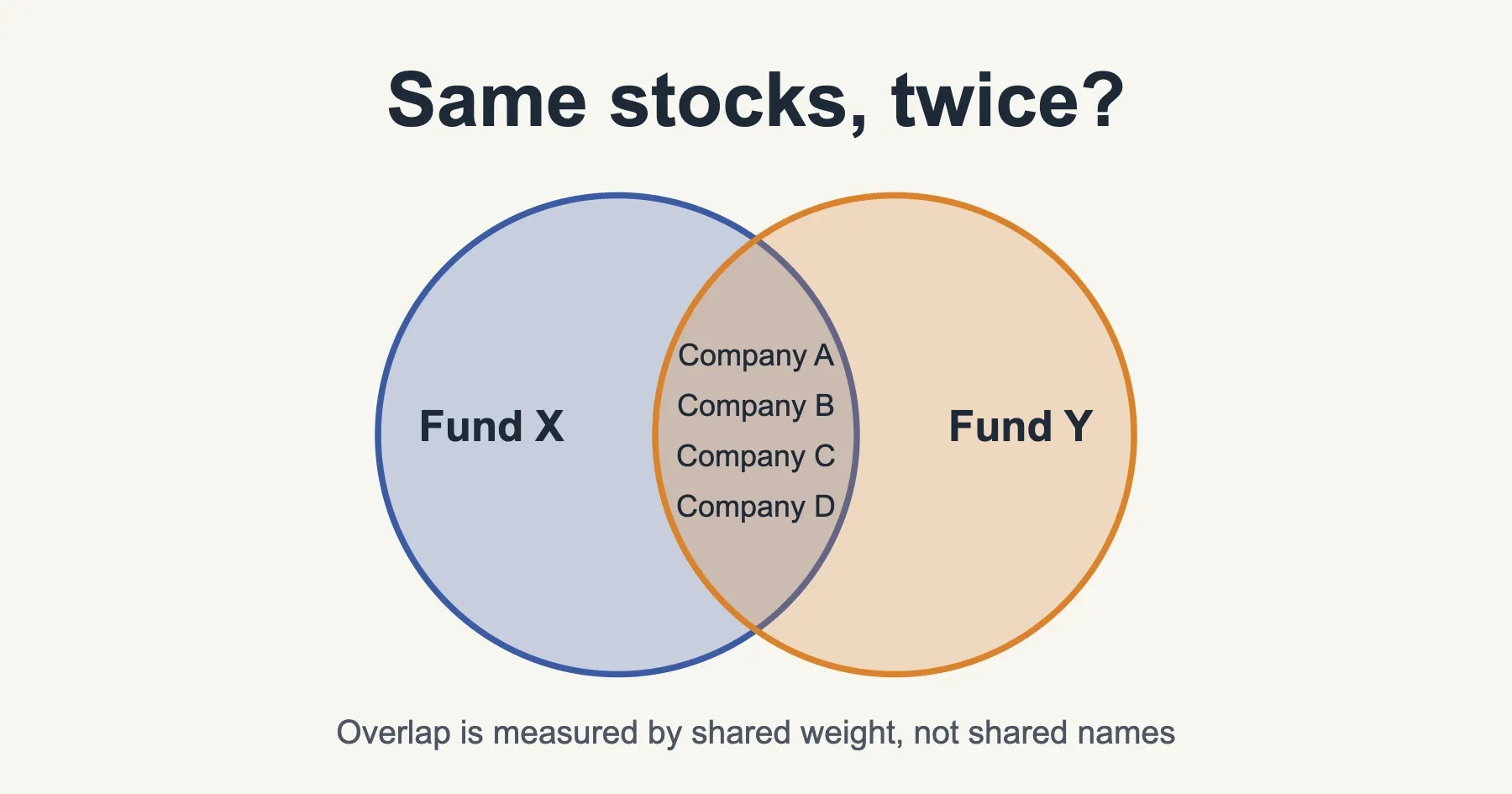
- Common stocks (names): how many companies appear in both portfolios. If two funds each hold 50 stocks and 4 are common, that is 8% of the names.
- Common weight: how much of each portfolio sits in those common companies. If those 4 companies make up a large slice of both funds, the weight overlap can be far higher than 8%.
Weight is what moves your money: a company that is 12% of one fund and 10% of another matters far more than one that is 0.5% of each. Overlap is also about holdings, not labels; funds in different categories can still share many companies. See mutual fund categories for what each label allows.
Where to find each fund's holdings
You need the list of stocks and their weights (percentage of net assets) for both funds, for the same month.
- Monthly portfolio disclosure. SEBI requires fund houses to disclose each scheme's portfolio every month, within 10 calendar days of the month end, and half-yearly portfolios within 10 calendar days too (debt schemes also disclose fortnightly). SEBI's investor charter lists timely disclosure of each scheme's portfolio on the mutual fund website as an investor right. This is the complete list of holdings and their percentage of net assets.
- Factsheet. Most factsheets show top holdings, a quick first check that covers only part of the portfolio. See how to read a mutual fund factsheet.
Calculate it by hand: the "smaller weight" method
Here is a hypothetical example. Fund X and Fund Y are two equity funds. To keep it readable, the table shows six companies, A to F; assume every other holding in each fund is different.
| Company | Weight in Fund X | Weight in Fund Y | Held by both? | Smaller weight |
|---|---|---|---|---|
| Company A | 9% | 7% | Yes | 7% |
| Company B | 8% | 10% | Yes | 8% |
| Company C | 6% | 9% | Yes | 6% |
| Company D | 12% | 10% | Yes | 10% |
| Company E | 7% | 0% | No | 0% |
| Company F | 0% | 6% | No | 0% |
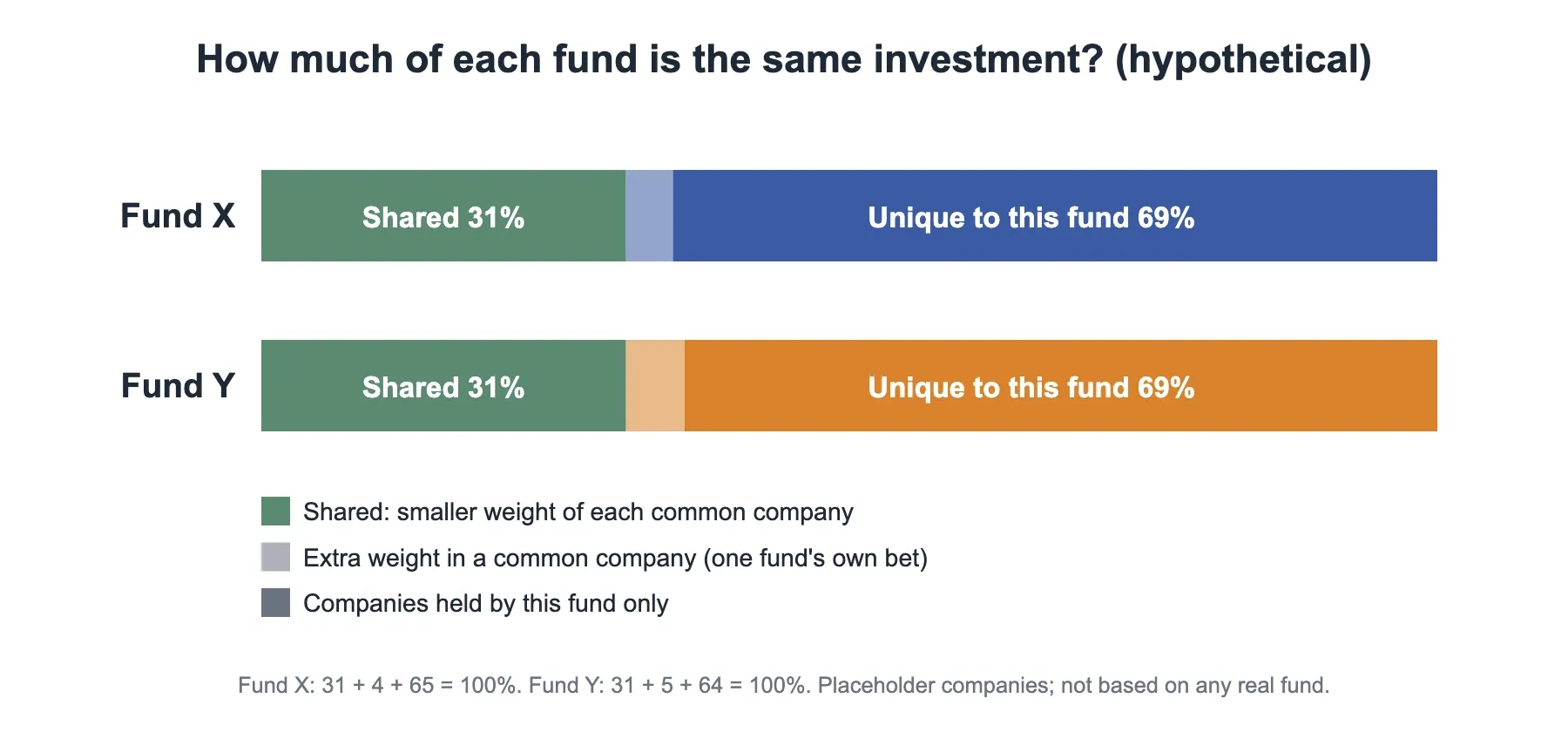
| Total overlap | 4 companies | 31% |
Step 1. List every company that appears in both funds. Here: A, B, C and D.
Step 2. For each, write the smaller weight. Company D is 12% of Fund X and 10% of Fund Y, so write 10%: that is the shared part; Fund X's extra 2% is its own bet.
Step 3. Add the smaller weights: 7 + 8 + 6 + 10 = 31%. Companies E and F add nothing, because each is held by only one fund.
So the funds have a 31% weight overlap: about 31% of each portfolio is, in effect, the same investment.
What this means for Ira's two ₹4,000 SIPs (hypothetical)
Applying these weights, ignoring costs and price changes:
- From Fund X, 35% of each ₹4,000 instalment (₹1,400) goes to companies A to D.
- From Fund Y, 36% (₹1,440) goes to the same four companies.
- Together, ₹2,840 of her ₹8,000 a month, or 35.5%, lands in four companies.
- Company D alone gets about ₹880 a month across both funds, more than any single company gets from either fund on its own.
By name count, 4 of 50 stocks looks like 8%; by weight, it is 31%. All figures hypothetical; placeholder companies; not based on any real fund. Online overlap tools do the same arithmetic; doing it once by hand helps you check which month's data a tool used.
Why some overlap is unavoidable
Same size universe. SEBI's categorisation framework (first set out in its 6 October 2017 circular) defines large cap companies as the 1st to 100th company by full market capitalisation, and requires a large cap fund to invest at least 80% of total assets in large cap equity. Two large cap funds choose mainly from the same 100 companies, so overlap is expected.
Index fund vs large cap fund. An index fund tracking a large-company index such as the Nifty 50 holds companies that are among the biggest listed businesses, which is the same pool a large cap fund must mostly draw from. Expect visible overlap between the two. See how index funds work.
Flexi cap and multi cap funds. These can buy across sizes, and many hold large companies for a big part of the portfolio, so they often overlap with large cap or index funds too. See flexi cap vs multi cap fund.
SEBI itself treats overlap as a design question for fund houses. Its categorisation circular of 26 February 2026 sets portfolio overlap limits for sectoral and thematic schemes against a fund house's other equity schemes, and gives existing schemes three years to comply. That rule is about how an AMC designs its range. It is not a threshold for your personal portfolio.
When overlap is a problem, and when it isn't: a checklist
There is no "safe" percentage. Use these questions instead:
- Do the two funds have different jobs? A large cap and a mid cap fund can be a deliberate pair even with some overlap. Two funds bought for the same reason with high overlap are often one decision made twice.
- Is the overlap in the biggest weights? Overlap concentrated in the top holdings matters more than overlap in small positions.
- What is your combined exposure to one company? Add up your rupees in it across funds, as with Company D.
- Are you paying twice for similar exposure? If an active fund and an index fund hold similar companies, compare their costs. See the expense ratio guide.
- Is the data from the same month? Portfolios change; compare like with like.
If the answers point to "different jobs, small shared weight", overlap may be fine. More funds is not the same as more diversification; see how many mutual funds a beginner should have.
What to do: redirect, consolidate, or leave it
Three broad options; which suits you depends on your situation. This is not a recommendation.
- Leave it. If the funds serve different purposes and shared weight is modest, no change may be needed.
- Redirect new SIPs. Stop or reduce one overlapping SIP and send that amount elsewhere. Existing units stay invested; nothing is redeemed.
- Consolidate existing units. Sell units of one fund and invest in another. Before you do, check two costs:
- Exit load: many equity schemes charge one on redemption within a set period, stated in the scheme documents. See exit load in mutual funds.
- Tax: redeeming units, including a "switch" between schemes, is a sale, so capital gains tax can apply (for equity-oriented funds, sections 196 and 198 of the Income-tax Act, 2025) depending on fund type and how long each instalment was held. See our mutual fund tax guide.
Redirecting new SIPs is often the lower-friction first step, because it triggers no exit load or tax on past instalments.
Frequently asked questions
How do I check overlap between two mutual funds?
Download both funds' monthly portfolios for the same month, list the companies both hold, take the smaller weight of each and add them. In our hypothetical example, that gives 31%.
What percentage of overlap is too much?
There is no SEBI threshold for investors. What matters is whether the funds do different jobs, whether overlap sits in the biggest holdings, and your rupees in any single company.
Does an index fund overlap with a large cap fund?
Usually, yes. A large cap fund must invest at least 80% in the top 100 companies by full market capitalisation, and a large-company index fund holds companies from the same group, so overlap is expected.
Should I sell a fund because of overlap?
Not automatically. Redirecting new SIPs sells nothing. Selling units can involve exit load and capital gains tax, so check both; a SEBI-registered investment adviser can help.
Is holding more funds the same as diversification?
No. Different funds can hold the same companies. Diversification depends on what the funds hold and in what weights, not how many you own.
Save this checklist
Rerun the two-factsheet check each time you add a fund.



