Can a homemaker start an SIP in her own name? Yes, and where the money comes from decides the tax
Yes: a housewife or homemaker needs PAN, KYC and her own bank account, not income proof. See whose income the gain is if a spouse or parent gifts it.
Summarize this article with AI





The short version
- A homemaker can start an SIP in her own name with her own PAN, completed KYC and a bank account where she is a holder. No income proof is needed.
- Pay from your own account. Your spouse paying directly from their account into your folio is generally treated as a third-party payment.
- Money gifted by a spouse: the gain is generally clubbed with the spouse's income (section 99, Income-tax Act, 2025).
- Your own savings, or a gift from your parents: the gain is your income.
- Keep records of each source, and check your situation with a tax professional.
Yes. A homemaker can start an SIP in her own name with her own PAN, completed KYC and a bank account in her name. No salary slip or income proof is needed. Tax depends on where the money came from: gains on money gifted by a spouse are generally added to the spouse's income under the clubbing rule, not hers.
Anjali, 34, runs the household in Nanded and has never had a salaried job. She wants an SIP of her own, and two questions stop her: will a fund house accept her without an income, and if her husband transfers the money, whose tax return does the gain land in? This guide answers both, with the rules as of 17 November 2026.
Can a homemaker with no income start an SIP in her own name?
Yes. Mutual funds don't ask whether you earn a salary. Any resident individual who completes KYC and pays from a bank account in her own name can open a folio and start an SIP. The folio, the units and the redemption money all belong to the person named as the investor.
What a homemaker does not need:
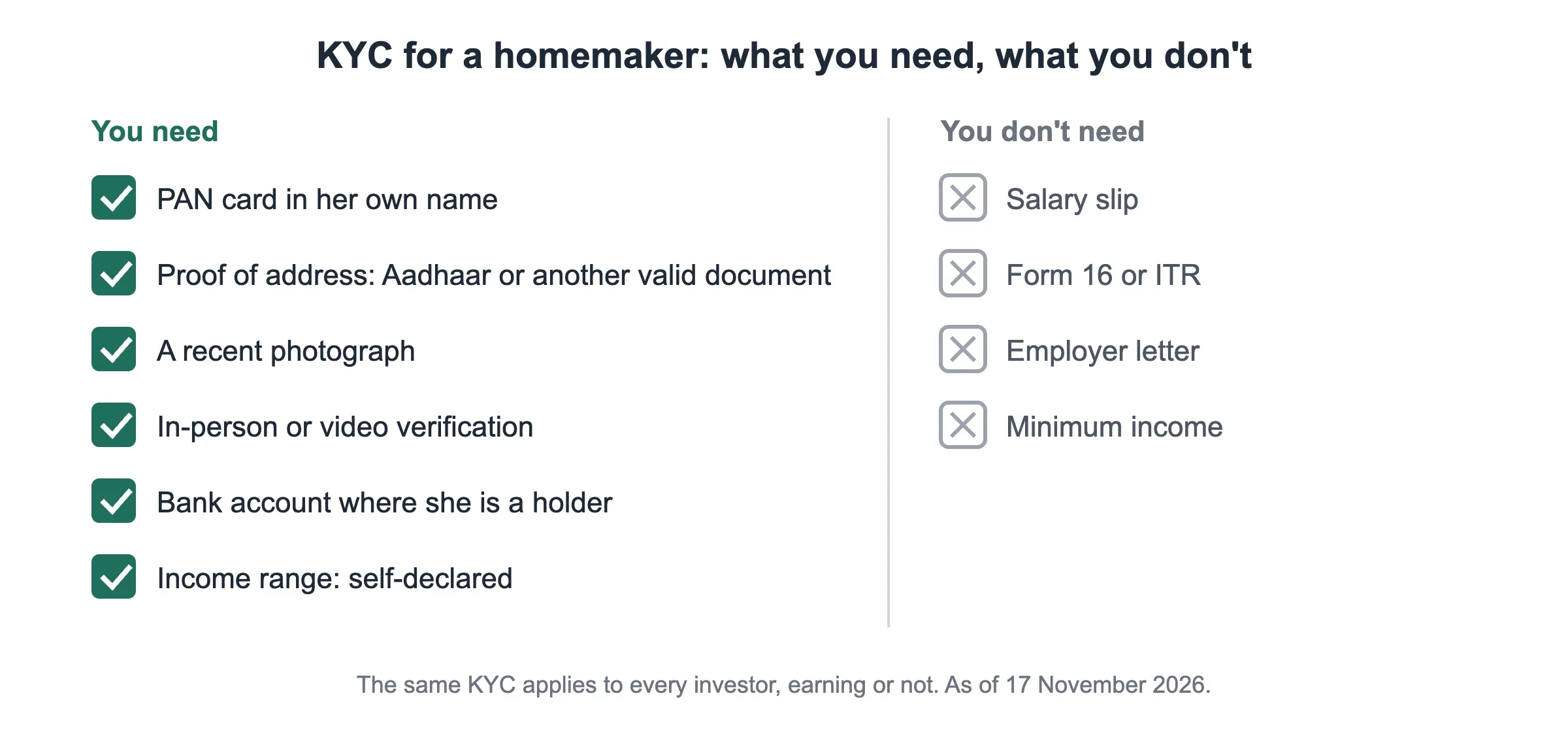
- A salary slip, Form 16 or ITR
- An employer letter or business proof
- A minimum income
What she does need is covered in the next two sections. If you are starting out, the step-by-step walkthrough in how to start an SIP, step by step shows the full sequence from KYC check to first debit.
Do I need my own PAN and bank account?
Yes to both.
PAN in your own name. KYC for mutual funds is linked to PAN, so the investor's own PAN is the anchor. A spouse's PAN can't stand in for yours.
A bank account where you are a holder. The SIP mandate and every payment should come from an account in your name, alone or held jointly with you. Fund houses generally do not accept payments from someone else's account for your folio. These are called third-party payments, and the exceptions are narrow (for example, a parent paying for a minor child's folio, or an employer paying through payroll). Your spouse paying straight from their own account into your folio is not one of them.
So if your spouse is giving you the money, the clean route is: they transfer it to your account, and your SIP is debited from there. That transfer is also what the tax rule below looks at.
What KYC documents does a homemaker need without salary slips?
The KYC documents are the same for everyone, earning or not:
- PAN card
- Proof of address: Aadhaar or another officially valid document, such as a passport, voter ID or driving licence
- A recent photograph
- Verification: in person or by video, depending on the route you use
The KYC form asks for an income range. This is self-declared, and choosing the lowest band is fine; no proof is attached. Once your KYC is registered with a KYC registration agency (KRA), any fund house can use it. To check where you stand, see mutual fund KYC online.
If my spouse gives me money for the SIP, is the return taxed in my name or theirs?
Usually theirs. This is the clubbing rule. Under section 99(1)(a)(ii) of the Income-tax Act, 2025 (the successor to section 64(1)(iv) of the 1961 Act), income from assets an individual transfers to their spouse "otherwise than for adequate consideration" is added to the income of the person who gave them. The rule is the same whichever spouse gives the money.
The gift itself is not taxed in your hands, because a spouse counts as a relative for gift-tax purposes. What moves across is the tax on what the gift earns.
A worked example in ₹ (hypothetical)
Anjali's husband transfers ₹4,600 a month to her account, and her SIP of ₹4,600 is debited from it. That is ₹55,200 a year.
After 24 instalments, she has put in ₹1,10,400. Assume she then redeems everything for ₹1,19,600, a gain of ₹9,200. That gain matches an assumed return of about 7.9% a year on the instalments. This is hypothetical, not a promise; returns vary.
- Funded by her husband's gift: the ₹9,200 gain is added to her husband's income under section 99, not hers.
- Funded from her own savings (for example, money she earned before or from her own work; savings built from household money a spouse gave may be treated differently, so check with a tax professional): the ₹9,200 is her income.
- Funded by a gift from her parents: the gift is exempt, and the ₹9,200 is her income. The clubbing rule for spouses doesn't apply to parents.
Each line describes tax on redemption, the event that creates the gain. How the gain itself is taxed depends on the fund type and holding period; how mutual funds are taxed in India explains that part. All of this is as of FY 2026-27, under the Income-tax Act, 2025, and is not tax advice.
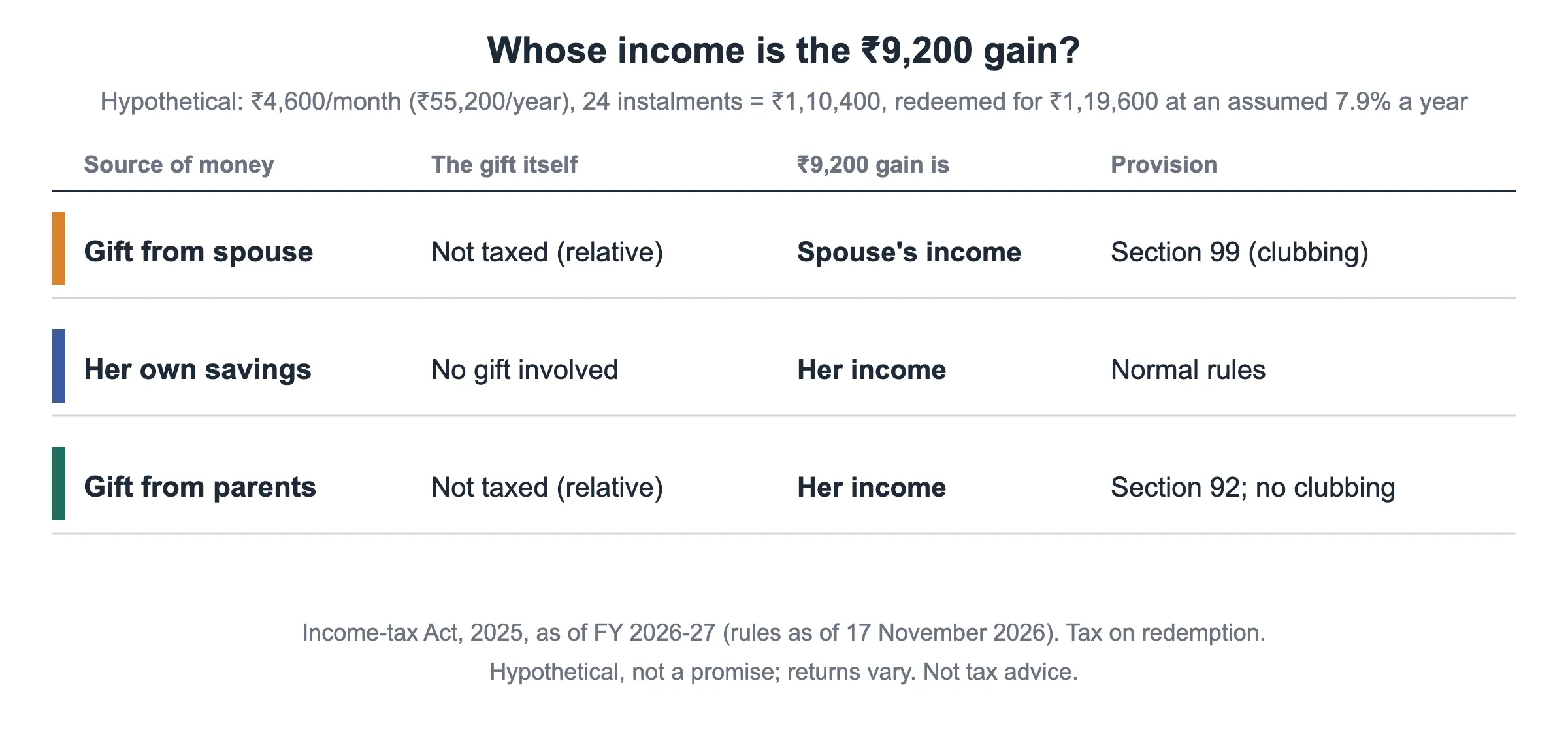
| Where the SIP money came from | The gift itself | Whose income the ₹9,200 gain is | Provision (Income-tax Act, 2025) |
|---|---|---|---|
| Gift from spouse | Not taxed (spouse is a relative) | Spouse's | Section 99 (clubbing) |
| Her own savings | No gift involved | Hers | Normal rules |
| Gift from her parents | Not taxed (parents are relatives) | Hers | Section 92 (gifts); no clubbing |
Can I invest money gifted by my parents, and is that taxed?
Yes, you can invest it, and the gift is generally not taxed. Money received without consideration is taxable above ₹50,000 in a year, but gifts from relatives are exempt, and parents fall within the definition of relative. Under the 2025 Act this sits in section 92, the successor to section 56(2)(x) of the 1961 Act.
Once invested in your name, the gains are your income. There is one family exception to know: a separate clubbing rule covers assets transferred by a person to their son's wife without adequate consideration, so money from parents-in-law can be treated differently from money from your own parents. If that applies to you, ask a tax professional before investing.
Keep a simple record of where the money came from
Because the source decides the tax, keep a note of each source: a bank statement line showing the transfer, and a one-line record of whether it was a gift from a spouse, a parent, or your own savings. If you mix sources in one SIP, the income may need to be split in proportion, which is easier with records.
Frequently asked questions
Can I add my spouse as a nominee?
Yes. A nominee is the person who receives your units if something happens to you, and a spouse can be one. The steps are in how to add a nominee to your folio.
Does the clubbed gain affect my spouse's ITR?
Yes. If the gain is clubbed, it is reported in your spouse's return as part of their income. Whether you need to file a return of your own depends on your own income.
Can I start with ₹250?
Some fund houses offer SIPs of ₹250 under SEBI's small-ticket SIP framework, with conditions. See who can start a ₹250 Chhoti SIP for who qualifies.
Should I open a joint folio or invest in my own name?
In a joint folio, the first holder is the investor for tax purposes, and the folio's mode of holding decides who can transact. If the aim is an investment that is clearly yours, a folio in your own name, with a nominee, is the simpler structure.
Is income earned on clubbed income also clubbed?
Generally, the clubbing rule covers the income from the transferred asset. Courts have held that income earned later by reinvesting that already clubbed income is not clubbed again, but the facts matter. A tax professional can confirm how it applies to your folio.
Read next
Check your KYC status first: mutual fund KYC online. If you are helping a student in the family too, see whether students can start an SIP.
— Laabh



