What a student needs to start an SIP before and after 18
Students aged 18+ can start an SIP with their own PAN, bank account and KYC. Under 18, a guardian runs a minor folio. Rules as of 13 Nov 2026.
Summarize this article with AI





The short version
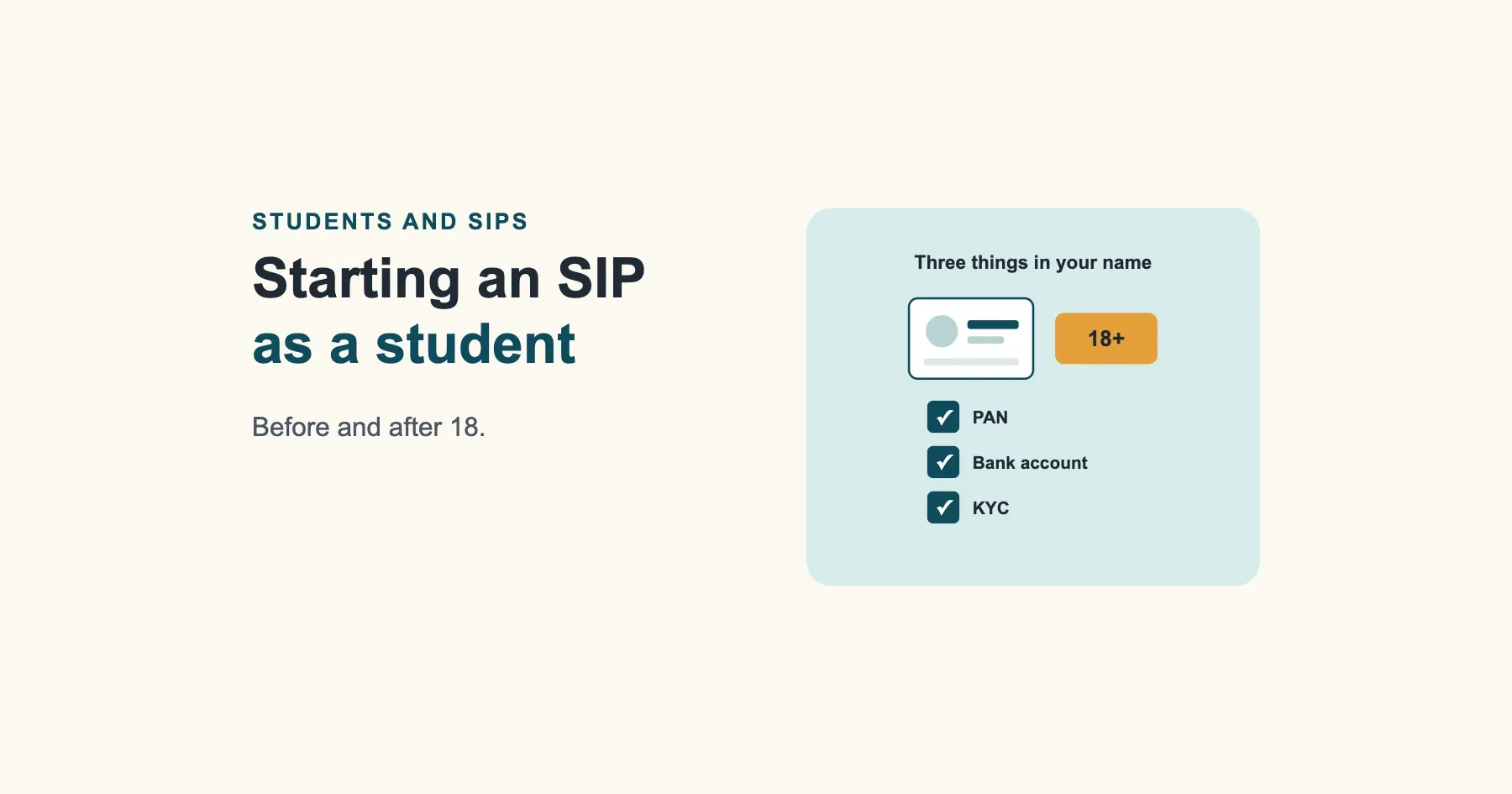
- Age and paperwork decide eligibility: PAN, bank account and KYC in your own name once you are 18.
- Under 18, investments go into a minor folio run by a parent or legal guardian.
- At 18, a minor folio needs a change of status, and SIPs in it are suspended until that is done.
- After 18, paying from a parent's account is generally treated as a third-party payment.
- Minimum SIP amounts are set scheme by scheme; the SID is where to check.
Yes, a student aged 18 or over can start an SIP with their own PAN, their own bank account and completed KYC. Under 18, the investment is made through a minor folio with a parent or guardian, and the folio's status changes when the student turns 18. Minimum amounts depend on the scheme.
Rules as of 13 November 2026, from SEBI circulars and fund-house documents.
Ananya is 19, in her second year of college in Indore, and earns a few thousand rupees a month from weekend tutoring. She wants to put ₹500 a month into a mutual fund SIP. Nobody will ask whether she is a student. What gets checked is whose name is on the PAN, the bank account and the KYC record.
Can students start an SIP in India?
They can. Mutual fund rules have no "student" category. They look at your age, and at whether the paperwork is in your own name.
- 18 or over: you invest as an adult. You sign, you pay from your own bank account, and the units are yours.
- Under 18: you are a minor in law. A parent or court-appointed legal guardian runs the folio on your behalf.
Pocket money, a stipend, internship pay or a birthday gift can all fund an SIP, as long as the payment comes from an account the rules accept.
The three things that must be in your own name
- PAN. SEBI made PAN the identification number for all securities market transactions, mutual funds included, from 2 July 2007 (circular MRD/DoP/Cir-05/2007). Fund houses ask every investor, and every joint holder, to have a PAN on the folio unless they fall in a specific exempt category.
- A bank account in your name. SIP instalments are debited from it, and redemption money is paid to a registered account in your name. A savings account you hold yourself, or a joint account where you are one of the holders, is the usual starting point.
- Completed KYC. KYC (Know Your Customer) is an identity and address check, recorded with a KYC Registration Agency (KRA) under SEBI's KYC master circular of 12 October 2023. Once complete, the record can be used across fund houses.
If your KYC shows "on hold", our guide to mutual fund KYC on hold explains what each status means and how it is usually fixed.
Can I start an SIP without a PAN card or with my parents' bank account?
Without a PAN: for most students, no. Fund-house documents describe a narrow PAN-exempt category (PEKRN) for small investments, including SIPs, of up to ₹50,000 per investor per year per mutual fund. Investors in it still complete KYC and give an alternate proof of identity. Check with the fund house whether you qualify. Getting a PAN is usually simpler, and you will need one for much else.
With a parent's bank account: it depends on your age.
- If you are 18 or over, payment from a parent's account is generally a "third-party payment": money from a bank account that isn't the investor's own. Fund houses generally don't accept these, and the exceptions they list are narrow, such as a parent paying on behalf of a minor. A joint account works only if you are one of its holders.
- If you are under 18, since 15 June 2023 SEBI allows payment for a minor's investment from the minor's own account, the parent's or legal guardian's account, or a joint account of the minor with the parent or guardian (circular SEBI/HO/IMD/POD-II/CIR/P/2023/0069, 12 May 2023). Redemption money still goes to the minor's own verified bank account.
For an 18-year-old, the cleanest setup is your own savings account. A parent who wants to help can transfer money into it, and the SIP is debited from there.
Can a 17-year-old invest in mutual funds?
Yes, through a minor folio held in the minor's name. A parent or court-appointed legal guardian signs and operates it, and the guardian's KYC is needed. If the minor has no PAN yet, fund-house documents ask for the parent's or guardian's PAN.
The full set-up is covered in our guide to starting an SIP in a child's name. For a 17-year-old, the practical point is timing: an SIP started now in a minor folio will need a status change within months.
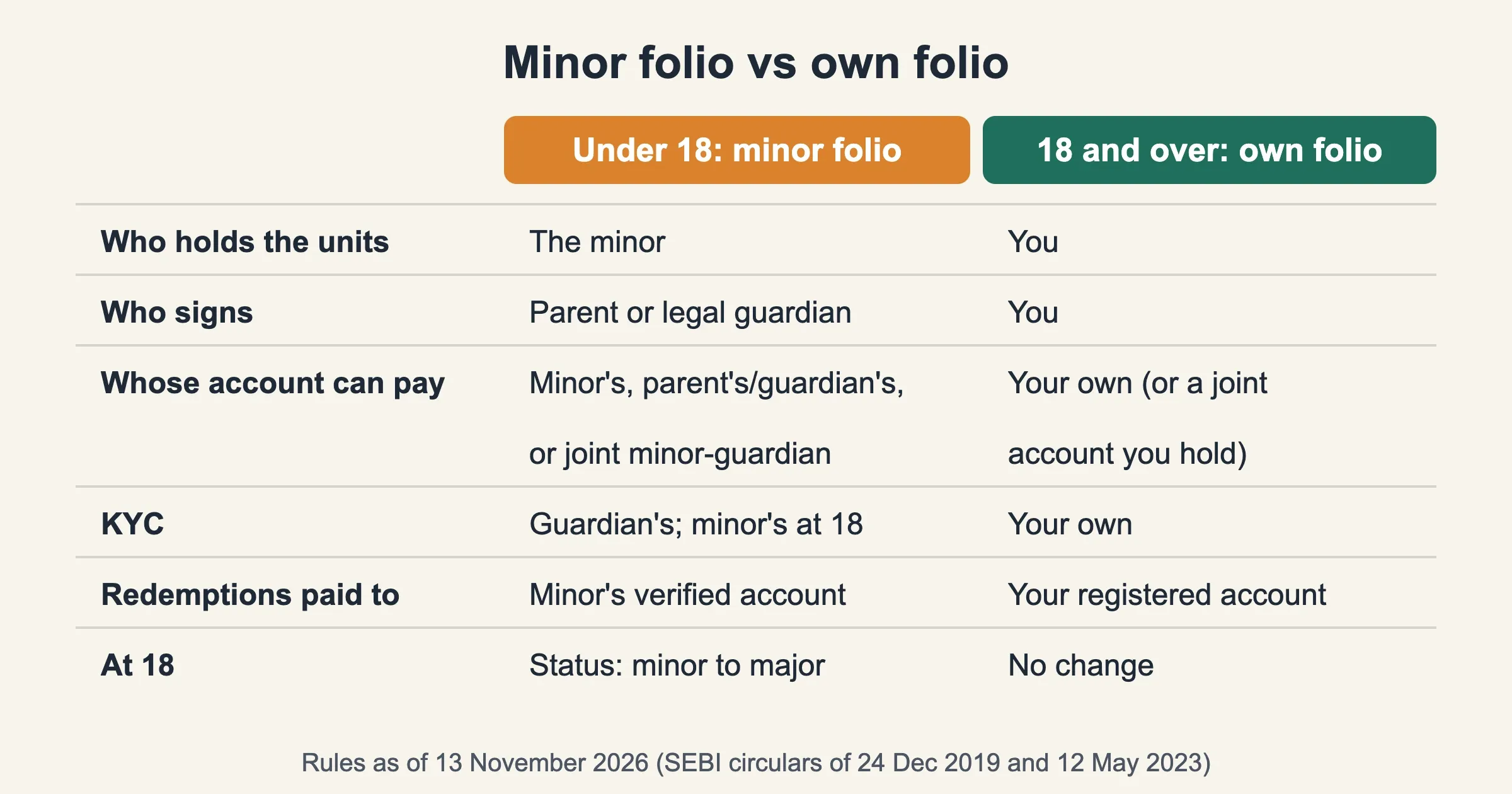
| Under 18: minor folio | 18 and over: own folio | |
|---|---|---|
| Who holds the units | The minor | You |
| Who signs and operates | Parent or legal guardian | You |
| Whose account can pay | Minor's, parent's or guardian's, or a joint minor-guardian account | Your own (or a joint account you hold) |
| KYC | Guardian's KYC; the minor completes KYC at 18 | Your own KYC |
| Redemptions paid to | The minor's verified bank account | Your registered bank account |
| At 18 | Status changes from minor to major | No change |
What happens to a minor's folio at 18?
Under SEBI's circular of 24 December 2019 (SEBI/HO/IMD/DF3/CIR/P/2019/166), when the minor turns 18:
- The new adult gives their own KYC details and updated bank details, including a cancelled cheque of the new account.
- No further transactions are allowed until the folio's status is changed from minor to major.
- Any SIP, STP or SWP registered in the folio is suspended from the date of majority until that change is done.
So a running SIP can pause at 18 until the paperwork catches up. If you were invested as a child, check the folio a few months before your birthday and keep your own PAN, bank account and KYC ready.
What is the minimum amount a student can start an SIP with?
No single national minimum applies. Each scheme sets its own minimum SIP amount in its Scheme Information Document (SID) and Key Information Memorandum (KIM). For the smallest SIPs discussed in India, read our explainer on the ₹250 chhoti SIP.
Take Ananya's ₹500 a month, where a scheme's SID allows that amount. After 3 months she has put in ₹1,500, after 6 months ₹3,000, and after 12 months ₹6,000.
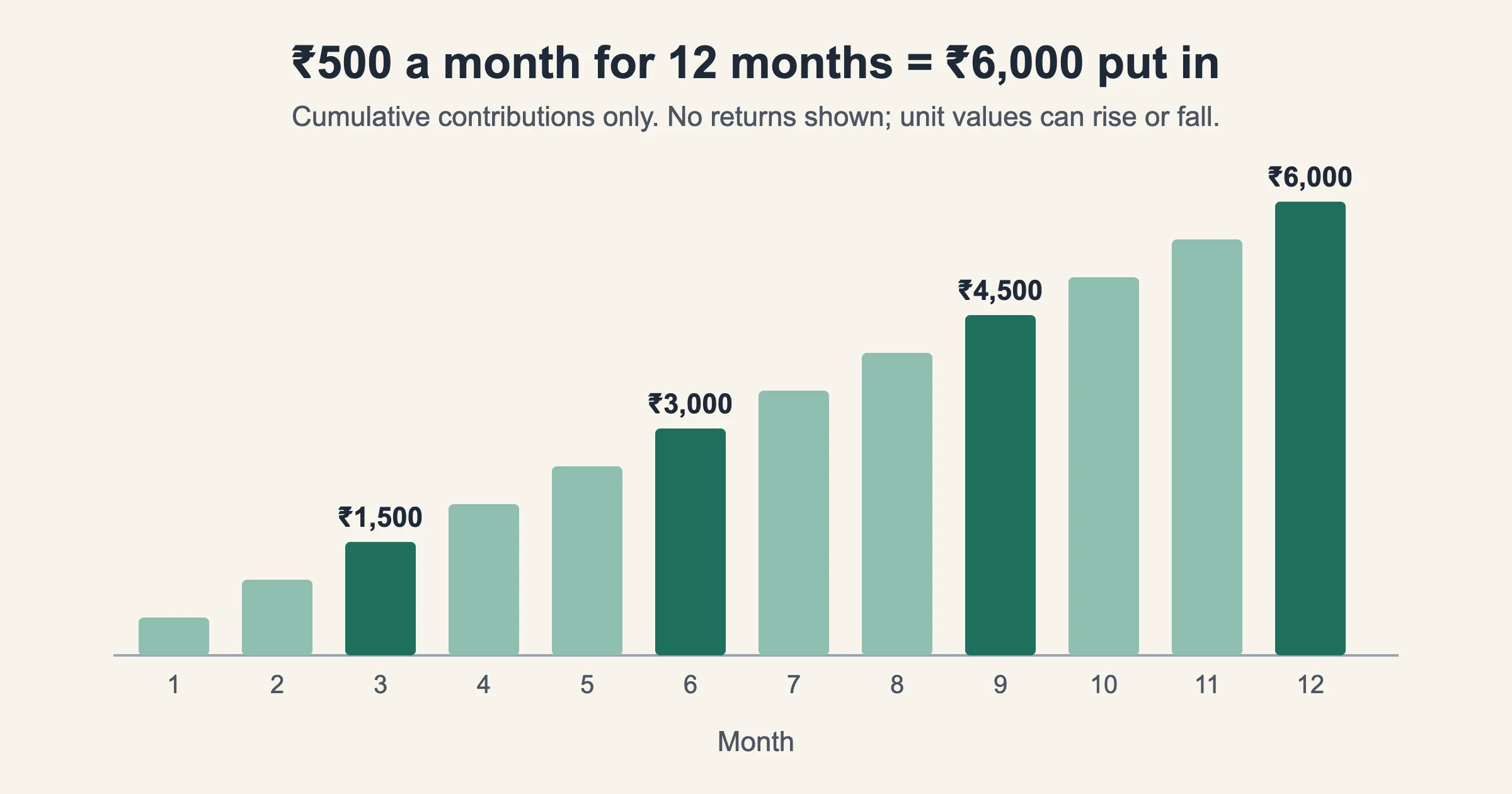
That ₹6,000 is only what goes in. The value of the units can be higher or lower at any point.
What if the units grew at a steady rate? At a hypothetical 6% a year, ₹500 a month would be about ₹6,199 after 12 months; at a hypothetical 10% a year, about ₹6,335. Hypothetical; not a promise; returns vary. This assumes monthly compounding (the annual rate divided by 12), each instalment invested at the start of the month, and no costs or taxes. Values can also fall below the amount invested.
Over a single year, the amount you put in moves the total far more than the rate does. The habit and the paperwork are the parts within your control.
Before the first instalment
- Keep a small buffer. Money you may need for fees, travel or a phone repair soon is better kept out of a market-linked fund. Our guide on how much emergency money to hold explains how to count it.
- Debit after your money arrives. If your stipend lands on the 5th, a debit on the 1st can bounce.
- Read the scheme documents. The SID and KIM give the minimum amount, exit load, riskometer level and costs.
- Know what a missed month means. Exams and gaps between internships happen. Our explainer on a missed SIP instalment covers what the bank and fund house each do.
For the setup itself, from KYC check to first debit, read our guide to starting an SIP online. For the basics, start with what an SIP is.
Frequently asked questions
Can students start an SIP in India?
Yes. A student aged 18 or over can start one with their own PAN, bank account and completed KYC. Under 18, the SIP runs in a minor folio operated by a parent or legal guardian.
Can I start an SIP without a PAN card or with my parents' bank account?
Most investors need a PAN; a narrow exempt category covers small investments of up to ₹50,000 per investor per year per mutual fund. If you are 18 or over, a parent's account is generally a third-party payment, which fund houses usually don't accept.
Can a 17-year-old invest in mutual funds?
Yes, through a minor folio operated by a parent or legal guardian. Since June 2023, payment can come from the minor's account, the parent's or guardian's account, or a joint account of the two.
What is the minimum amount a student can start an SIP with?
It depends on the scheme. Each scheme states its minimum SIP amount in its Scheme Information Document (SID).
What happens to a minor's mutual fund folio when the child turns 18?
Its status has to change from minor to major, with the new adult's own KYC and bank details. Until then, no further transactions are allowed and any registered SIP is suspended.
What if I miss an instalment during exams?
Usually, no units are bought for that month. Your bank may charge a fee for a failed debit, and under some fund houses' terms several consecutive misses can cancel the SIP. Check your scheme's terms.
Read next
Under 18, or close to it? Check how a minor folio works and what changes at 18 in our guide to starting an SIP in a child's name. Starting small? Compare notes with the ₹250 chhoti SIP.
— Laabh



