How much SIP for ₹1 crore: the answer changes with three assumptions
SIP needed for ₹1 crore at hypothetical 8–12% a year over 10, 15 or 20 years, with the formula, inflation and step-up shown. Not guaranteed.
Summarize this article with AI





The short version
- The SIP needed for ₹1 crore depends on three assumptions: years, return and inflation.
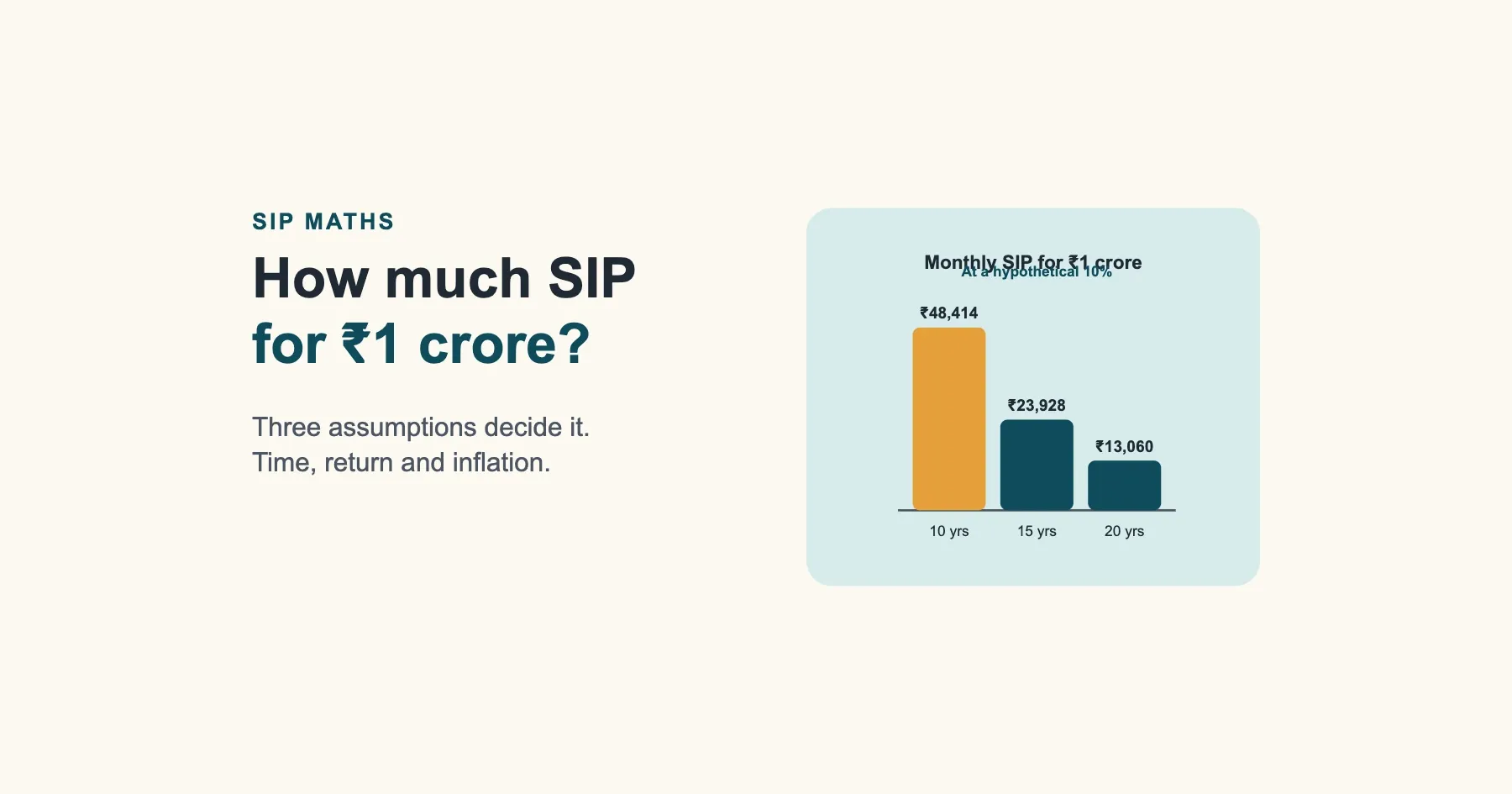
- At hypothetical 8% to 12% a year, it ranges from about ₹10,009 a month over 20 years to about ₹54,299 a month over 10 years.
- ₹12,000 a month for 20 years grows to about ₹71.15 lakh to ₹1.20 crore in these hypothetical scenarios.
- At a hypothetical 6% inflation, ₹1 crore in 20 years buys about what ₹31.2 lakh buys today.
- A step-up SIP reaches the target sooner mainly by adding more money.
It depends on the years you give it and the return you assume. At a hypothetical 8% to 12% a year for 20 years, a monthly SIP of roughly ₹10,009 to ₹16,865 reaches ₹1 crore on paper. Over 10 years, the same goal needs about ₹43,041 to ₹54,299 a month. None of these figures is guaranteed.
Search "how much SIP for 1 crore" and some answers headline one confident number built on an 18% or 20% return. That number hides three assumptions: how long you invest, what return you assume, and what ₹1 crore will buy when you get there. Here are all three, with the formula, so you can check every figure.
How much SIP do I need to make ₹1 crore in 10, 15 or 20 years?
Monthly SIP needed to reach ₹1 crore (hypothetical, not a promise; returns vary and can be negative in some years):
| Years | At 8% a year (hypothetical) | At 10% a year (hypothetical) | At 12% a year (hypothetical) |
|---|---|---|---|
| 10 years | ₹54,299 | ₹48,414 | ₹43,041 |
| 15 years | ₹28,707 | ₹23,928 | ₹19,819 |
| 20 years | ₹16,865 | ₹13,060 | ₹10,009 |
Convention: the annual rate is divided by 12 and compounded monthly; each instalment is paid at the start of the month. Figures are rounded to the nearest rupee. Taxes, expense ratios and exit loads are ignored.
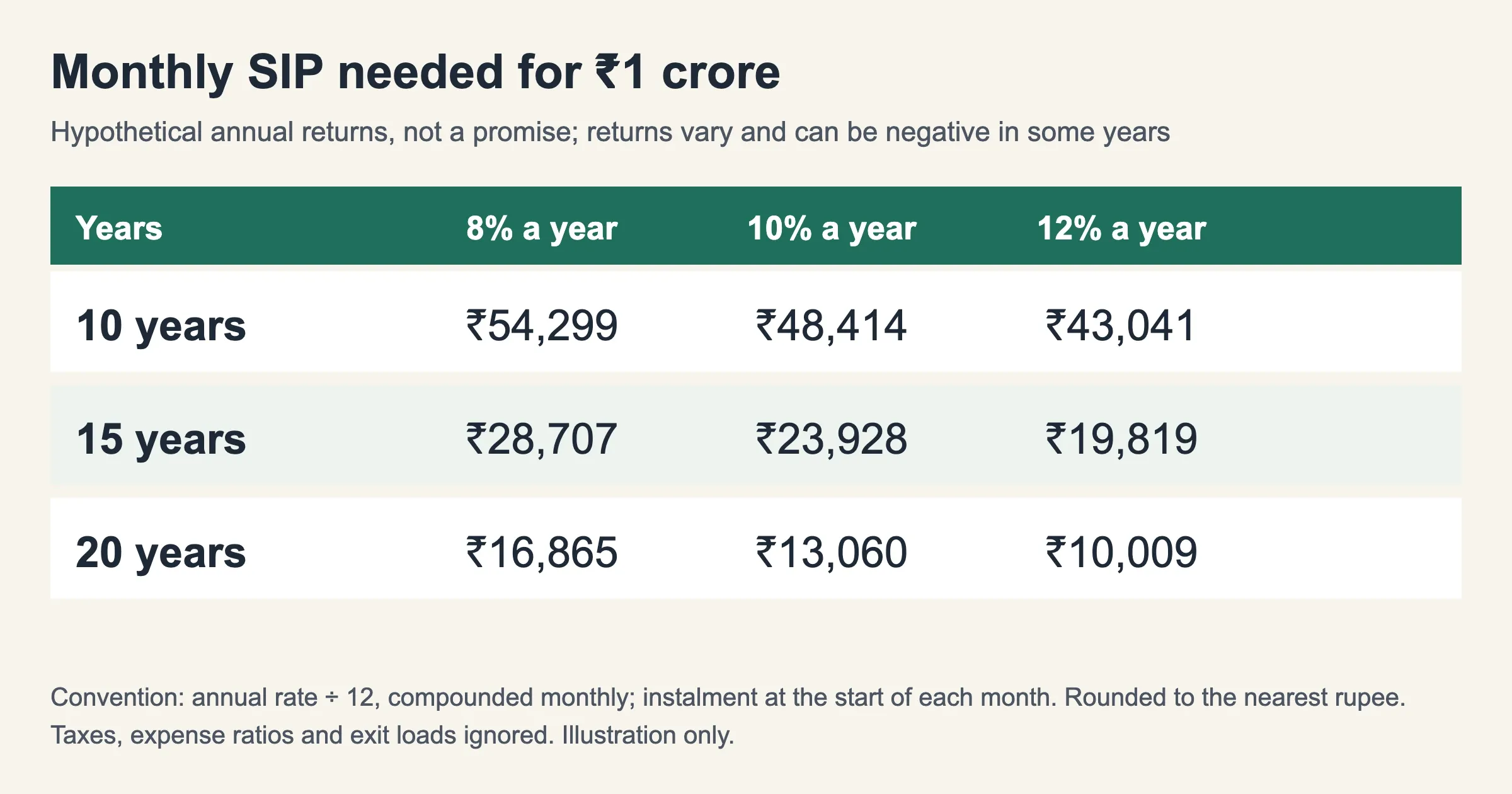
Moving from 10 to 20 years cuts the monthly amount by roughly two-thirds at every rate. Time is the assumption you control most; the return is the one you control least.
The formula, in one line
The future value of a monthly SIP paid at the start of each month is:
FV = P × [((1 + i)^n − 1) ÷ i] × (1 + i)
Here P is the monthly SIP, i is the hypothetical annual rate divided by 12, and n is the number of instalments (240 for 20 years).
To find the SIP for a target, divide the target by everything after P. Put in ₹1 crore, 10% and 240 months and you get ₹13,060.
One detail explains why calculators differ. Dividing by 12 and compounding monthly turns a stated 12% into about 12.68% over a full year (10% into about 10.47%, 8% into about 8.30%). Calculators using an effective annual rate or end-of-month payments show slightly different numbers. What matters is that the convention is stated.
What return rate should I assume?
Use a range, not one number. A fund's return depends on what it holds, and that varies by category: equity funds can rise or fall sharply from year to year, while debt funds tend to move less, though they carry their own risks. The 8%, 10% and 12% here are hypothetical rates chosen to show sensitivity, not a forecast for any fund or category.
An 18% or 20% assumption deserves a second look: it is only an assumption, and returns can be lower or negative in some years. Testing a lower rate shows how much the answer depends on it. To compare your actual SIP returns with an assumption later, use XIRR, not a simple average.
Is ₹10,000 a month enough to reach ₹1 crore?
On the table above, only at the longest horizon and the highest rate, and even then it falls just short. ₹10,000 a month for 20 years grows to about ₹99.91 lakh at a hypothetical 12% a year. At a hypothetical 10% it reaches about ₹76.57 lakh, and at 8% about ₹59.29 lakh.
A ₹12,000-a-month example
Say you can set aside ₹12,000 a month and leave it for 20 years. You put in ₹28,80,000 in total. Here is what that could grow to (hypothetical, not a promise; returns vary and can be negative in some years):
| Hypothetical annual return | Value after 20 years |
|---|---|
| 8% | ₹71,15,367 (about ₹71.15 lakh) |
| 10% | ₹91,88,363 (about ₹91.88 lakh) |
| 12% | ₹1,19,89,775 (about ₹1.20 crore) |
Same convention: monthly compounding, instalment at the start of the month.
So ₹12,000 a month crosses ₹1 crore in 20 years only in the 12% scenario. At 8% or 10%, the gap needs more years, a higher amount, or both.
How much will ₹1 crore be worth after inflation in 20 years?
Less than it sounds. If prices rise at a hypothetical 6% a year, ₹1 crore received in the future buys what this much buys today:
| ₹1 crore received after | Value in today's money (hypothetical 6% inflation) |
|---|---|
| 10 years | ₹55,83,948 (about ₹55.8 lakh) |
| 15 years | ₹41,72,651 (about ₹41.7 lakh) |
| 20 years | ₹31,18,047 (about ₹31.2 lakh) |
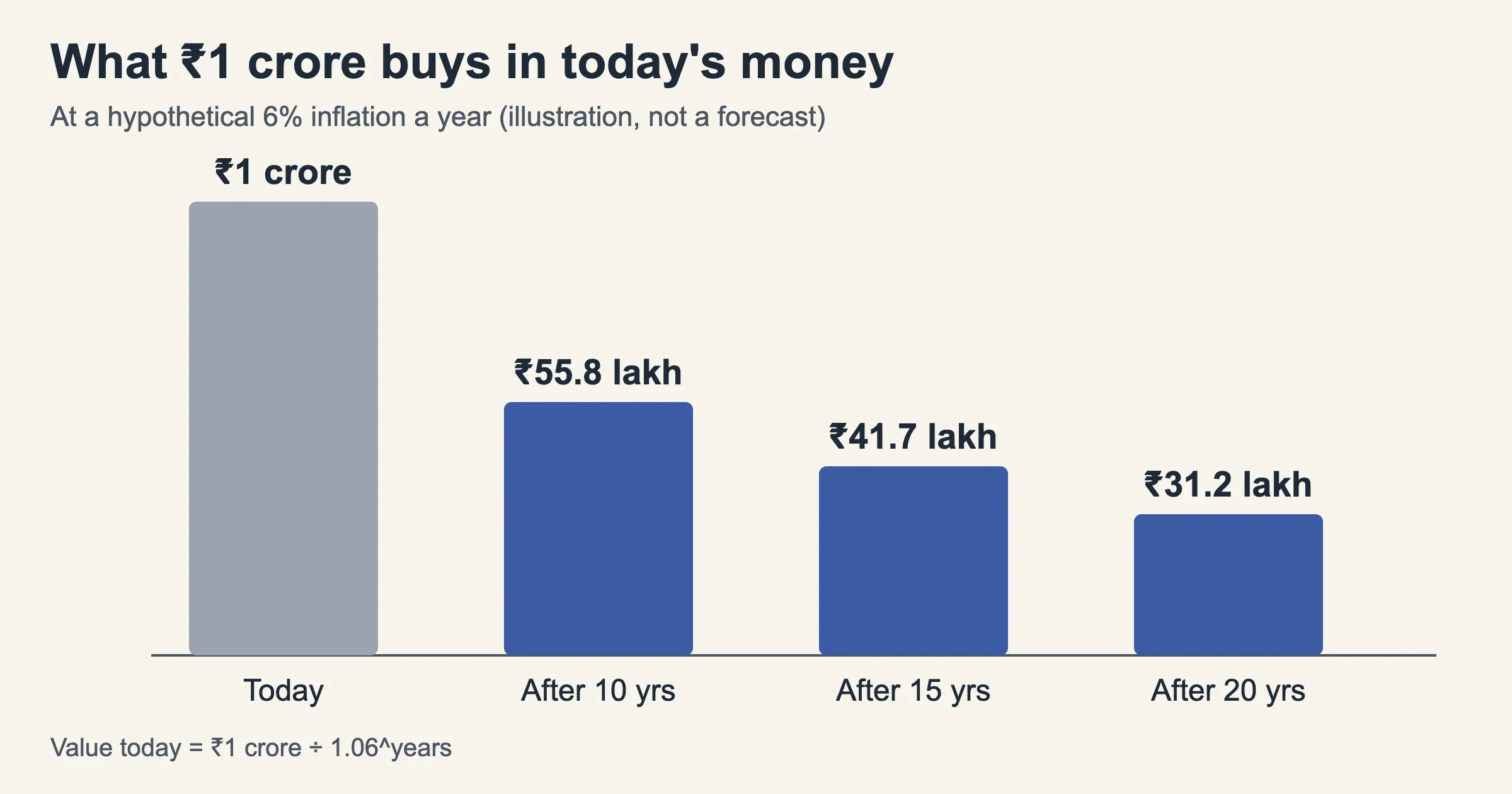
Turned the other way, matching today's ₹1 crore of buying power in 20 years would take about ₹3.21 crore at a hypothetical 6% inflation (about ₹2.19 crore at 4%, ₹3.87 crore at 7%).
That is what "SIP returns after inflation" means in practice: the ₹91.88 lakh from the 10% example is worth about ₹28.65 lakh in today's money at 6% inflation. Before fixing ₹1 crore as a target, price what you want it to pay for in future rupees.
Does a step-up SIP reach ₹1 crore faster than a flat SIP?
Yes, in the arithmetic. Here is the ₹12,000 example at a hypothetical 10% a year, raised once a year (hypothetical, not a promise; returns vary and can be negative in some years):
| Plan | Total invested over 20 years | Value after 20 years | Time to reach ₹1 crore |
|---|---|---|---|
| Flat ₹12,000 | ₹28,80,000 | ₹91,88,363 | 20 years 9 months |
| Step-up 5% a year | ₹47,61,497 | ₹1,29,90,840 | 18 years 1 month |
| Step-up 10% a year | ₹82,47,600 | ₹1,93,74,484 | 15 years 9 months |
Convention: as above; the step-up is applied at the start of each new SIP year.
Read the middle column first. A step-up gets there sooner mainly because you contribute far more money, not because of a better return. It fits if your income is likely to rise and the higher instalment won't squeeze your essentials; check your budget each year before raising it. Our step-up SIP guide covers how much to raise it by.
What the table can't promise
Every number above assumes the same return every year. Real markets don't work that way.
- Returns vary. A fund can fall in some years, sometimes sharply.
- Sequence matters. With the same average return, a fall in the final years hurts more, because the corpus is largest then.
- Costs and tax reduce what you keep. The tables ignore expense ratios, exit loads and tax.
If the market falls mid-plan, see what happens to your SIP when the market falls. For why the years matter so much, read the power of compounding in an SIP.
Frequently asked questions
How much SIP do I need for ₹1 crore in 15 years?
At a hypothetical 8%, 10% or 12% a year, about ₹28,707, ₹23,928 or ₹19,819 a month, assuming monthly compounding and start-of-month instalments. These are illustrations, not promised outcomes.
How much SIP do I need for ₹1 crore in 20 years?
About ₹16,865, ₹13,060 or ₹10,009 a month at a hypothetical 8%, 10% or 12% a year. Actual returns vary and can be negative in some years.
Is the result guaranteed?
No. Mutual fund returns are market-linked and can be negative in some years. AMFI's investor-education material says "the returns or the potential returns of a mutual fund product cannot be guaranteed."
Should I use an SIP or a lump sum for this goal?
It depends on whether the money arrives monthly from salary or all at once, such as a bonus. Our guide to investing a bonus as a lump sum or through an SIP compares the options.
Next: let the SIP grow with your salary
Want the monthly figure to rise with your salary? Continue to step-up SIP. For the basics first, read what an SIP is.
— Laabh



