How to Improve Your CIBIL Score: What Moves It, How Long Each Fix Takes, and How to Dispute an Error
How to improve your CIBIL score: fixes ranked by speed, card utilisation maths, and RBI's 30-day dispute rule with ₹100 a day compensation.
Summarize this article with AI





The short version
- Your score changes only when your credit report changes, so read the free full report each RBI-licensed bureau must give you once a calendar year.
- Errors are the fastest fix: the lender has 21 days, the complaint must be resolved in 30 calendar days, then ₹100 per day compensation applies (RBI, 26 Oct 2023).
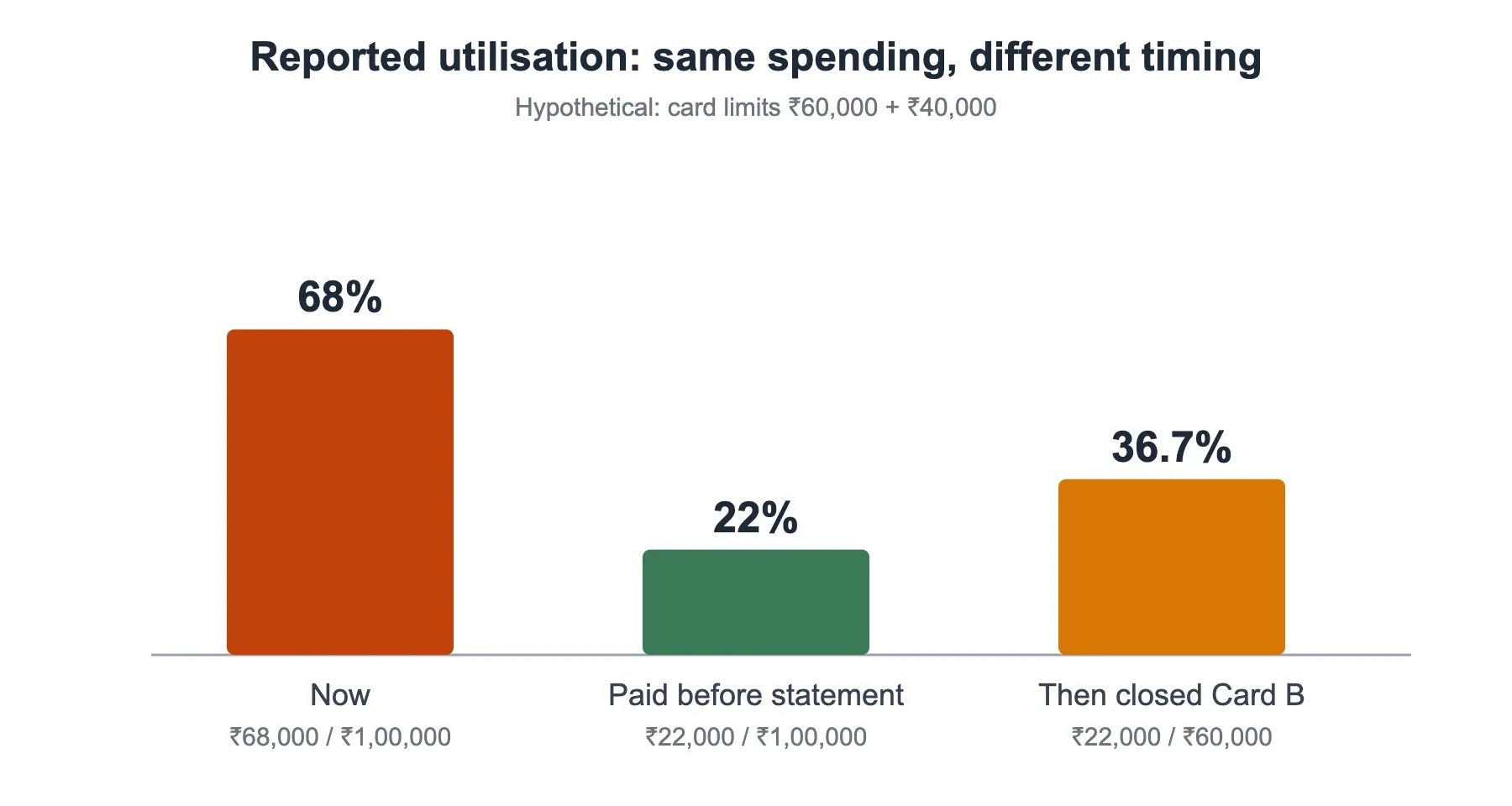
- Paying card balances before the statement date lowers reported utilisation: 68% fell to 22% in our hypothetical two-card example.
- Closing an old card can raise utilisation (22% to 36.7% in the example) and shorten your history.
- A genuine late payment or settled loan cannot be disputed away; it fades as newer on-time months build up.
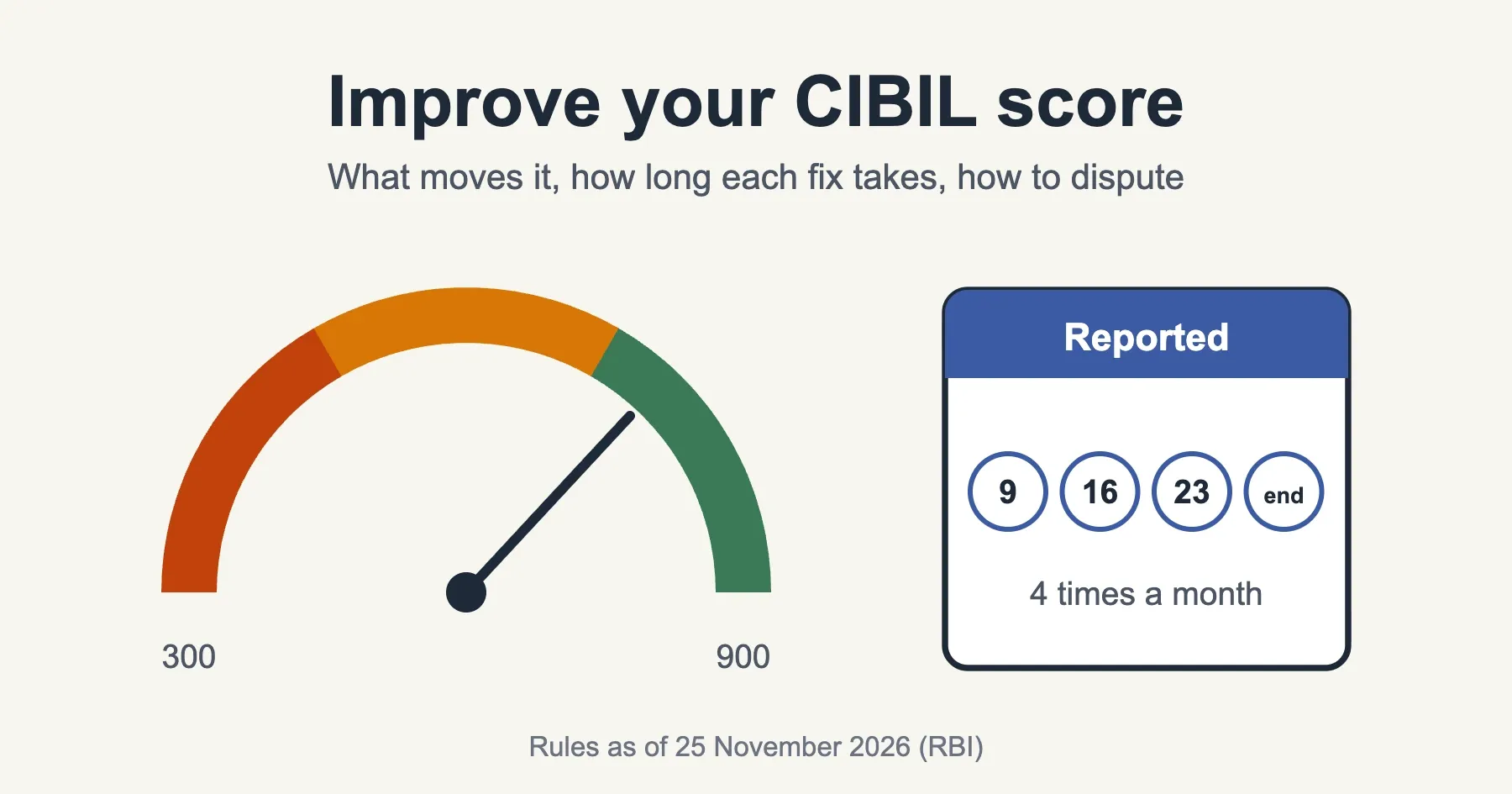
As of 25 November 2026: your CIBIL score improves only when the credit report behind it improves. The fixes that show up first are correcting errors and lowering the card balance that gets reported on your statement date; on-time payments rebuild the score over months, and a missed payment takes much longer to fade. Since 1 July 2026, lenders report to the bureaus four times a month under RBI rules, so a genuine change can reach your report within weeks.
"CIBIL score" is the name most people search for, but CIBIL is one of four credit information companies (CICs) licensed by the Reserve Bank of India. RBI's 2025 credit-information directions list them as CRIF, Equifax, Experian and TransUnion CIBIL. Each keeps its own report and score on you. None publishes its formula, so this page promises no number of points; it explains what changes your report, roughly how soon, and what to do when it is wrong.
Rohit, 28, in Kochi, plans to apply for a home loan in about nine months. He has two credit cards, one late payment from last year and high card bills.
First, read your credit report
Start with the report, not the score. Since 1 January 2017, RBI has required every CIC to give you one free full credit report, including your score, once each calendar year, electronically after verifying your identity; RBI's 2025 CIC directions carry the rule forward. That is one free report a year from each of the four.
Check every line:
- Accounts: every loan and card should be yours; an unknown one can mean an error or identity misuse.
- Payment history: match "days past due" entries against your bank statements.
- Balances and limits: a closed loan shown as open, or a wrong card limit, distorts your borrowing.
- Enquiries: applications you never made are worth disputing.
- Personal details: a wrong PAN or date of birth can attach someone else's data to you.
How to improve your CIBIL score: fixes ranked by how fast they show up
| Fix | What it changes in your report | Typical time to reflect |
|---|---|---|
| 1. Dispute an error | Removes a wrong account, late mark or balance | RBI sets a 30-day limit for resolution |
| 2. Lower card balances before the statement date | Reported balance and credit utilisation | The next reporting cycle or two |
| 3. Pay every due on time | Builds a run of on-time months in payment history | Months; the record grows month by month |
| 4. Space out applications | Fewer recent enquiries | Months, as recent enquiries age |
| 5. Keep old cards open | Keeps your total limit and account age | Protects the score rather than raising it |
1. Dispute errors: the fastest legitimate fix
Disputes are free. You do not need a paid "credit repair" service. RBI's compensation framework (circular of 26 October 2023, in force from April 2024 and carried into the 2025 directions) sets the clock:
- Complain to the CIC showing the error, or to the lender that reported it, with proof. Note the complaint number and date.
- The lender must send corrected information to the CIC within 21 calendar days.
- The CIC has the remaining 9 days: resolution is due within 30 calendar days of filing.
- After that, you are entitled to ₹100 per calendar day of delay, paid by the lender, the CIC, or both in proportion to their delay.
- If your complaint is rejected, you must be told why.
Hypothetical example. Rohit finds a closed loan still shown as overdue and files on 1 December 2026. The lender's deadline is 22 December; the 30-day limit is 31 December 2026. The corrected report arrives on 12 January 2027, which is 42 calendar days after filing and 12 days beyond the limit. At ₹100 a day, that is ₹1,200 in compensation, paid by whichever party caused the delay. (Our day count runs from the filing date; confirm the exact count with the CIC's compensation policy.)
2. Bring card utilisation down before the statement date
Credit utilisation is the share of your card limits that is in use. What the bureau usually sees is the balance on your statement, not the amount you pay later on the due date. Paying before the statement is generated lowers the balance that gets reported.
Hypothetical example (Rohit's cards).
| Card A | Card B | Total | |
|---|---|---|---|
| Limit | ₹60,000 | ₹40,000 | ₹1,00,000 |
| Statement balance now | ₹45,000 (75%) | ₹23,000 (57.5%) | ₹68,000 (68%) |
| Pays before statement dates | ₹23,000 | ₹23,000 | ₹46,000 |
| Reported balance after | ₹22,000 (36.7%) | ₹0 | ₹22,000 (22%) |
Same spending: only the payment timing changed, and reported utilisation fell from 68% to 22%.
3. Never miss a due date
Payment history is the slowest part to rebuild. Set autopay for at least the minimum due on every card and auto-debit for EMIs. The minimum keeps the account from being reported past due, but interest still runs on the unpaid balance: a safety net, not a plan. Our explainer on the credit card interest-free period shows what part-payment costs.
RBI's 2025 credit-information directions require lenders to alert customers by SMS or email when they report a default or days past due to the CICs. If you get such an alert and believe it is wrong, dispute it at once.
4. Space out new loan and card applications
Each application lets the lender pull your report, and that hard enquiry shows up on it. Several in a short span can make you look credit-hungry, so avoid new cards or small loans in the months before a big loan.
5. Keep old cards open, unless the fees outweigh it
Closing a card removes its limit. If Rohit closes Card B after clearing it, the same ₹22,000 sits on ₹60,000 of limit: utilisation rises from 22% to 36.7%. An old card also adds to your credit history's age. If its annual fee is hard to justify, closing can still make sense; pay balances down first.
Myths that waste time
- "Checking my own score lowers it." Your own check is a consumer enquiry, which the bureaus say does not lower your score.
- "Paying the minimum is enough." It avoids a late mark, not interest.
- "A paid agency can wipe out a bad record." Only errors can be removed, and disputing them is free.
What you cannot fix fast
An account that went 90 or more days overdue, a written-off loan or a "settled" loan (one where the full amount was not repaid) is accurate history if it happened. No dispute removes it; its weight fades only as newer, cleaner months build up. What helps:
- Clear any overdue amount now, so the account stops adding late months.
- Ask the lender whether paying the remaining dues on a settled account changes its status, and get the answer in writing.
- Keep every other account on time and utilisation low, then recheck your report after a couple of reporting cycles.
Rohit's order: dispute the error now, pay cards before statement dates, keep autopay on and pause new applications until the loan is sanctioned.
Why fix credit before your first SIP
A high-interest card balance costs a known rate every month, while an SIP's return is uncertain. Clearing card debt and setting up autopay usually comes before investing, alongside an emergency fund. If you also carry a personal loan, our comparison of paying off a loan or starting an SIP works through the trade-off. Starting with no credit history? Read how to build a credit score with your first salary instead.
Frequently asked questions
How can I improve my CIBIL score?
Check your free credit report from each bureau and dispute any errors. Then pay card balances before the statement date, keep every due on autopay, space out applications and keep old cards open. Errors and utilisation show up fastest; payment history takes months. (Hinglish: CIBIL score kaise badhaye? Pehle free report check karein, galti ho to dispute karein, phir card bill statement date se pehle bharein.)
How long does it take to improve a CIBIL score?
It depends on the fix. Since 1 July 2026, lenders report to the bureaus four times a month, so a corrected error or lower card balance can appear within weeks. Rebuilding payment history after a late payment takes many months, and no bureau publishes an exact timeline.
Does checking my own CIBIL score reduce it?
No. Your own check is a consumer enquiry, which the bureaus say does not affect your score. A lender pulling your report after you apply is a hard enquiry, and several in a short time can weigh on it.
How do I correct a mistake in my CIBIL report?
Raise a complaint with the bureau or the lender, with proof. The lender has 21 days to send corrected data, and the complaint must be resolved within 30 calendar days of filing. After that, RBI's framework entitles you to ₹100 per calendar day of delay.
Does closing a credit card lower my credit score?
It can. Closing a card cuts your total limit, so the same balance becomes a higher utilisation: in our hypothetical example, 22% became 36.7%. It can also shorten your credit history.
Save this checklist
Free report from each bureau yearly; disputes logged with dates; card payments before statement dates; autopay on every due; no new applications before a big loan.