PMS vs Mutual Fund: What the ₹50 Lakh Minimum Changes, How Each Is Taxed, and Where a First-Time Investor Fits
PMS vs mutual fund: SEBI's ₹50 lakh PMS minimum, the MF-SIF-PMS-AIF ladder, fees, and why PMS gains are taxed in the year of sale. As of 22 Nov 2026.
Summarize this article with AI





The short version
- PMS and mutual funds can hold similar shares; the wrapper differs.
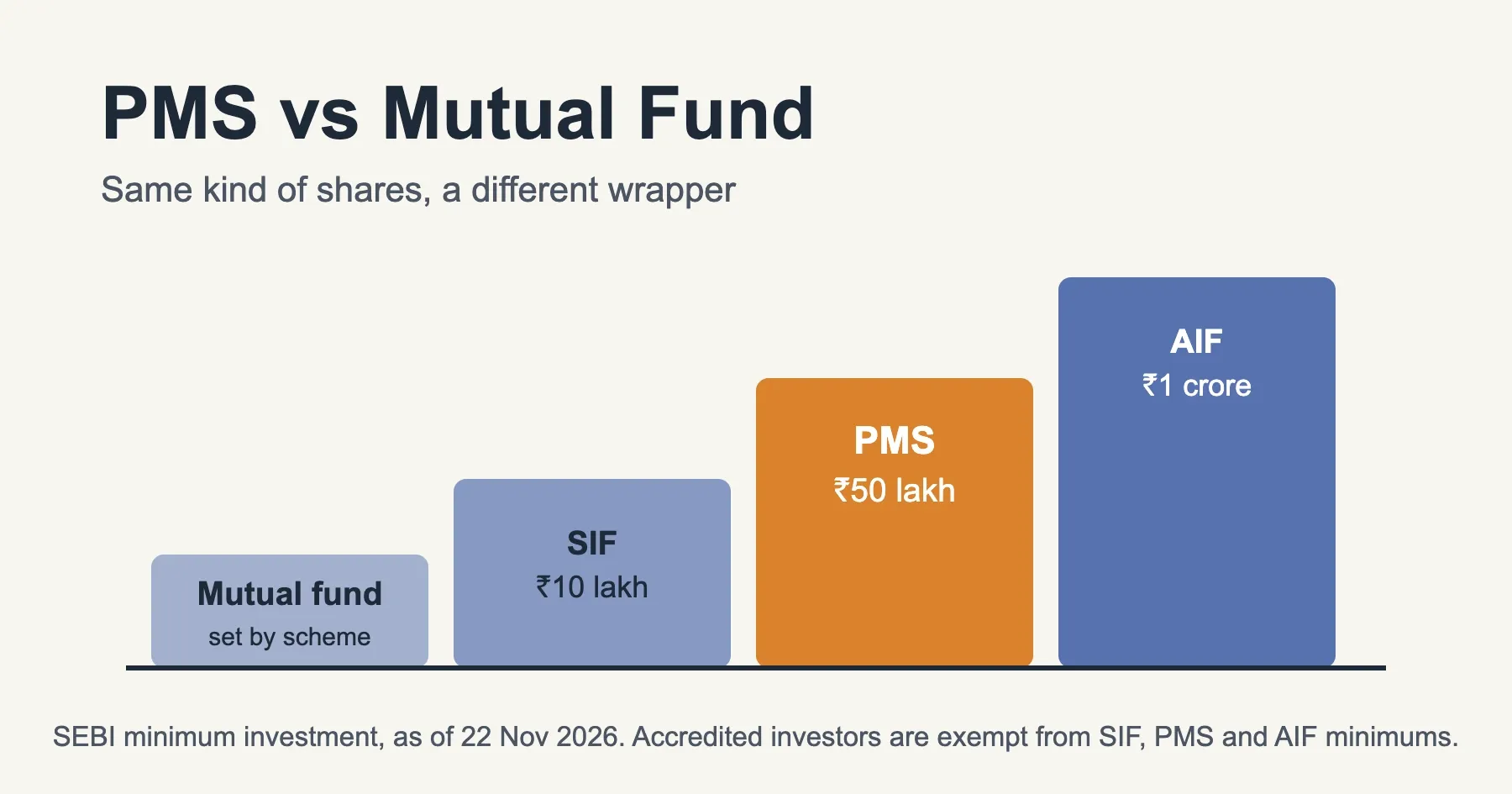
- SEBI minimums, as of 22 November 2026: SIF ₹10 lakh, PMS ₹50 lakh, AIF ₹1 crore.
- PMS fees are fixed, return-based or both, never upfront; MF costs sit inside the NAV.
- PMS sales are taxed in the year they happen; MF gains on redemption.
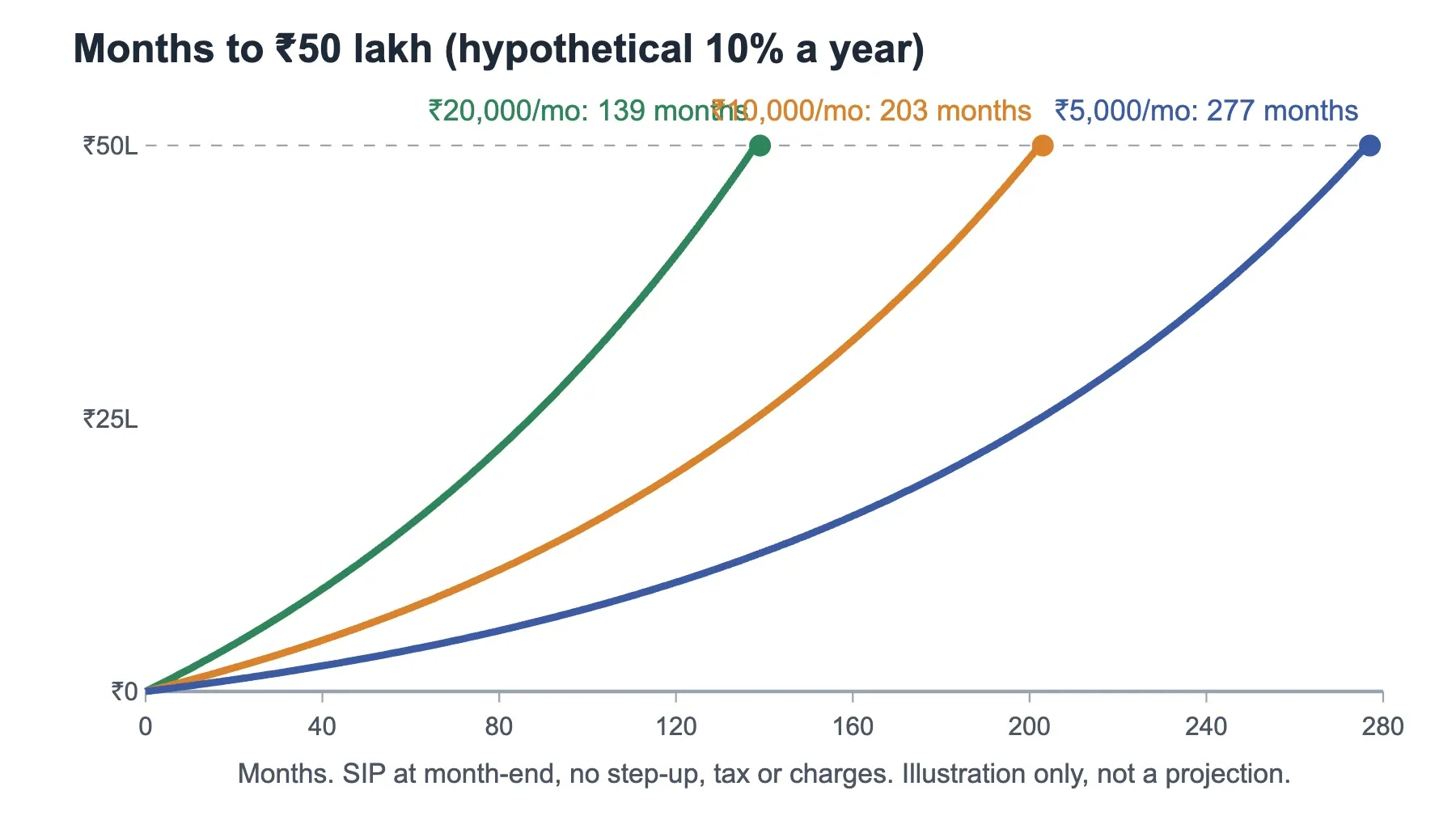
- At a hypothetical 10%, a ₹10,000 SIP needs about 203 months to reach ₹50 lakh.
As of 22 November 2026: a portfolio management service (PMS) is a SEBI-registered portfolio manager running a separate portfolio for you, and SEBI's Portfolio Managers Regulations, 2020 set the minimum at ₹50 lakh (Regulation 23(2)). A mutual fund pools many investors' money into one scheme; you own units, and schemes set their own, usually small, minimums. Neither is "better" by label: the difference lies in ownership, ticket size, fees and when tax reaches you.
Mehak, 29, a data analyst in Kochi, runs a ₹10,000 monthly SIP. A colleague mentioned his PMS, and she wondered whether it was the "next level". A PMS and an equity mutual fund can hold very similar shares; what changes is the wrapper.
What a PMS actually is
A SEBI-registered portfolio manager runs money or securities for one client under a written agreement, in one of three ways:
- Discretionary: the manager decides what to buy and sell for you (Regulation 2(1)(g)).
- Non-discretionary: the manager acts on your directions (Regulation 23(1)).
- Advisory: the manager advises; the decisions stay with you.
The manager must appoint a custodian (Regulation 26), keep each client's securities separate (Regulation 23(4)) and may not hold them in its own name (Regulation 24(15)). You get a report at least every three months (Regulation 31(1)).
PMS vs mutual fund at a glance
| What you compare | Mutual fund | PMS |
|---|---|---|
| What you own | Units of a pooled scheme | The securities in your own separate portfolio account |
| Minimum | Set by each scheme (see its documents) | ₹50 lakh in funds or securities (Reg 23(2)); accredited investors exempt |
| Reporting | NAV and scheme disclosures | Client report at least every three months (Reg 31) |
| Fees | Expense ratio, already inside the NAV | Fixed, return-based or both, agreed in writing; no upfront fee (Reg 22(11)) |
| When capital-gains tax reaches you | When you redeem or sell your units | When the manager sells securities in your account |
| Rulebook | SEBI (Mutual Funds) Regulations, 2026 | SEBI (Portfolio Managers) Regulations, 2020 |
The SEBI ticket-size ladder: MF, SIF, PMS, AIF
PMS searches often surface Specialized Investment Funds (SIFs) and Alternative Investment Funds (AIFs) too. Their minimums compare like this.
| Product | Minimum investment | Who holds what | Rulebook (source) |
|---|---|---|---|
| Mutual fund | Set by each scheme | You hold units of a pooled scheme | SEBI (Mutual Funds) Regulations, 2026 |
| SIF | ₹10 lakh, counted per PAN across all investment strategies of a particular SIF | You hold units of a pooled strategy | A mutual fund product under the MF Regulations, 2026 (SEBI SIF FAQs A1, A6) |
| PMS | ₹50 lakh | Securities sit in your separate portfolio account | SEBI (Portfolio Managers) Regulations, 2020, Reg 23(2) |
| AIF | ₹1 crore (₹25 lakh for the fund's or manager's employees and directors) | You invest in a pooled fund | SEBI (AIF) Regulations, 2012, Reg 10(c) |
Accredited investors (certified by an accreditation agency) are exempt from the SIF, PMS and AIF minimums (SIF FAQ A7; PMS Reg 23(2) proviso; AIF Reg 10(c)). Last verified: 22 November 2026.
How fees work in each
Mutual fund: expense ratio inside the NAV
There is no separate bill: expenses come out of the scheme's assets, so the NAV is already net of them. Our guide to the expense ratio in mutual funds explains SEBI's 2026 limits.
PMS: an agreed fee, charged to your account
Regulation 22(11) says the fee "may be a fixed fee or a return based fee or a combination of both", and bans upfront fees, direct or indirect. Fee ranges must appear in the disclosure document (Regulation 22(12)), and the agreement must set out early-withdrawal terms (Regulation 22(2)(f)). Ask how any return-based fee is calculated, whether the quoted fee includes taxes, and what leaving early costs.
Where tax hits you: each PMS trade vs MF redemption
In a PMS, the shares are yours, so every sale the manager makes is your sale, and each gain or loss lands in your income tax return for that year. In a mutual fund, the manager trades inside the scheme; your capital-gains event is when you redeem or sell units.
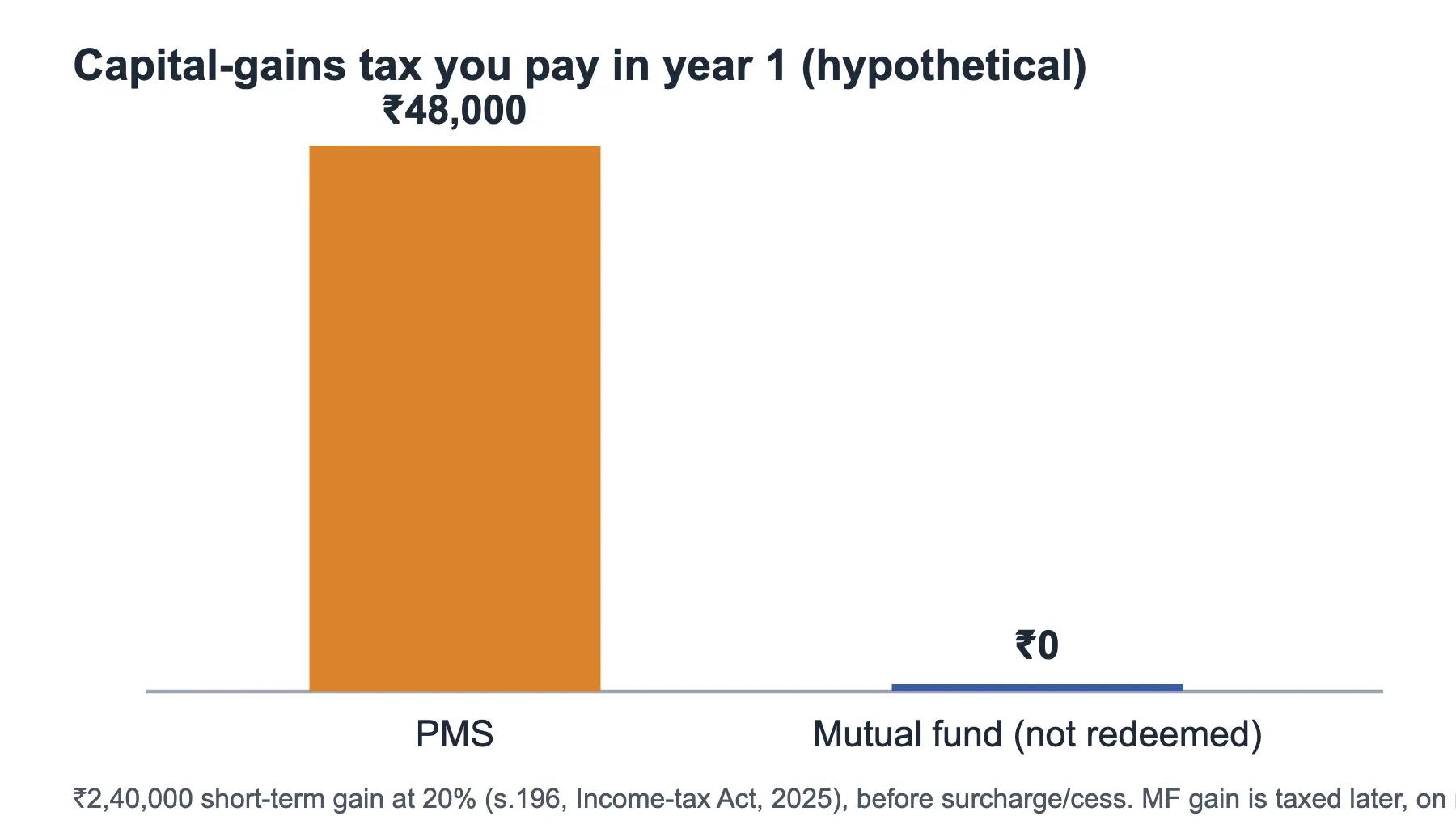
Worked example (hypothetical). ₹50,00,000 goes into a discretionary PMS. During the year, the manager sells shares bought a few months earlier, on an exchange with securities transaction tax (STT) paid, booking ₹2,40,000 of short-term gain.
- Under section 196 of the Income-tax Act, 2025, short-term gains on STT-paid equity shares are taxed at 20%. If your other income already exceeds the basic exemption limit, tax is ₹48,000 for that year, before any surcharge or cess.
- A hypothetical fixed fee of 2% a year on ₹50,00,000 is ₹1,00,000, debited to your account, before any taxes on the fee.
With similar trading inside an equity mutual fund you hold all year, your capital-gains tax that year is ₹0, because you redeemed nothing, and no separate fee is debited.
The fund is not tax-free: the gain sits in the NAV and is taxed when you redeem, at the rate for your holding period. What changes is timing and yearly paperwork.
How far is ₹50 lakh? SIP maths for a first-timer
Is a PMS Mehak's next step? We ran her SIP and two others at a hypothetical 10% a year, compounded monthly. This is an illustration, not a projection; actual returns vary and can be negative.
| Monthly SIP | Months to reach ₹50 lakh | About | Total put in |
|---|---|---|---|
| ₹5,000 | 277 | 23.1 years | ₹13,85,000 |
| ₹10,000 | 203 | 16.9 years | ₹20,30,000 |
| ₹20,000 | 139 | 11.6 years | ₹27,80,000 |
At ₹10,000 a month, Mehak would need about 17 years at that assumed rate just to reach the entry ticket. For most first-time investors, a PMS is not the next rung after an SIP; it is built for a different scale. To see how a step-up changes timelines, read how much SIP for ₹1 crore.
Questions to ask before considering either
Factors, not a recommendation:
- Surplus. Can you put ₹50 lakh in one portfolio and keep your emergency and goal money separate?
- Monitoring. Will you read a quarterly report and follow what was bought and sold?
- Tax filing. Can you report many trades in your return each year?
- Fees. Can you compare a PMS fee with an expense ratio on the same amount?
- Documents. Have you read the disclosure document or scheme documents, not a brochure?
Several "not yet" answers are useful information, not a shortfall. Mutual funds vs stocks for beginners may be the closer decision today, and active vs passive mutual funds covers the cost side.
Frequently asked questions
What is the difference between PMS and mutual fund?
In a PMS, a SEBI-registered manager runs a separate portfolio for you, with a ₹50 lakh minimum (Regulation 23(2), SEBI Portfolio Managers Regulations, 2020). In a mutual fund, you own units of a pooled scheme with a scheme-set minimum, and tax reaches you when you redeem.
What is the minimum investment for PMS in India?
As of 22 November 2026, ₹50 lakh in funds or securities (Regulation 23(2), SEBI Portfolio Managers Regulations, 2020). Accredited investors are exempt, subject to disclosure.
Is PMS better than mutual fund?
Neither is better by label. It depends on having ₹50 lakh for one portfolio, reading quarterly reports, reporting many trades in your return, and how the fees compare on the same amount.
How is PMS taxed compared with mutual funds?
PMS gains are taxed in your return the year the manager sells: a hypothetical ₹2,40,000 short-term gain on STT-paid shares is taxed at 20% under section 196, Income-tax Act, 2025, which is ₹48,000 before surcharge or cess. Mutual fund gains are taxed when you redeem. Tax rules change; consult a tax professional for your situation.
What is the difference between PMS, SIF and AIF?
Ticket size and structure: a SIF (a mutual fund product) needs ₹10 lakh per PAN, a PMS ₹50 lakh in your own separate portfolio, an AIF ₹1 crore. Accredited investors are exempt from all three minimums.
Save this ladder
Save this ladder table for the next "premium" pitch, and re-check the SEBI minimums before acting on it.



