Active vs Passive Mutual Funds: What the Extra Fee Has to Earn Back, Category by Category
Active vs passive mutual funds: an active fund must beat its index by the cost gap just to tie. ₹ example plus SPIVA data by category.
Summarize this article with AI





The short version
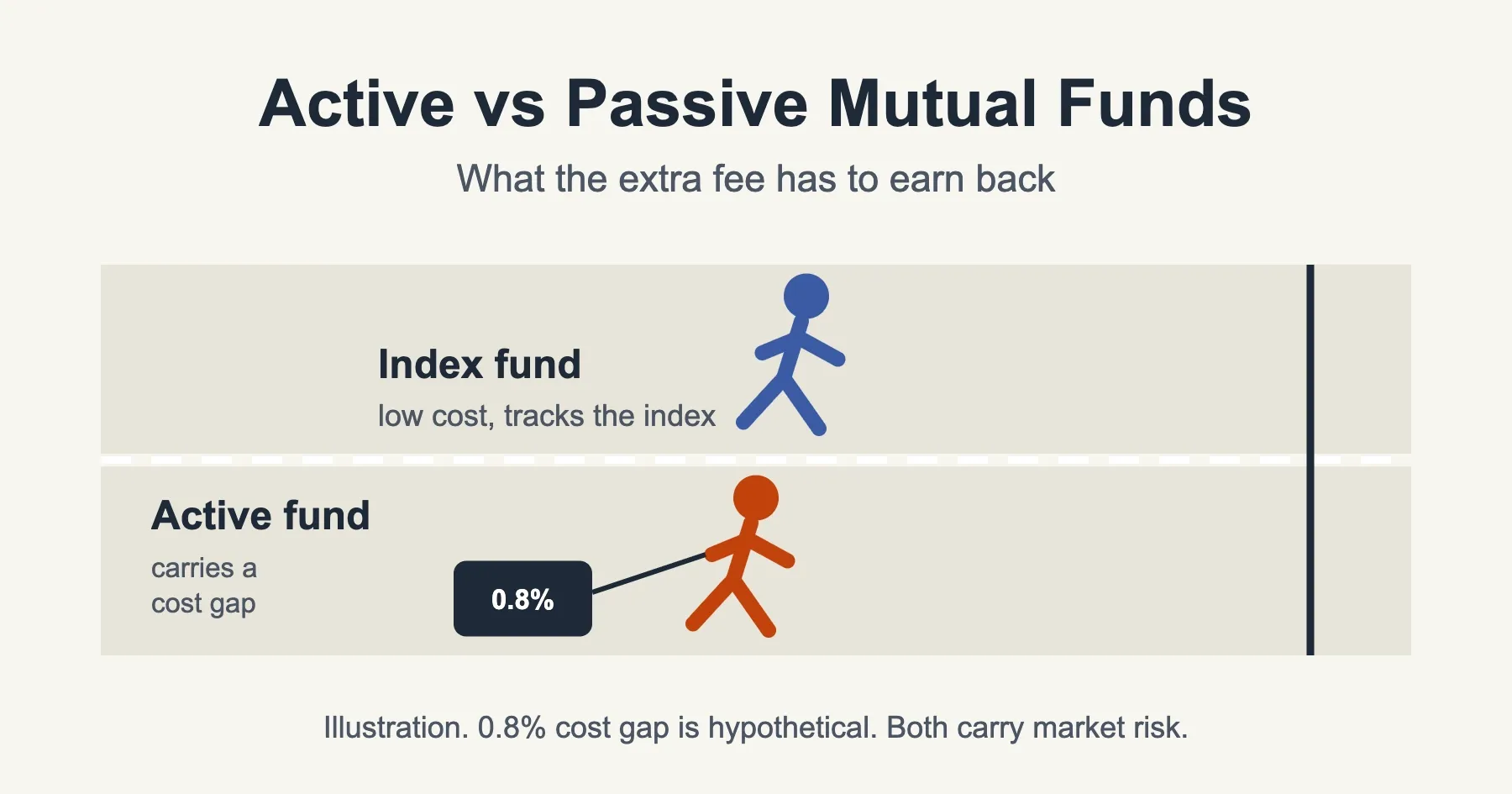
- A passive fund (index fund or ETF) aims to match an index at low cost; an active fund tries to beat its benchmark and charges more for it.
- In the hypothetical example, an active fund that only matches the index ends ₹3,23,818 behind after 15 years; it must beat the index by the 0.8-point cost gap just to tie.
- SPIVA India Mid-Year 2026: most active large cap funds lagged over 3 and 5 years; mid/small cap results swung from 15.00% lagging (1 year) to 81.67% (10 years).
- Passive funds held about 17.7% of industry assets as of 31 October 2026, per AMFI.
- Decide by category, cost gap, tracking quality, time horizon and comfort with lagging, not by a general "which is better".
As of 22 November 2026: a passive mutual fund (an index fund or an ETF) aims to match an index at a low cost, while an active mutual fund pays a manager to try to beat that index and charges more for trying. So an active fund has to out-earn its index by at least the cost gap just to tie a passive fund on the same index. How often active funds manage that differs sharply by category and time period, so "active vs passive mutual funds: which is better" has no single answer.
Tejas, 27, a software tester in Kochi, is comparing an index fund with a pricier active fund for his second SIP. This page gives him the maths and the evidence, not a verdict.
What a passive fund does
A passive fund copies an index: same securities, roughly the same weights, changed only when the index changes. It comes in two forms:
- Index funds: bought and redeemed with the fund house at the day's NAV, which suits an SIP.
- ETFs (exchange traded funds): listed on a stock exchange and bought through a demat account at the market price. See index fund vs ETF for an SIP.
A passive fund does not match its index exactly. Tracking difference is the gap between the fund's return and the index's over a period; costs are the main reason it is usually negative. Tracking error is how much that gap varies; lower means closer tracking. Two funds on the same index can differ on both, as our guide to comparing two index funds on the same index shows.
What an active fund does
An active fund's manager chooses what to buy, how much and when to sell, within the rules SEBI sets for the fund's category. SEBI's circular on Categorization and Rationalization of Mutual Fund Schemes, dated 26 February 2026, is the current rulebook for those categories, and the scheme's SID states the category, strategy and benchmark.
The benchmark is the yardstick, and the fair test uses its Total Return Index (TRI), which adds dividends back. See what a benchmark is and why TRI is the fair test.
Active vs passive mutual funds, side by side
| What you compare | Passive fund (index fund or ETF) | Active fund |
|---|---|---|
| Goal | Match the index, minus costs | Beat the benchmark, after costs |
| Who decides what to hold | The index | The fund manager, within SEBI category rules |
| Cost | Usually a lower expense ratio | Usually higher, paying for research and management |
| Risk of lagging the index | Small: roughly costs plus tracking difference | Can lag by much more, or lead |
| What to check | Expense ratio, tracking difference, tracking error | Expense ratio, return vs TRI benchmark over several periods |
Expense ratios vary by scheme and plan; check the scheme's disclosures. For current ceilings, see our expense ratio guide.
The cost hurdle, in rupees
This example is hypothetical: the rates are assumptions, not expected returns. Tejas invests ₹10,000 at the start of each month for 15 years (₹18,00,000 in total), compounded monthly. The index returns 11% a year. The passive fund costs 0.2% a year and the active fund 1.0%, a cost gap of 0.8 percentage points. The passive fund's tracking difference is taken as its cost alone.
| Scenario (hypothetical) | Net annual return | Value after 15 years |
|---|---|---|
| Passive fund tracks the index | 10.8% | ₹45,03,061 |
| Active fund beats the index by 1.5 points before costs | 11.5% | ₹48,10,828 |
| Active fund matches the index before costs | 10.0% | ₹41,79,243 |
| Active fund lags the index by 1 point before costs | 9.0% | ₹38,12,438 |
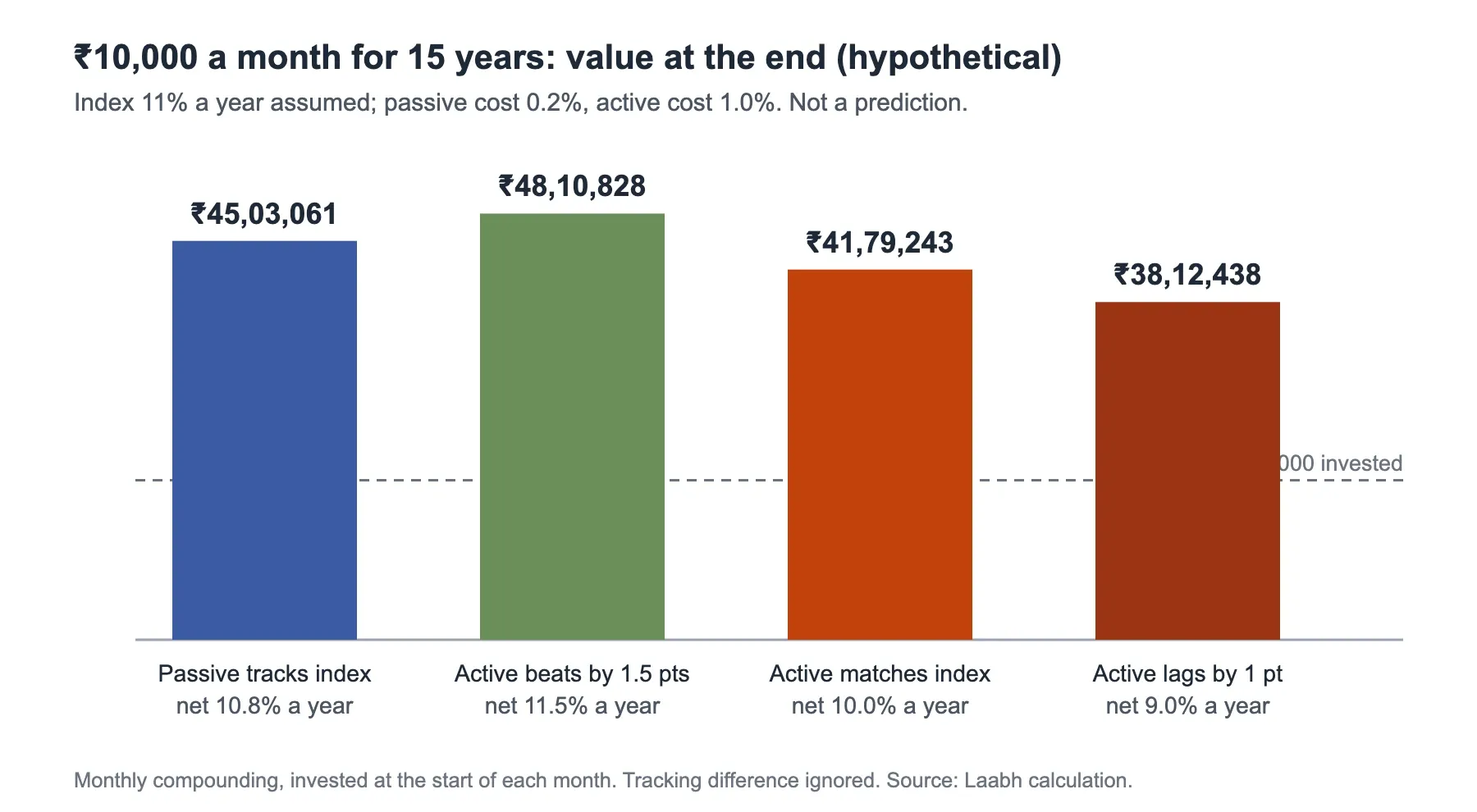
- Matching the index is not enough. If the manager picks exactly as well as the index, Tejas ends ₹3,23,818 behind the passive investor: the cost gap, compounded.
- To tie, the active fund must beat the index by 0.8 points a year before costs, on average, for all 15 years.
- The outcomes cut both ways. Beating the index by 1.5 points leaves him ₹3,07,767 ahead; lagging by 1 point leaves him ₹6,90,623 behind.
What the data says, by category
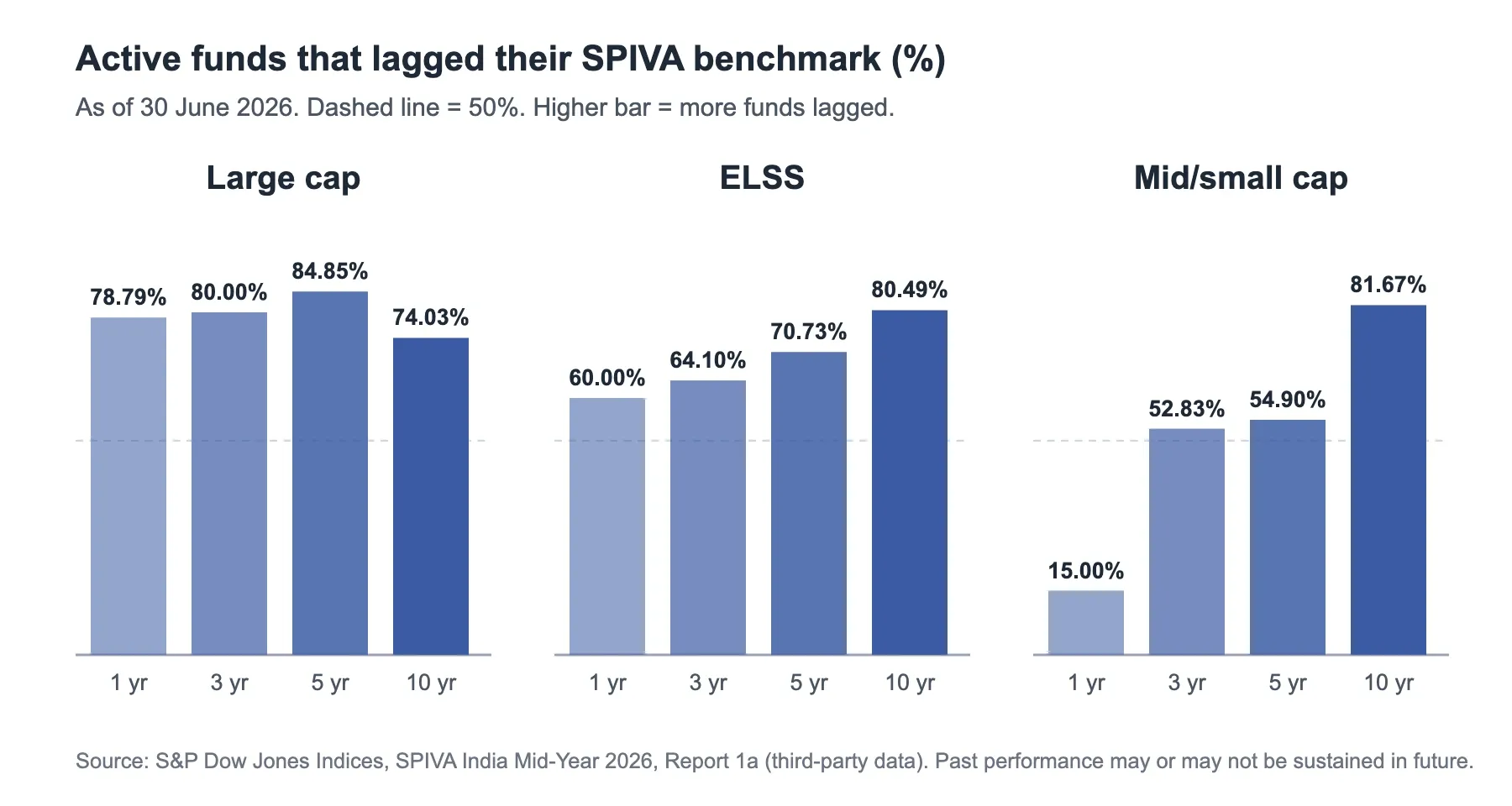
One widely cited public scorecard is SPIVA India from S&P Dow Jones Indices, a third-party index provider. Its Mid-Year 2026 report covers periods to 30 June 2026 and measures active funds against S&P indices it picks for each category, which may differ from the benchmark in a fund's own SID. One source, about the past.
Share of active funds that underperformed the SPIVA benchmark (as of 30 June 2026):
| Category (SPIVA benchmark) | 1 year | 3 years | 5 years | 10 years |
|---|---|---|---|---|
| Large cap (S&P India LargeMidCap) | 78.79% | 80.00% | 84.85% | 74.03% |
| ELSS (S&P India BMI) | 60.00% | 64.10% | 70.73% | 80.49% |
| Mid/small cap (S&P India SmallCap) | 15.00% | 52.83% | 54.90% | 81.67% |
Large cap
80.00% of active large cap funds lagged over 3 years and 84.85% over 5. Large companies are widely researched, which plausibly leaves less for a manager to find.
Mid/small cap
The period changes the picture: over 1 year only 15.00% lagged, but over 10 years 81.67% did.
ELSS
ELSS (equity-linked savings schemes) are measured against a broad market index, and the share lagging rises with the period: 60.00% over 1 year, 80.49% over 10.
Also read survivorship: per the same report, only 80.52% of large cap funds and 70.73% of ELSS funds present at the start of the 10 years still existed at the end.
How much money is in passive funds now
AMFI's Monthly Note for October 2026 puts index funds and ETFs at ₹14,79,681 crore as of 31 October 2026, out of industry assets of ₹83,38,858 crore: about 17.7% (our calculation). That figure includes debt, gold and silver products; equity index funds and equity ETFs alone come to ₹10,47,251 crore.
Questions to ask yourself before choosing
- Which category am I in? The large cap scorecard is not the mid/small cap one.
- What is the exact cost gap? Compare expense ratios in the same plan type (direct with direct) and run it through the rupee table above.
- How closely does the passive option track? Check tracking difference and tracking error, not only cost.
- How long will I stay? In mid/small cap, 1-year and 10-year results pointed in opposite directions.
- Can I live with lagging? An active fund can trail for years; a passive fund trails by roughly its costs and tracking difference, and falls when the index falls. Both carry market risk.
- Am I doubling up? An index fund and an active fund in the same category may hold many of the same stocks; see portfolio overlap.
Active vs passive ETFs
Most ETFs in India track an index, so "ETF" and "passive" usually go together. Before buying any ETF, read its SID: it states whether the fund tracks an index, and which.
Frequently asked questions
What is the difference between active and passive mutual funds?
A passive fund copies an index and aims to match its return minus costs. An active fund's manager picks securities to try to beat a benchmark, and usually charges a higher expense ratio for it.
Are passive funds better than active funds?
Not across the board. An active fund must beat its index by the cost gap just to tie, and how often that happened varies: per SPIVA India Mid-Year 2026, 80.00% of large cap funds lagged over 3 years, but only 15.00% of mid/small cap funds over 1 year.
What is a passive fund in India?
An index fund or an ETF that tracks a market index instead of relying on a manager's picks. Index funds are bought at NAV from the fund house; ETFs trade on an exchange.
Why do active funds charge more?
They pay a fund manager and research team to choose securities. In the hypothetical ₹10,000-a-month example, a 0.8-point annual cost gap adds up to ₹3,23,818 over 15 years if the active fund only matches the index.
Can I hold both active and passive funds?
Yes. Check whether the two funds hold many of the same stocks, and whether the active fund's extra cost makes sense for that category. This is a factor check, not an allocation recommendation.
Save this checklist
Save the six questions above for the next time you compare two funds.



