SIP vs Lump Sum: The Same ₹1.2 Lakh Through Three Market Paths, and Why the Answer Depends on When the Money Arrives
SIP vs lumpsum with the same ₹1.2 lakh on three price paths: units, average cost and end value, plus STP and the waiting cash. As of 22 Nov 2026.
Summarize this article with AI





The short version
- If money arrives monthly, an SIP is how it gets invested; the real choice is only for a sum you already hold.
- With the same ₹1.2 lakh, the lump sum ended ahead on a steady rise and a rise-then-fall; the SIP ended ahead when prices fell first (hypothetical).
- An SIP does not remove risk; it changes which price path hurts.
- Interest on the SIP's waiting cash narrows the gaps but did not change the outcome here.
- An STP spreads entry like an SIP, with an exit load and tax check on each transfer.
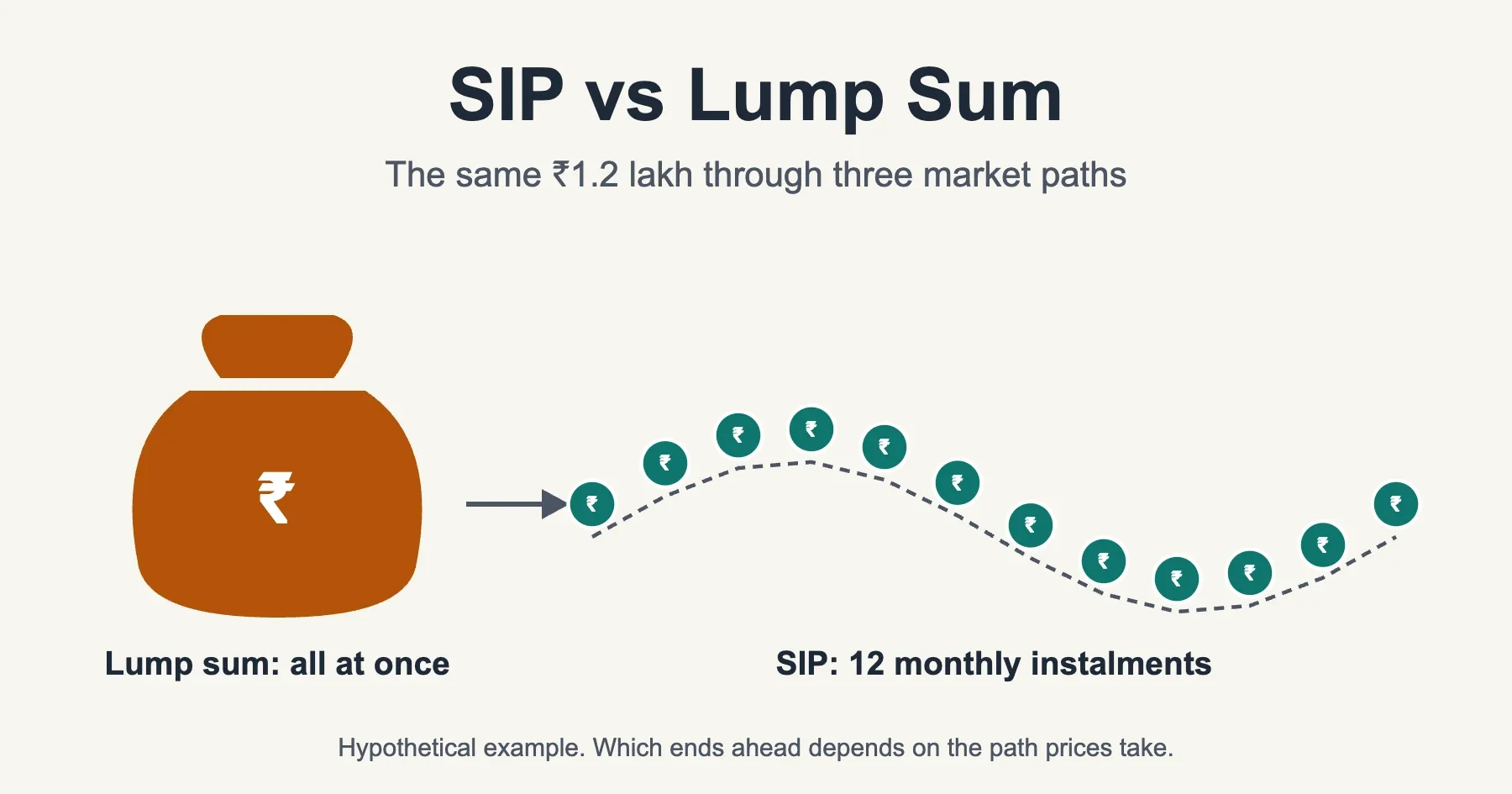
As of 22 November 2026: an SIP invests a fixed amount in a mutual fund scheme at regular intervals; a lump sum invests the whole amount in one go. If prices rise after you start, the lump sum usually ends ahead; if they fall first, the SIP usually does. If your money arrives monthly from salary, an SIP is simply how it gets invested, so the real SIP vs lump sum choice is only for money you already hold.
Devansh, 28, in Hyderabad, has a ₹1.2 lakh FD that just matured and an equity fund in mind for a goal about seven years away. Fixed-rate comparisons hide what separates the two methods: what prices do after he starts. So this page runs his ₹1.2 lakh through invented price paths.
First question: does the money already exist?
- Money that arrives monthly. A ₹10,000 surplus from each month's salary does not exist yet in month 1, so it cannot go in as a lump sum. Investing it as it arrives, through an SIP, is not a strategy choice; it is how that money gets invested.
- A sum you already hold. An FD maturity, built-up savings, a gift or sale proceeds. Here the choice is real: invest it all now (lump sum), or spread the entry over months through an SIP from your bank or an STP from a liquid or debt fund.
Devansh is in the second group.
What each method does
| Lump sum | SIP | |
|---|---|---|
| Payments | One payment | A fixed amount at regular intervals, usually by bank mandate |
| NAV you get | One NAV, set by when your money reaches the fund and the cut-off time | A different NAV for each instalment |
| Units | All bought on one date | Bought in batches, each with its own date |
| Money exposed to the market | All of it from day one | Builds up instalment by instalment |
Minimums depend on the scheme; check its scheme information document (SID). New to NAV? See what NAV means. Spreading purchases is called rupee cost averaging; AMFI's booklet says it helps average purchase cost but does not ensure a profit or prevent a loss.
Worked example: ₹1.2 lakh, three market paths
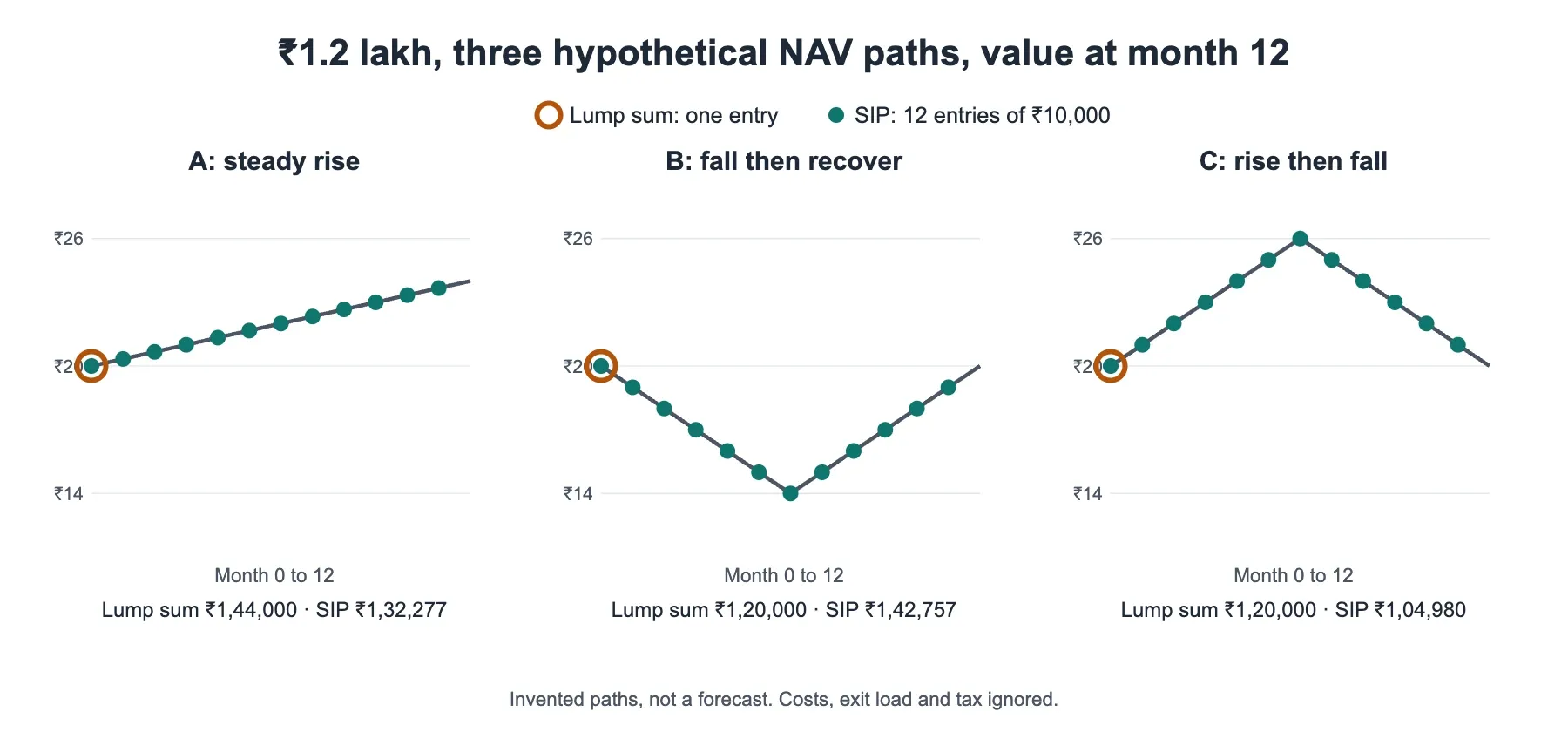
Set-up (hypothetical): ₹1,20,000. Lump sum: all at month 0 at a NAV of ₹20, buying 6,000 units. SIP: ₹10,000 at the start of months 0 to 11. Both valued at month 12. NAV moves in a straight line month by month between the points shown. Paths are invented, not a forecast; costs, exit loads and taxes ignored. Path D is an extra comparison.
| Path (NAV at month 0, 6, 12) | Lump sum value | SIP units | SIP average cost | SIP value | Who ends ahead |
|---|---|---|---|---|---|
| A: steady rise, ₹20, ₹22, ₹24 | ₹1,44,000 | 5,511.53 | ₹21.77 | ₹1,32,277 | Lump sum, by ₹11,723 |
| B: fall then recover, ₹20, ₹14, ₹20 | ₹1,20,000 | 7,137.83 | ₹16.81 | ₹1,42,757 | SIP, by ₹22,757 |
| C: rise then fall, ₹20, ₹26, ₹20 | ₹1,20,000 | 5,248.99 | ₹22.86 | ₹1,04,980 | Lump sum, by ₹15,020 |
| D: fall and stay low, ₹20, ₹15, ₹16 | ₹96,000 | 7,263.42 | ₹16.52 | ₹1,16,215 | SIP, by ₹20,215 |
The waiting cash. The SIP's not-yet-invested money sits somewhere. At an assumed 6% a year (hypothetical, simple interest, before tax), the shrinking balance (₹1,10,000 in month 1, ₹1,00,000 in month 2, and so on) earns about ₹3,300. Adding it, the SIP reaches ₹1,35,577 in path A (gap ₹8,423), ₹1,46,057 in B, ₹1,08,280 in C (gap ₹11,720) and ₹1,19,515 in D. It narrows the gaps without changing who ends ahead.
What the table shows: the path decides, and you can't see it in advance
- A: prices only rose, so each later instalment bought fewer units.
- B: 11 of 12 instalments bought below ₹20. The NAV ends where it started, so the lump sum is flat and the SIP about 19% up.
- C: the NAV again starts and ends at ₹20, but 11 instalments bought above ₹20, so the SIP ends ₹15,020 down. An SIP is not automatically safer; it changes which path hurts.
- D: both lose: the lump sum ₹24,000, the SIP ₹3,785.
No one can reliably know in advance which path the next 12 months will take, so this page picks no winner. From month 12 both are fully invested, so later moves affect them alike: the choice is about the entry window. If prices fall while your SIP runs, see what happens to an SIP when the market falls.
The in-between option: STP from a liquid or debt fund
AMFI's booklet describes a systematic transfer plan (STP) as transferring a fixed amount from one scheme to another at regular intervals, usually from a debt fund into an equity fund. Devansh could put the ₹1.2 lakh in a liquid fund and transfer ₹10,000 a month into the equity fund: entry is spread as in the SIP column, and the waiting money sits in the liquid fund. Check three things:
- Exit load in the source fund. Each transfer redeems units of the source fund, so any exit load in its SID applies within the load period. The SEBI (Mutual Funds) Regulations, 2026 cap an open-ended scheme's exit load at 3% of NAV; each scheme sets its own. See exit load and SEBI's 3% ceiling.
- Tax on each transfer. Gains on the units redeemed are taxable in that year, under the rules for that type of fund.
- The parking return is not fixed. It can differ from the 6% assumed above. Liquid ETF vs liquid fund covers where short-term money can sit.
For the bonus version of this choice, see bonus: lump sum or SIP.
Factors to weigh for a sum in hand
| Factor | Question to ask | What the answer points to |
|---|---|---|
| Horizon | When will you need the money? | Under about 3 years, equity by either method is commonly seen as a mismatch |
| A fall in month 2 | If the fund fell 25% in month 2, would you sell? | If yes, full exposure from day one may be hard to hold; spreading limits early exposure |
| Where the money sits | Bank, FD or another fund? | From another fund, moving it is a redemption |
| Exit load and tax | Is it leaving another scheme? | Check that scheme's exit load and tax first |
| Follow-through | Will every instalment get invested? | An SIP or STP stopped in month 3 leaves cash idle |
In numbers (hypothetical): a 25% fall early in month 2, before that month's instalment, shows the lump sum's ₹1,20,000 at ₹90,000, but only hits the SIP's ₹20,000 already invested (₹15,000 if bought at ₹20).
Two things that don't change between SIP and lump sum
Same fund, same costs. The expense ratio is taken from the fund's assets and reflected in its NAV, whichever method bought your units.
Same tax rules, unit by unit. As of 22 November 2026, AMFI's tax corner treats equity-oriented fund units held more than 12 months as long-term. Under the Income-tax Act, 2025, short-term gains on them are taxed at 20% where securities transaction tax applies (section 196), and long-term gains above ₹1,25,000 a year at 12.5% (section 198), plus surcharge and cess. A lump sum's units share one purchase date; each SIP batch has its own, so in month 13 an SIP holding is part long-term, part short-term. Scheme documents commonly state that units are redeemed first in, first out; check your SID.
Frequently asked questions
Which is better, SIP or lump sum?
Neither wins on every path. In the hypothetical ₹1.2 lakh example, a steady rise left the lump sum ₹11,723 ahead and a fall-then-recovery left the SIP ₹22,757 ahead. If your money arrives monthly, an SIP is simply how it gets invested.
What is a lump sum investment in mutual funds?
Investing the whole amount in a scheme in one payment, so all units are bought at one NAV, subject to cut-off times. The full amount is exposed to market moves from that day.
When should I invest a lump sum in a mutual fund?
No one can reliably time it. Weigh your horizon, whether you would hold through a sharp early fall, where the money sits now, and any exit load or tax if it leaves another fund. If a fall in month 2 would make you sell, spreading entry through an SIP or STP is the alternative.
Is STP better than lump sum?
Not by default. An STP moves a fixed amount from one scheme, usually a liquid or debt fund, into another at regular intervals, spreading entry like an SIP. Check the source fund's exit load and the tax on each transfer. Whether it ends ahead depends on the price path.
SIP ya lumpsum kaun sa better hai?
Pehle dekhiye paisa ek saath hai ya har mahine aata hai. Har mahine aata hai to SIP hi seedha raasta hai. Paisa haath me hai to market pehle badhe to lump sum aage, pehle gire to SIP; yeh pehle se koi nahi jaanta.
Save this page
Save this page for the next time a lump sum lands in your account.



