Is an SIP risk-free? What can go wrong and what an SIP reduces
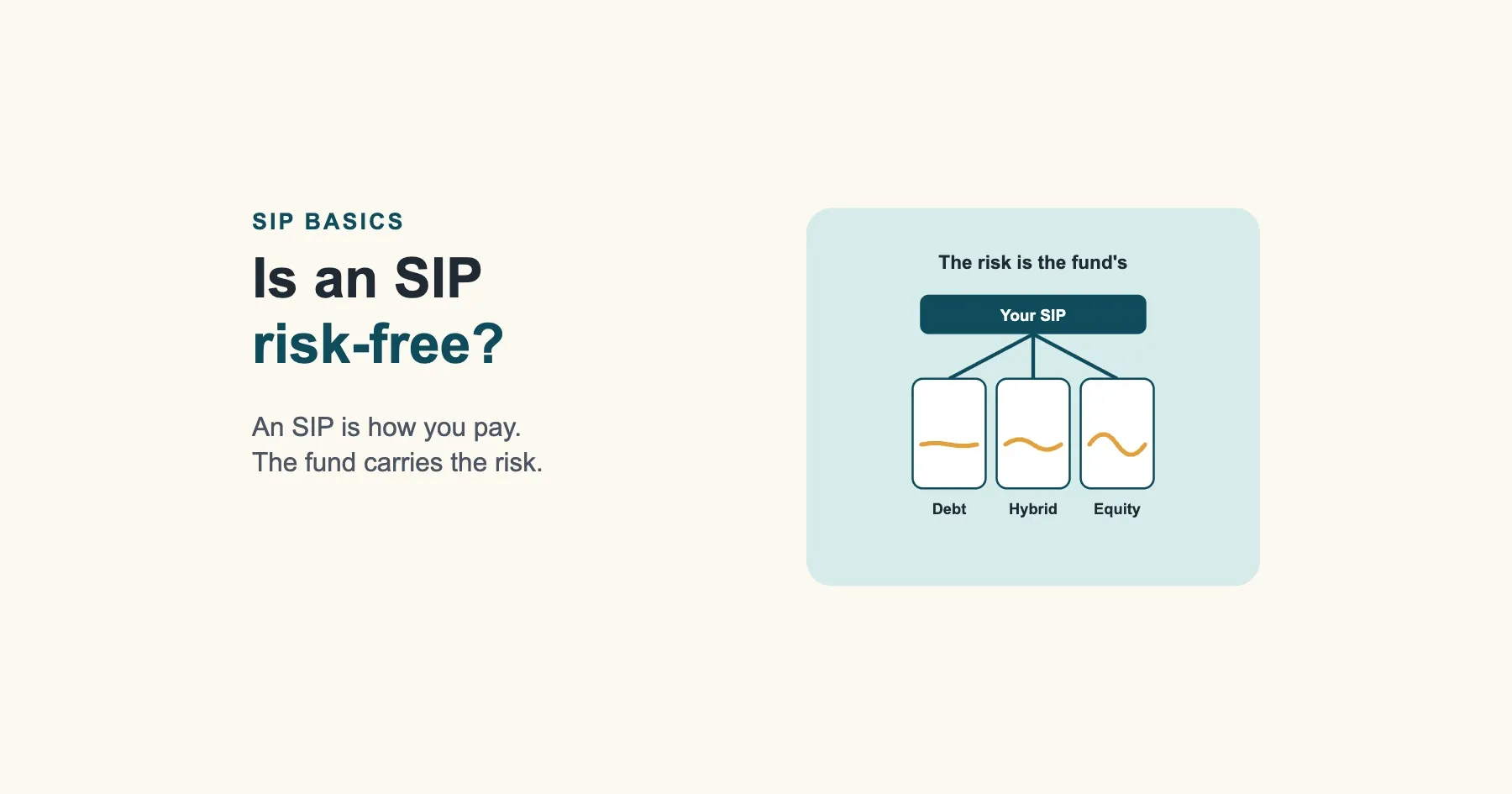
No. An SIP is a way to invest; the risk is the fund's. Read the riskometer, a hypothetical ₹2,000-a-month example, and why an SIP can show a loss.
Summarize this article with AI





The short version
- An SIP is a way of paying into a mutual fund; the scheme carries the risk.
- Your SIP value can fall below the amount invested.
- Check the scheme's riskometer; SEBI's circular says it is evaluated monthly.
- Rupee-cost averaging reduces timing risk only.
- Over one year, negative SIP returns are a normal possibility for funds holding shares.
No. An SIP (systematic investment plan) is a way of investing a fixed amount in a mutual fund at regular intervals. It has no safety level of its own. The risk depends on the fund you choose, shown on that scheme's riskometer, and the value of your SIP can fall below what you have put in.
Is SIP risk free?
An SIP feels steady: the same amount leaves your account on the same date every month, much like a recurring deposit. The outcome isn't.
But the SIP only decides how money enters a fund. The fund decides what happens to it after that. ₹2,000 a month into a fund holding shares behaves very differently from ₹2,000 a month into a fund holding short-term bonds, though both are "SIPs".
SEBI's investor FAQs say of mutual funds: "Like all investments, they also carry certain risks." The useful question is not "is SIP safe?" but "how risky is the fund my SIP goes into?" For the basics, see our guide to what an SIP is.
Can you lose money in an SIP?
Yes. If the fund's NAV (the price of one unit) falls, the units you hold are worth less, and your SIP value can sit below the total you have invested. This tends to show up when:
- markets fall soon after you start;
- you check after a short period, before any recovery;
- the fund is riskier than you expected, such as a sectoral or small-company fund;
- in debt funds, interest rates rise sharply or a bond the fund holds is downgraded or defaults.
AMFI's guide names "Market risk, meaning the value of the fund moves up and down with changes in stock and bond markets," and adds "interest-rate risk, credit/default risk and concentration risk." None of these goes away because you invest monthly.
Where the risk actually sits: category and riskometer
Under SEBI's October 2020 circular on product labelling, every scheme's riskometer has six levels, from "Low Risk" to "Very High Risk". The circular says it "shall be evaluated on a monthly basis", is disclosed with the portfolio on the fund house's and AMFI's websites "within 10 days from the close of each month", and that "Any change in risk-o-meter shall be communicated" to the scheme's unitholders. Rules are updated from time to time, so confirm the current position in the scheme documents and on SEBI's website.
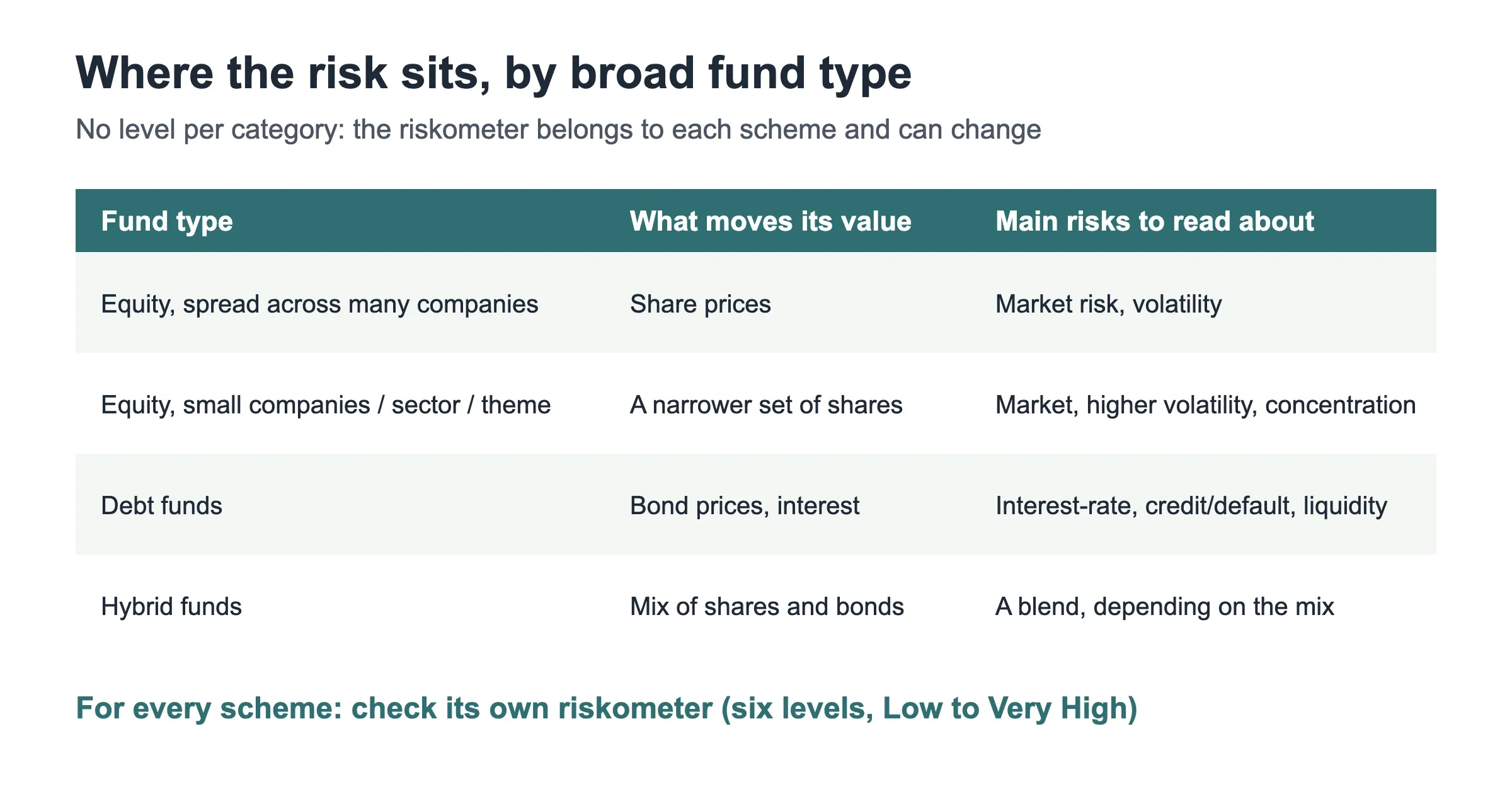
The table gives no level per category on purpose: the level belongs to each scheme and can change.
| Broad fund type | What moves its value | Main risks to read about | Where to check its level |
|---|---|---|---|
| Equity funds spread across many companies | Share prices | Market risk, volatility | That scheme's riskometer |
| Equity funds focused on small companies, a sector or a theme | Prices of a narrower set of shares | Market risk, higher volatility, concentration risk | That scheme's riskometer |
| Debt funds | Bond prices and interest earned | Interest-rate risk, credit/default risk, liquidity risk | That scheme's riskometer |
| Hybrid funds | A mix of shares and bonds | A blend of the above, depending on the mix | That scheme's riskometer |
Our explainer on the six riskometer levels shows how to read the label, and which type of fund a beginner might start with covers the categories.
What rupee-cost averaging does and doesn't do
A fixed rupee amount buys more units when the NAV is low and fewer when it is high. SEBI's FAQs describe this as a chance to "enter the market regularly, thus averaging the acquisition cost of Units."
Take ₹2,000 a month for 12 months (₹24,000 in total) in two made-up paths. Convention: each instalment is invested at the start of the month at that month's NAV; value is measured at the end of month 12. Starting NAVs for months 1 to 12: path A ₹100, 97, 94, 91, 88, 85, 85, 85, 86, 86, 87, 87 (₹87 at the end); path B ₹100, 97, 94, 91, 88, 85, 88, 91, 94, 97, 99, 100 (₹102 at the end).
Hypothetical NAV paths, not a promise; returns vary and can be negative.
| Path A: falls, recovers a little | Path B: falls, then recovers fully | |
|---|---|---|
| NAV (starts at ₹100) | ₹85 by month 6, ends at ₹87 | ₹85 by month 6, ends at ₹102 |
| Total invested | ₹24,000 | ₹24,000 |
| Units bought | 269.68 | 256.93 |
| Average cost per unit | ₹89.00 | ₹93.41 |
| Value at end of month 12 | ₹23,462 | ₹26,207 |
| Gain or loss | –₹538 | +₹2,207 |
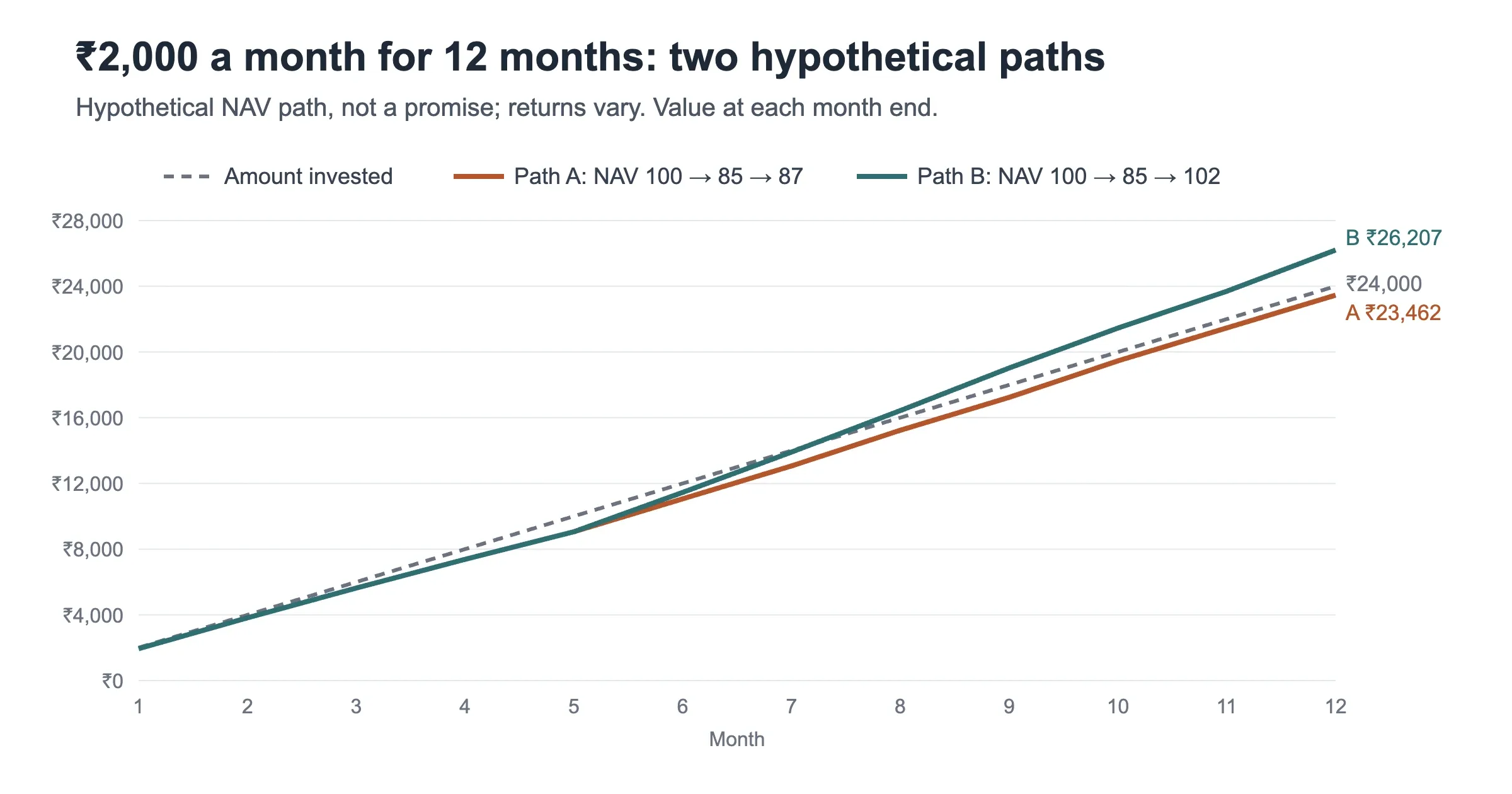
What averaging did: it pulled the average cost below the starting NAV of ₹100 in both paths. In path B the NAV ends 2% above its start, yet the SIP is up about 9.2%, thanks to the cheaper units bought in the dip.
What it didn't do: in path A the NAV did not climb back to the ₹89 average cost within 12 months, so the SIP ended about 2.24% below the amount invested. Even path B sat below the amount invested for the first seven months. Averaging lowers entry cost; as AMFI's guide puts it, it "doesn't guarantee profits or prevent losses".
Is SIP safer than lump sum investing?
Same fund risk, different timing risk. A lump sum enters at one price; an SIP spreads money across many prices.
In the same hypothetical paths, ₹24,000 invested at once at ₹100 would end at ₹20,880 in path A and ₹24,480 in path B, behind the SIP both times. But in a hypothetical path where the NAV rises steadily from ₹100 to ₹112, the lump sum ends at ₹26,880 and the SIP at ₹25,506, because the SIP keeps buying at higher prices.
An SIP fits if your money arrives monthly, or you'd rather not commit everything at one price. A lump sum fits if the money is already with you and you're comfortable with the fund's swings from day one. For a bonus, lump sum, SIP or STP compares the routes.
Why is my SIP showing negative returns after one year?
A year is short for a fund that holds shares. Only the first instalment has been invested for a full year; the last, about a month. If the market fell during the year, most of your money has had little time to recover.
- Read XIRR, not the simple percentage. It accounts for each instalment's date; our plain-English guide to XIRR shows how.
- Judge it against the fund's horizon. A negative figure after a fall is how market-linked funds can behave, not a sign the SIP "broke".
Whether to continue depends on your goal and timeline; what happens to your SIP when the market falls sets out what to weigh.
How SIP risk differs from FD and RD
A bank FD or RD pays an interest rate set when you open it, and its value does not move with the stock or bond markets. An SIP buys fund units whose NAV moves with the value of what the fund holds.
Deposits have their own risks: interest after tax may trail inflation, and breaking one early can cost interest. The kind of risk differs. SIP vs FD vs RD starts with when you'll need the money.
Frequently asked questions
Is SIP safe?
An SIP is a method of investing, so its risk is the fund's. Equity funds can fall in value; debt funds carry interest-rate and credit risk. Read the scheme's riskometer and documents first.
Can an SIP give negative returns?
Yes. If the NAV falls below your average cost per unit, the SIP shows a loss. In hypothetical path A above, ₹24,000 invested over 12 months was worth ₹23,462.
Which type of mutual fund SIP has the lowest risk?
No mutual fund is risk free. Risk is set scheme by scheme on the riskometer, from Low to Very High, and evaluated monthly. Check the specific scheme's riskometer rather than assuming a level from its category.
Should I stop my SIP if it is showing a loss?
That depends on your goal, timeline and whether the fund still suits you; one number can't decide it. Our article on SIPs in a falling market sets out what to weigh before stopping.
Read next
Compare what tends to happen to an SIP when markets fall, and what to think about before stopping: what happens to your SIP when the market falls.
— Laabh



