What Is a PPF Account? The 15-Year Timeline of What You Can Deposit, Borrow and Withdraw, Year by Year
What a PPF account is, year by year: deposit ₹500 to ₹1.5 lakh, borrow from year 3, withdraw from year 7, extend after 15. Rate 7.1% for Oct to Dec 2026.
Summarize this article with AI





The short version
- PPF is a 15-year government small savings account; deposits are ₹500 to ₹1.5 lakh a year.
- The rate is notified quarterly: 7.1% for October to December 2026.
- Loans in years 3 to 6; partial withdrawals from year 7; premature closure from year 7 only on listed grounds.
- After year 15 you can close, extend with deposits (Form-4 within one year), or continue without deposits.
- The section 123 deduction is old-regime only; interest and maturity are exempt in both regimes (Schedule II).
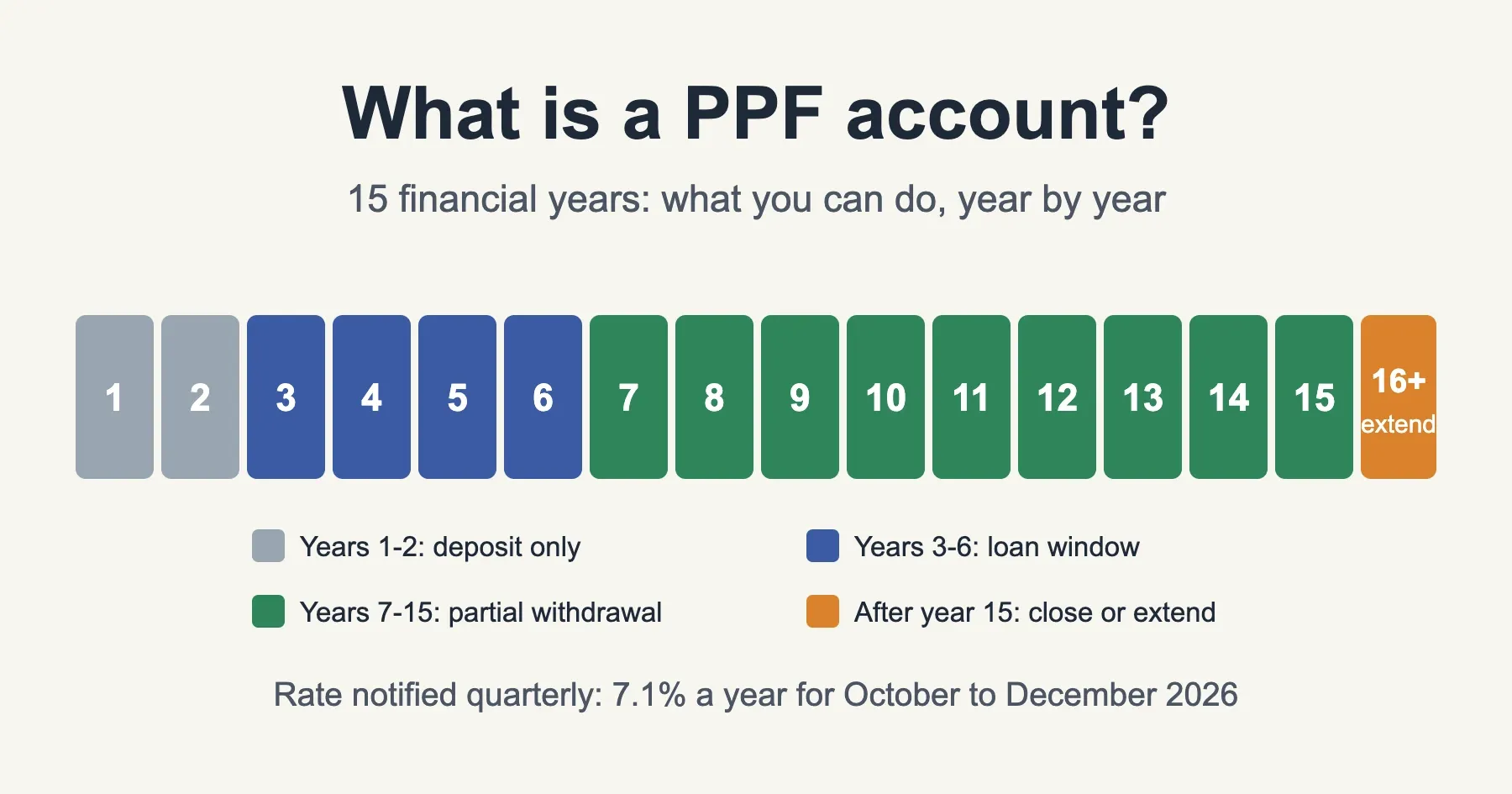
As of 25 November 2026: a Public Provident Fund (PPF) account is a Central Government small savings account, governed by the PPF Scheme, 2019, that runs for 15 financial years. You deposit between ₹500 and ₹1.5 lakh each financial year, and the interest rate is notified by the Ministry of Finance every quarter: 7.1% a year for 1 October to 31 December 2026. You can borrow against it from the third financial year, withdraw part of it from the seventh, and extend it in five-year blocks after maturity.
Pranav, 26, works in Nagpur, and his parents want him to open a PPF account. His questions: how long is the money stuck, what can he do before year 15, and does it still save tax? One timeline table and one worked example answer them.
What a PPF account is, and who can open one
PPF is a government-backed savings scheme. Its current rules are the Public Provident Fund Scheme, 2019 (G.S.R. 915(E), 12 December 2019), notified under the Government Savings Promotion Act, 1873.
Opening for yourself or for a minor
You open an account on Form-1; a guardian can open one account for a minor. Joint accounts are not allowed. The ₹1.5 lakh yearly maximum covers your own account and any minor's account you run.
Residency
Form-1 asks you to declare that you are a resident citizen of India and to report any change. A change in residency status is one of the listed grounds for early closure.
How PPF interest works, in one paragraph
Interest is worked out monthly on the lowest balance between the close of the fifth day and the month-end, and credited at the end of the financial year (31 March). A deposit made by the 5th earns that month's interest; one made on the 6th does not. Our guide to the 5th-of-the-month rule shows the arithmetic month by month.
The 15-year PPF timeline
Year 1 is the financial year you open the account. The rules count from the end of that year, so the windows open in years 3 and 7.
| Financial year | Deposit allowed? | Loan? | Partial withdrawal? | Premature closure? | Limit formula |
|---|---|---|---|---|---|
| Years 1 to 2 | Yes, ₹500 to ₹1.5 lakh, in multiples of ₹50 | No | No | No | Deposit cap includes any minor's account you run |
| Years 3 to 6 | Yes | Yes, one loan a year, only after the earlier loan is repaid | No | No | Loan up to 25% of the balance at the end of the second year before the year you apply |
| Years 7 to 15 | Yes | No | Yes, once a year | Yes, only on the listed grounds, with interest 1% lower | Withdrawal up to 50% of the lower of: balance at end of the fourth year before, or end of the year before |
| After year 15 | Only if you extend with deposits (Form-4) | No | Yes, once a year | Not applicable | Extension with deposits: total withdrawals in a 5-year block up to 60% of the balance at the block's start |
A loan is repaid within 36 months, after which interest of 1% a year on the principal is charged; miss the 36 months and it is 6% a year. The listed grounds for premature closure are treatment of a life-threatening disease of the holder, spouse, dependent children or parents; the holder's higher education; and a change in residency status.
Worked example: one saver, 15 years (hypothetical)
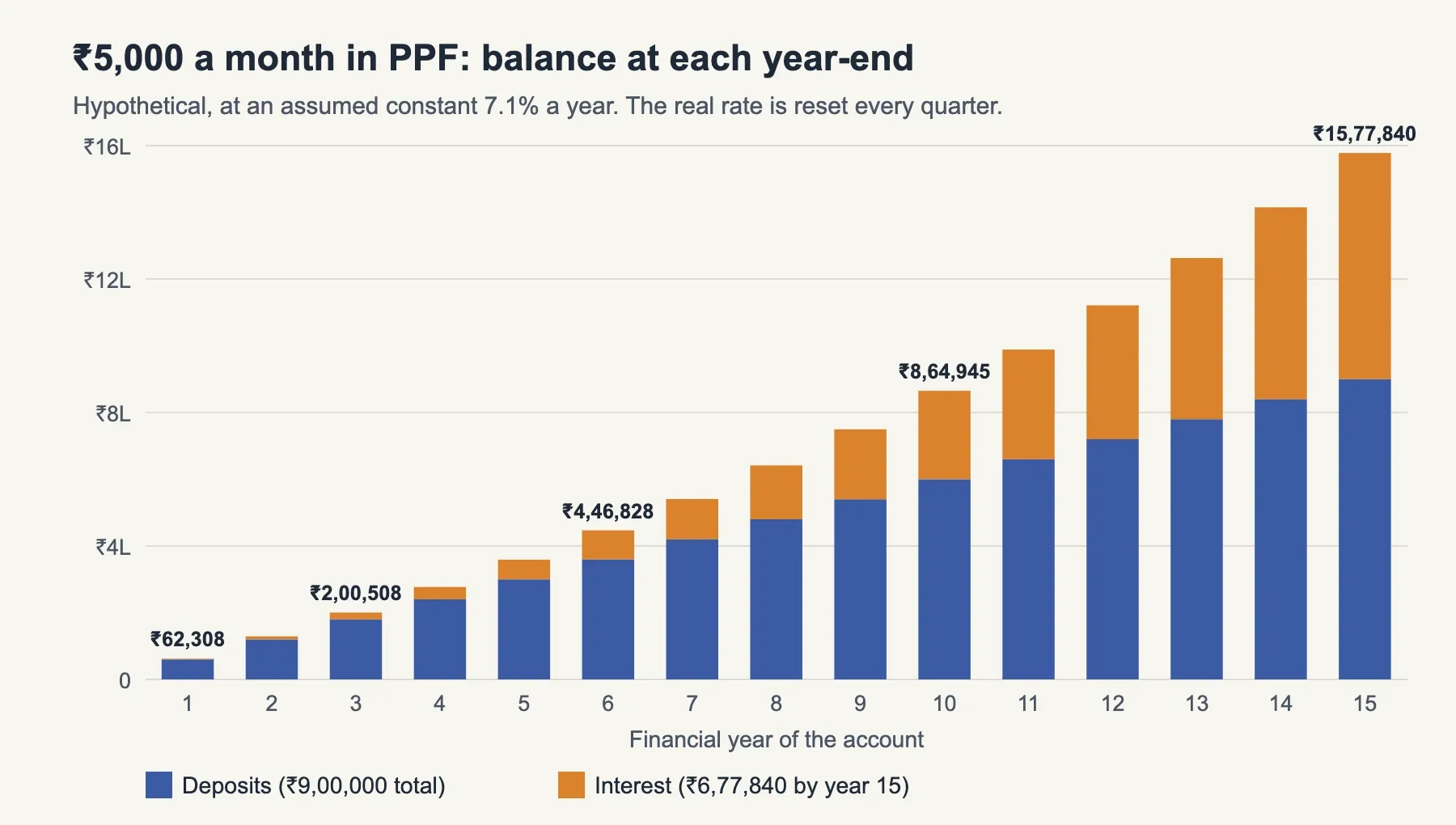
Pranav deposits ₹5,000 by the 5th of every month from April of year 1 (₹60,000 a year) for 15 financial years. These figures assume 7.1% stays unchanged for 15 years, which will not happen; the rate is reset every quarter.
| Checkpoint | Balance at year-end, at an assumed constant 7.1% (₹) |
|---|---|
| End of year 1 | 62,308 |
| End of year 3 | 2,00,508 |
| End of year 6 | 4,46,828 |
| End of year 10 | 8,64,945 |
| End of year 15 (maturity) | 15,77,840 |
He deposits ₹9,00,000 in total, and interest at the assumed rate adds ₹6,77,840.
Along the way, at the same assumed rate:
- Loan in year 3: up to 25% of the year-1 closing balance, about ₹15,577.
- Partial withdrawal in year 7: up to 50% of the lower of the year-3 balance (₹2,00,508) and the year-6 balance (₹4,46,828), about ₹1,00,254.
- Timing variation: if he put the same ₹60,000 in as one sum by 5 April each year, the maturity figure would be about ₹16,27,284, because each rupee earns interest for more months. This shows timing, not a recommendation.
- Extension without deposits: leaving ₹15,77,840 in for five more years would grow to about ₹22,23,362 by the end of year 20.
What happens at year 15: close, extend with deposits, or extend without
After 15 years from the end of the opening year, you have three choices:
- Close it on Form-3 and take the balance.
- Extend with deposits. Apply on Form-4 within one year of maturity. The account runs another five years, deposits continue within the same limits, and withdrawals in the block can total 60% of the balance at its start, one a year. For Pranav that would be up to about ₹9,46,704 over five years.
- Do nothing. It continues without deposits, earning the notified rate, with one withdrawal a year.
Miss the Form-4 deadline and the account can continue only without deposits.
PPF and tax in 2026 (Income-tax Act, 2025)
The Income-tax Act, 2025 replaced the 1961 Act from 1 April 2026, so the familiar "80C" label is out of date.
The deposit: section 123, old regime only
Section 123 of the Income-tax Act, 2025 lets an individual deduct sums paid or deposited in the tax year that are listed in Schedule XV, up to ₹1,50,000 in total. It replaces section 80C; PPF deposits fall under Schedule XV item 1(e). The new regime under section 202 is now the default unless you opt out, and it does not allow the section 123 deduction. On the new regime, your PPF deposit is savings, not a tax saving. Our old vs new regime guide shows how to compare the two.
The interest and the maturity amount
PPF interest and maturity are exempt in both regimes under Schedule II, Sl. No. 3 of the Income-tax Act, 2025 (successor to section 10(11)); its interest limit applies only to yearly contributions above ₹2.5 lakh, beyond PPF's cap.
How to open a PPF account
- Go to a post office or a bank branch that offers PPF.
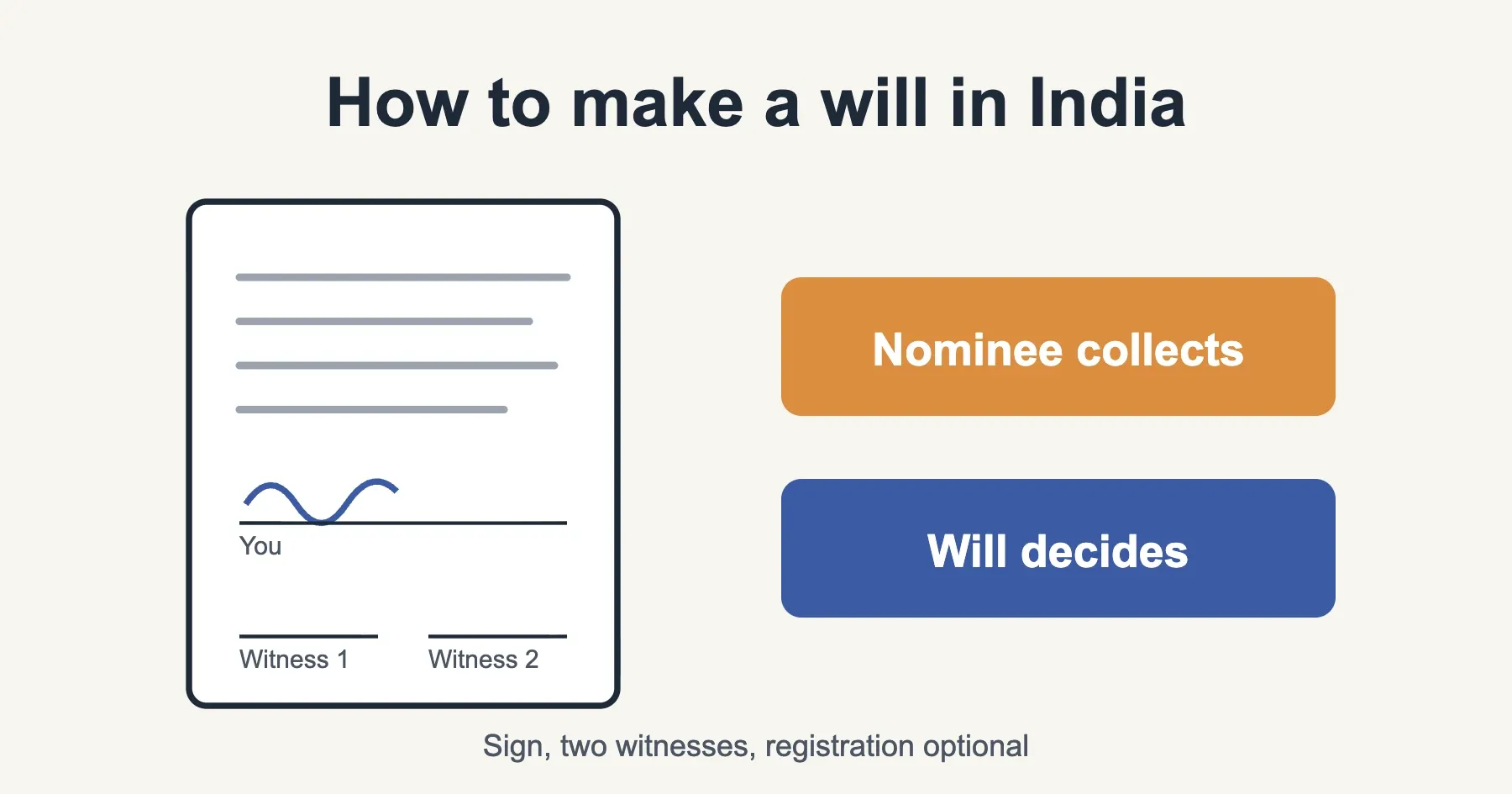
- Fill Form-1, with its residency declaration and nomination. On the holder's death the account is closed and paid to the nominee; it cannot be continued.
- Complete KYC as the office asks.
- Deposit at least ₹500; later deposits go in multiples of ₹50.
Where PPF fits next to an SIP
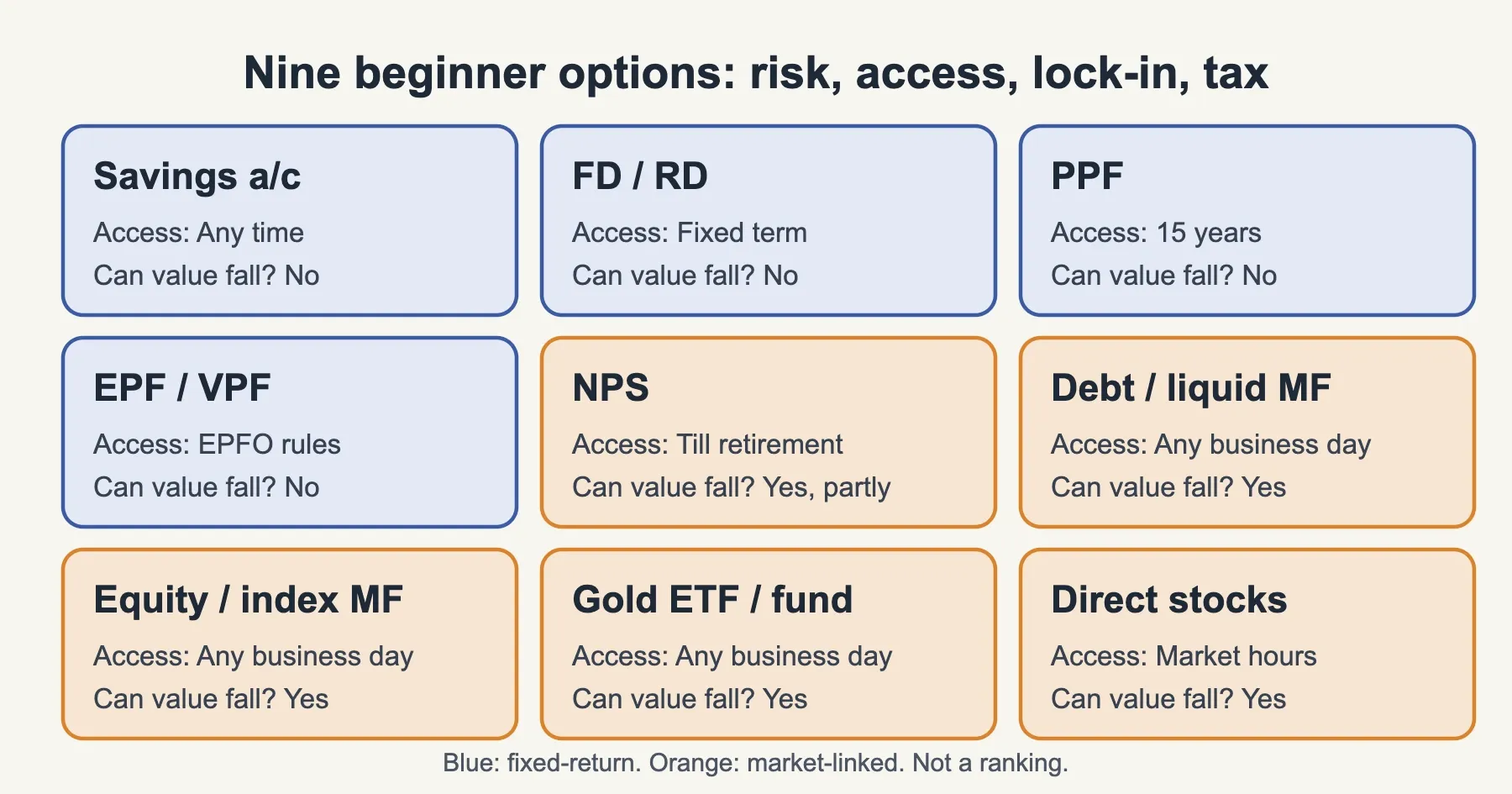
PPF and a mutual fund SIP do different jobs: PPF pays a government-notified rate with set exit windows, while an SIP's value moves with the market. Our PPF vs SIP guide asks what each rupee is for, and the first job money checklist shows where long-term saving fits.
Frequently asked questions
What is a PPF account and how does it work?
A Central Government small savings account under the PPF Scheme, 2019. It runs 15 financial years; you deposit ₹500 to ₹1.5 lakh a year, and interest at the quarterly notified rate (7.1% for October to December 2026) is credited each 31 March.
Can I withdraw money from PPF before 15 years?
Partly. From year 7 you can withdraw once a year, up to 50% of the lower of two past balances (about ₹1,00,254 in year 7 in the hypothetical example, at an assumed 7.1%). In years 3 to 6 you can borrow instead. Early closure needs a listed ground and pays interest 1% lower.
What is the PPF interest rate now and does it change?
7.1% a year for 1 October to 31 December 2026, per the Ministry of Finance's office memorandum of 30 September 2026. The rate is notified quarterly, so it can change from 1 January 2027; that rate had not been announced as of 25 November 2026.
Is PPF tax-free under the new tax regime in 2026?
The deposit deduction (section 123 of the Income-tax Act, 2025, cap ₹1,50,000) is available only under the old regime, and the new regime is now the default. PPF interest and maturity are exempt in both regimes (Schedule II, Sl. No. 3); confirm your position with a tax professional.
What happens to my PPF account after 15 years?
Close it on Form-3, extend it five years with deposits via Form-4 within one year of maturity, or let it continue without deposits. With deposits, withdrawals in the block can total 60% of its opening balance.
Learn more
Save the timeline table, and read PPF vs SIP next.