The 8-4-3 Rule of SIP, Stress-Tested: When It Holds, When It Breaks, and What It Can't Promise
The 8-4-3 rule of SIP holds only at a constant 12%. A hypothetical ₹10,000 SIP run at 8%, 10%, 14% and with one bad year.
Summarize this article with AI





The short version
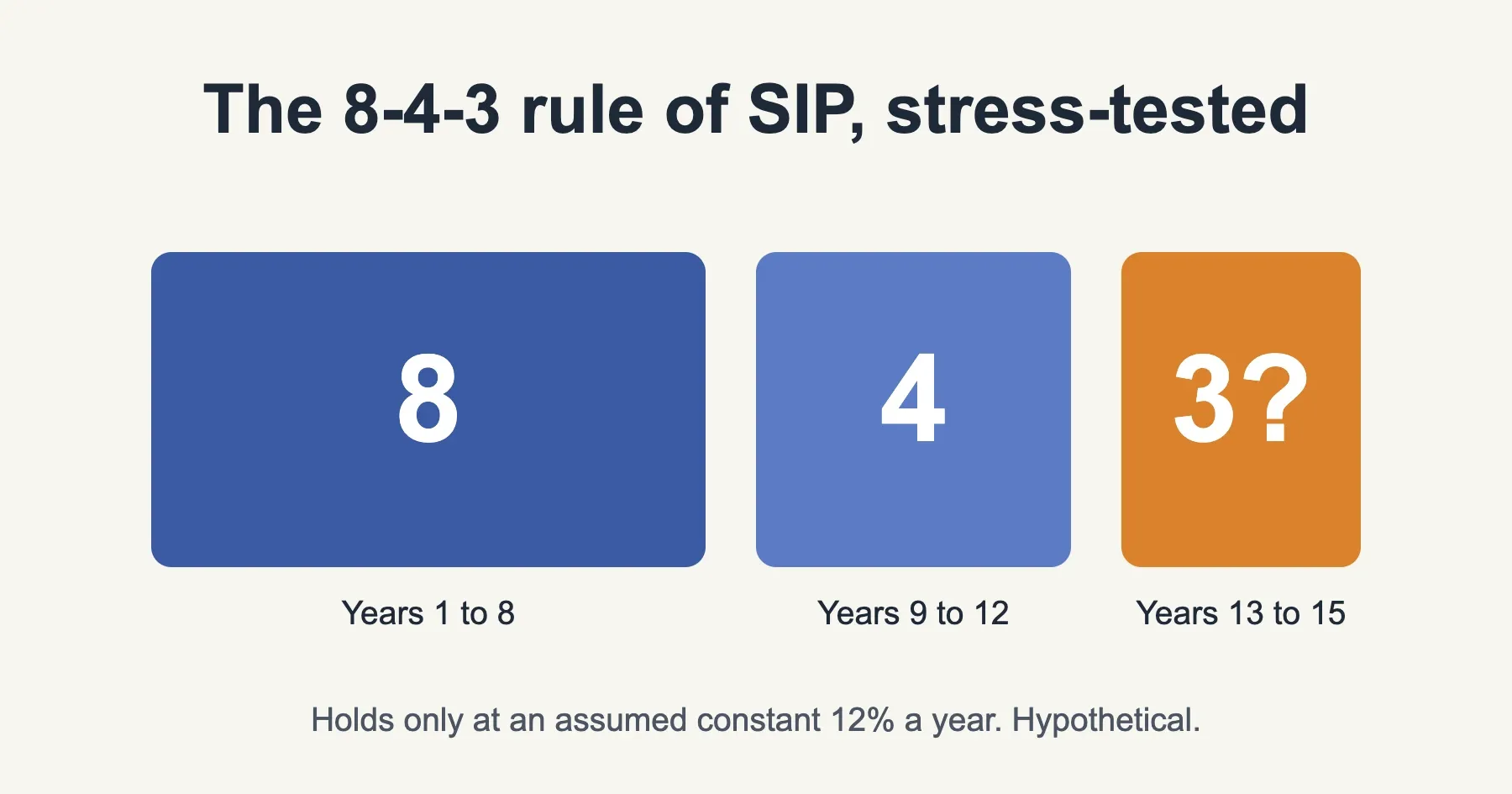
- The 8-4-3 rule (build for 8 years, roughly double in 4, roughly triple the year-8 value by year 15) is what a constant ~12% annual return produces, not a law of SIPs.
- In a hypothetical ₹10,000 SIP, the year-15 ÷ year-8 multiple is 2.55× at 8%, 2.78× at 10%, 3.03× at 12% and 3.31× at 14%.
- One −20% year costs about ₹2.70 lakh at year 15 if it lands in year 2, but about ₹13.06 lakh if it lands in year 14: order of returns matters most when the corpus is large.
- AMFI's investor education site states mutual funds have no fixed rate of return and calculators are for illustration only.
- Use the rule as a reason to stay invested; plan with several return rates, inflation, costs, step-ups and an annual goal review.
As of 22 November 2026: the 8-4-3 rule of SIP says a monthly SIP builds a corpus over the first 8 years, roughly doubles it in the next 4, and roughly triples the year-8 figure by year 15. That pattern appears only if you assume a constant return of about 12% a year, every year. It is a rule of thumb, not a forecast; AMFI's investor education site states that mutual funds do not have a fixed rate of return and that it is not possible to predict one.
Prachi, 27, a lab technician in Nagpur, saw the rule in a short video and wants to know if she can plan a ₹10,000 SIP around it. Below, that SIP runs through four return rates and two bad-year sequences.
What the 8-4-3 rule says
The rule splits a 15-year SIP into three phases. Here is what each phase looks like for a hypothetical ₹10,000 monthly SIP at a constant 12% a year, before costs and tax.
| Phase | Years | Money invested in the phase | Corpus at end of phase | Added to corpus in the phase |
|---|---|---|---|---|
| Build | 1 to 8 | ₹9.60 lakh | ₹15.70 lakh | ₹15.70 lakh |
| "Double" | 9 to 12 | ₹4.80 lakh | ₹30.81 lakh | ₹15.11 lakh |
| "Triple" | 13 to 15 | ₹3.60 lakh | ₹47.59 lakh | ₹16.78 lakh |
The last 7 years add about twice what the first 8 built, on less new money.
The maths behind it: why 12% produces "double in 4, triple in 7"
Two things drive the pattern: you keep adding ₹1.2 lakh a year, and everything already invested keeps earning the assumed return. By year 13 that return works on a corpus of over ₹30 lakh, so one year of growth at 12% can add more than a year of contributions.
At exactly 12%, year 12 lands at about 1.96 times year 8 and year 15 at about 3.03 times. Change the rate and the multiples move.
Money in vs money grown
| By the end of | Money invested | Corpus at 12% (hypothetical) | Growth over money invested |
|---|---|---|---|
| Year 8 | ₹9.60 lakh | ₹15.70 lakh | ₹6.10 lakh |
| Year 12 | ₹14.40 lakh | ₹30.81 lakh | ₹16.41 lakh |
| Year 15 | ₹18.00 lakh | ₹47.59 lakh | ₹29.59 lakh |
How we calculated: ₹10,000 invested at the start of each month for 180 months. The annual return is converted to the equivalent monthly rate, (1 + annual rate)^(1/12) − 1, so a "12% year" grows money by exactly 12%. Year-end values, before expenses, exit load and tax. AMFI's SIP calculator instead divides the yearly rate by 12; on that convention the 12% figures come out higher, at ₹16.15 lakh, ₹32.23 lakh and ₹50.46 lakh. Neither convention is a prediction.
Stress test 1: the same SIP at 8%, 10%, 12% and 14%
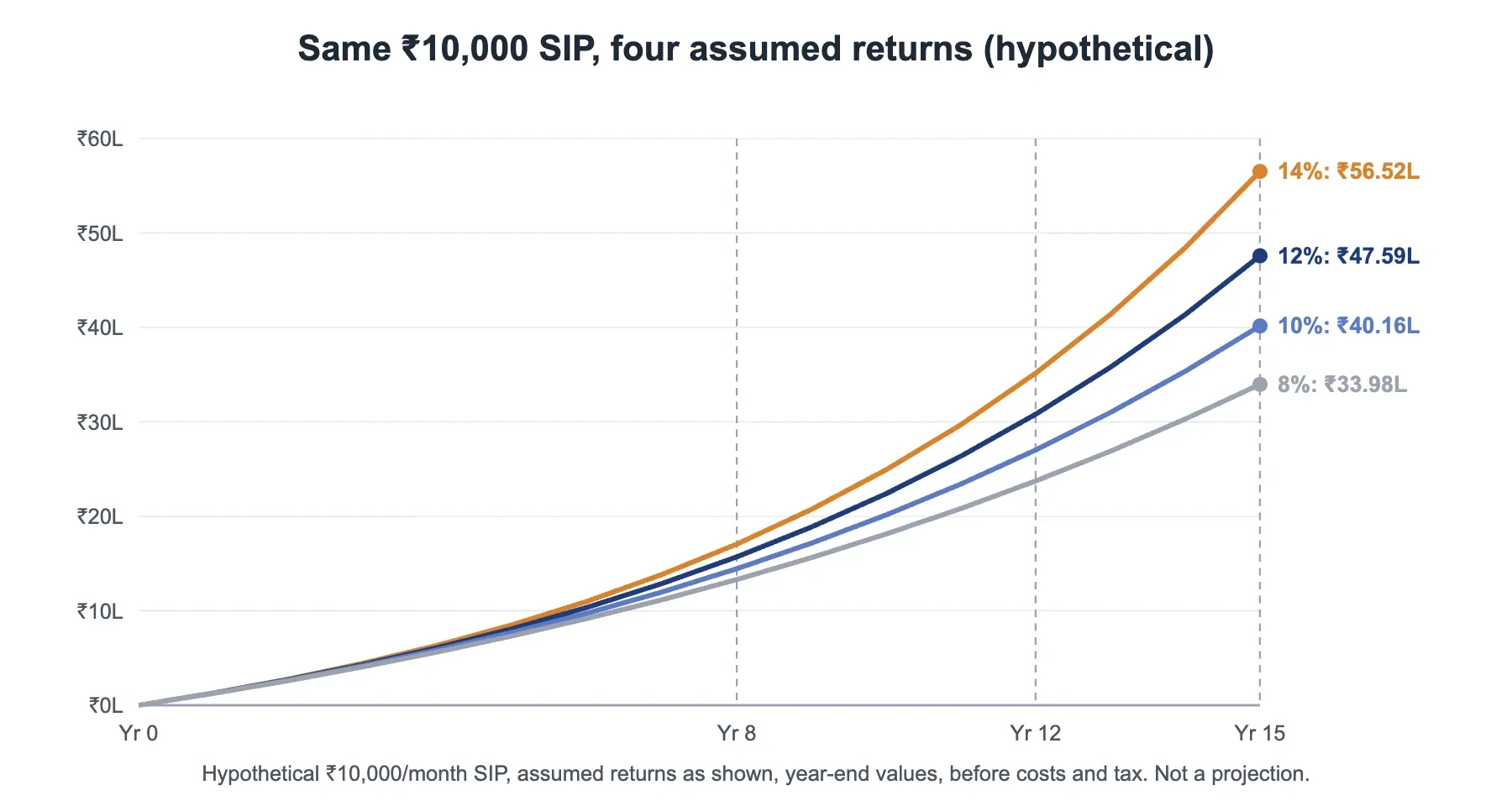
Same ₹10,000 a month, same 15 years, four constant returns.
| Assumed return | Year 8 | Year 12 | Year 15 | Y12 ÷ Y8 | Y15 ÷ Y8 |
|---|---|---|---|---|---|
| 8% | ₹13.31 lakh | ₹23.75 lakh | ₹33.98 lakh | 1.78× | 2.55× |
| 10% | ₹14.46 lakh | ₹27.03 lakh | ₹40.16 lakh | 1.87× | 2.78× |
| 12% | ₹15.70 lakh | ₹30.81 lakh | ₹47.59 lakh | 1.96× | 3.03× |
| 14% | ₹17.06 lakh | ₹35.16 lakh | ₹56.52 lakh | 2.06× | 3.31× |
What it shows:
- At 8% and 10%, the rule overstates the multiples.
- At 14%, the multiples beat the rule.
- Across the four rates, the year-15 corpus ranges from ₹33.98 lakh to ₹56.52 lakh, a gap of ₹22.54 lakh on the same ₹18 lakh invested.
So "8-4-3" is not a property of SIPs. It is a property of 12%.
Stress test 2: one bad year, early vs late
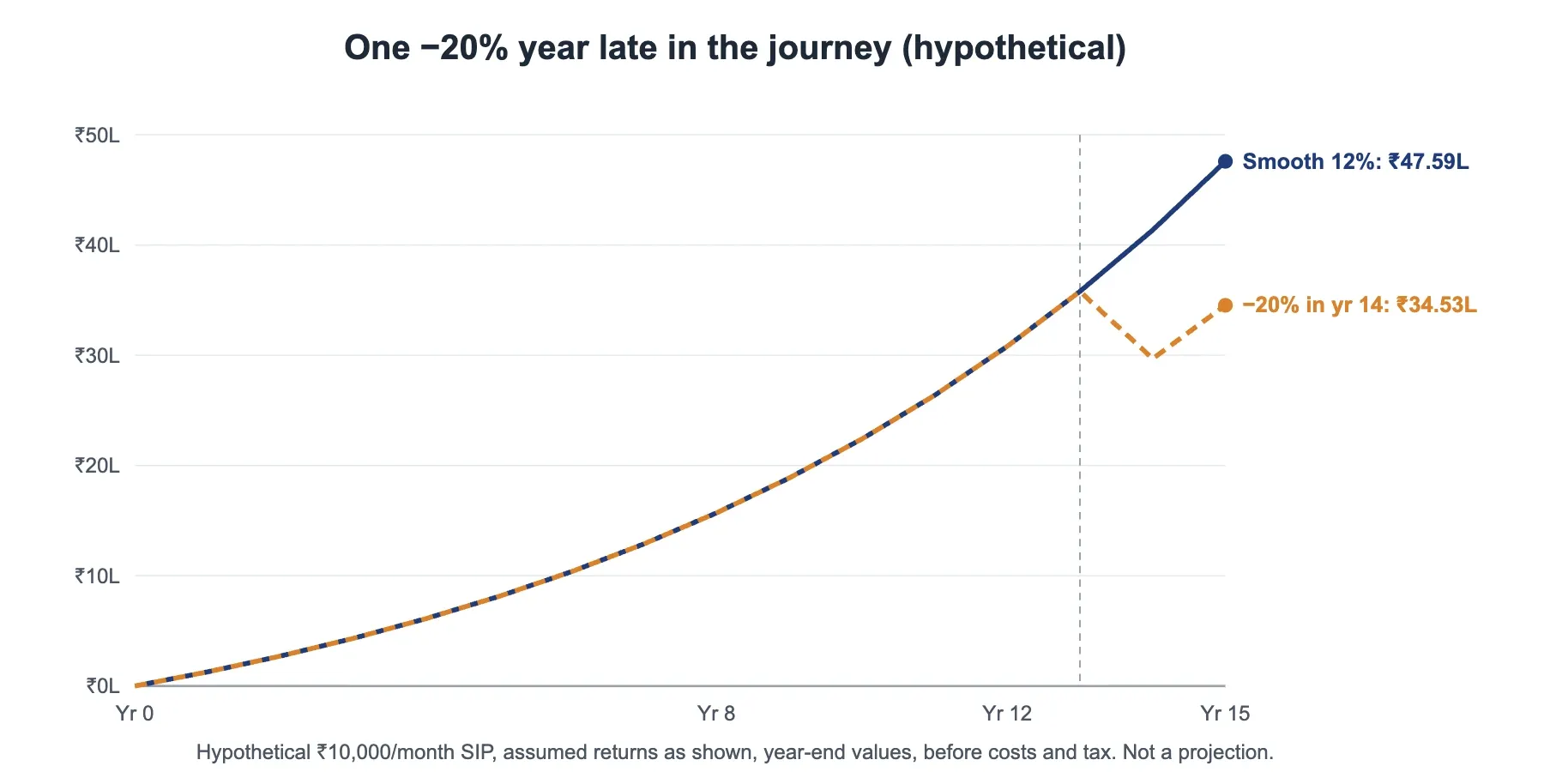
Keep 12% for 14 of the 15 years, make one year −20%, and keep investing throughout.
| Scenario (hypothetical) | Year 8 | Year 15 | Y15 ÷ Y8 | Year-15 gap vs smooth 12% |
|---|---|---|---|---|
| Smooth 12% every year | ₹15.70 lakh | ₹47.59 lakh | 3.03× | none |
| −20% in year 2 | ₹14.48 lakh | ₹44.89 lakh | 3.10× | ₹2.70 lakh lower |
| −20% in year 14 | ₹15.70 lakh | ₹34.53 lakh | 2.20× | ₹13.06 lakh lower |
The same −20% year costs about ₹2.70 lakh when it lands in year 2, when the corpus is small. In year 14 it costs about ₹13.06 lakh: in that example the corpus falls from ₹35.78 lakh at the end of year 13 to ₹29.69 lakh at the end of year 14, even after ₹1.2 lakh of new money goes in. This is sequence of returns risk, and the 8-4-3 rule assumes it away.
What the rule gets right, and what it hides
What it gets right. Time does a lot of the work. In every scenario above, the later years add more than the early ones because growth compounds on a larger base: a reason to start early and keep going through bad years. More in the power of compounding in an SIP.
What it hides.
- Returns are not constant. AMFI's SIP calculator notes that calculators are "for illustrations only and do not represent actual returns", and that past performance "may or may not be sustained in future and is not a guarantee of any future returns".
- Order matters. A bad year late in the journey hurts more than the same year early on, as the stress test shows.
- Inflation. ₹47.59 lakh in 15 years will buy less than ₹47.59 lakh today. See SIP returns after inflation.
- Costs. A scheme's expenses reduce what you actually earn, so a pre-cost illustration is higher than the post-cost result would be at the same market return.
- Tax. Gains on redemption can be taxed; see how mutual funds are taxed.
Regulators treat projections with caution too. SEBI's June 2026 consultation paper on a common advertisement code, which covers mutual funds, proposes barring advertisement content based on assumptions or projections, and promises of guaranteed or indicative returns. It is a proposal; check SEBI's website for its current status.
How to use the rule sensibly: a 5-point checklist
- Read it as a reason to stay invested, not a target. The later years carry the most weight, which only helps if you are still investing in them.
- Run your plan at more than one rate. Compare 8%, 10% and 12%, and plan around a figure you could live with if returns come in lower.
- Plan for a bad year near the end. For a goal with a fixed date, many investors review their mix as the date approaches, because a late fall has less time to recover.
- Use step-ups, not hope. Raising the SIP as your income grows changes the outcome more predictably than assuming a higher return. See how much to step up an SIP.
- Review the goal every year. Check the amount you need in today's money and the gap to it. For a ₹1 crore target, see how much SIP for ₹1 crore.
Frequently asked questions
What is the 8-4-3 rule of SIP?
A popular rule of thumb: an SIP corpus builds over 8 years, roughly doubles over the next 4, and reaches about three times the year-8 value by year 15. It holds only under an assumed constant return of about 12% a year.
Does the 8-4-3 rule work at 10% returns?
Not quite. In our hypothetical ₹10,000 SIP at a constant 10%, year 12 is 1.87 times year 8 and year 15 is 2.78 times year 8, short of "double" and "triple". At 8% the multiples drop to 1.78 and 2.55.
How much will a ₹10,000 SIP become in 15 years under the 8-4-3 rule?
At an assumed constant 12% a year, the hypothetical corpus is about ₹47.59 lakh on ₹18 lakh invested, before costs and tax. At constant 8% to 14% it ranges from about ₹33.98 lakh to ₹56.52 lakh. Actual results depend on actual returns, which cannot be predicted.
Why does compounding speed up in the later years of an SIP?
The return works on a bigger base: by year 13 one 12% year can add more than a year's contributions. It cuts both ways: a −20% year at year 14 leaves the corpus about ₹13 lakh below the smooth path, against under ₹3 lakh for the same fall in year 2.
Is the 8-4-3 rule reliable for planning a goal?
No. It is a rule of thumb, not a forecast. Use it to understand why time matters, then plan with several return rates, allow for inflation and costs, and review the goal every year.
Save this checklist
Save this checklist and the stress-test table; they say more than the rule's three numbers.



