Financial Planning for Beginners: A One-Page Plan in Five Steps, Worked Through on a ₹60,000 Take-Home Salary
Financial planning for beginners in five steps, worked on a hypothetical ₹60,000 take-home: goals, cash flow, emergency fund, protection, goal amounts.
Summarize this article with AI





The short version
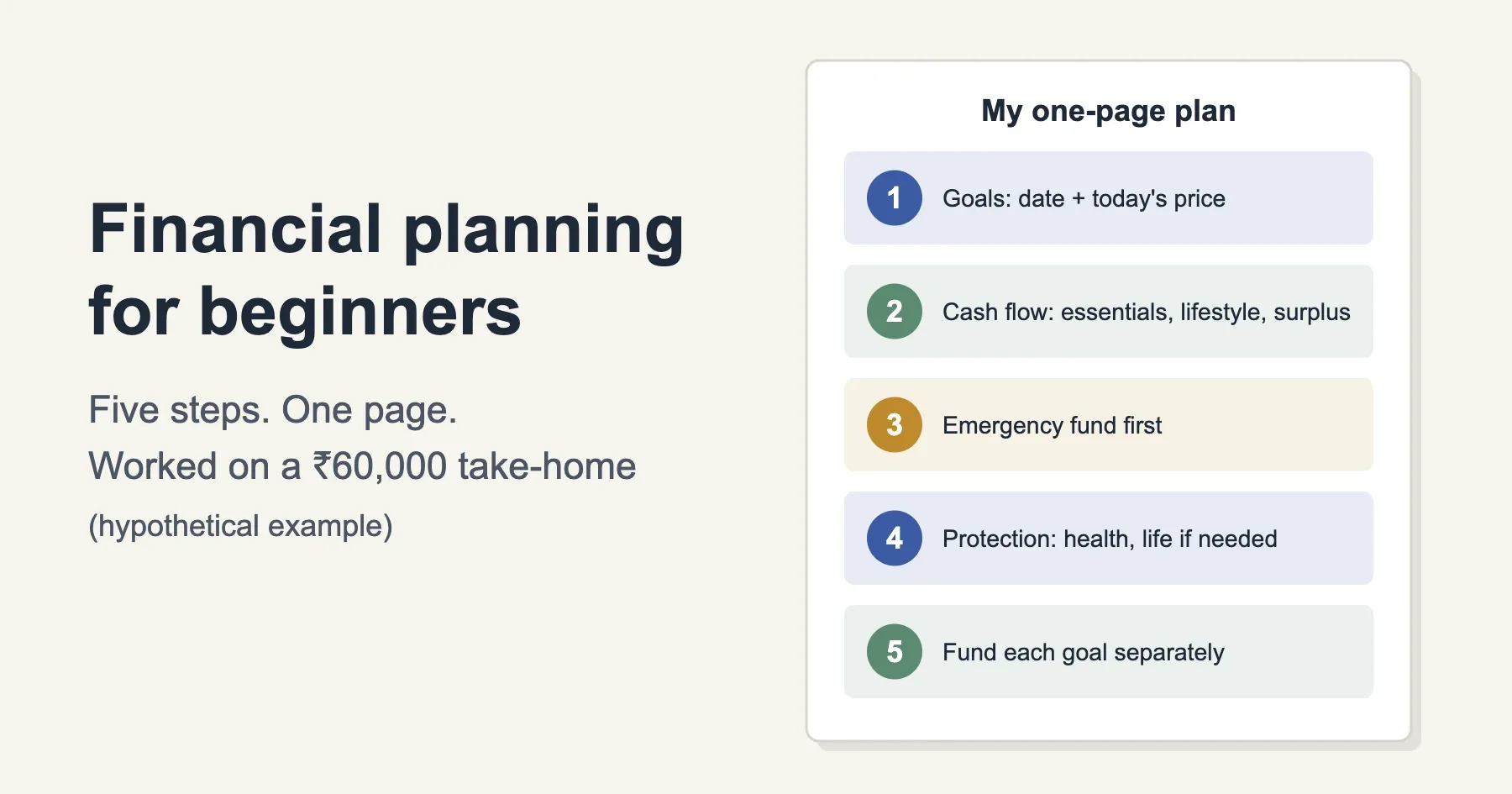
- Order: goals, cash flow, emergency fund, protection, then fund each goal.
- Price each goal at its future cost, at a stated inflation assumption.
- Your surplus caps all goal amounts combined.
- If goals don't fit, move a date, trim a target or raise the surplus; don't raise the assumed return.
- Review the sheet yearly and after big life changes.
As of 22 November 2026: financial planning for beginners comes down to five steps, done in this order. Write down your goals with a date and today's price, map your monthly cash flow, build an emergency fund, cover your protection needs, and then give each goal its own monthly amount. When the goals add up to more than you can save, change the date, the target or the surplus, not the assumed return.
Tanmay, 26, takes home ₹60,000 a month and has three goals but no written plan. Below, his hypothetical numbers go through a one-page goal sheet, including a first draft that did not fit and how he fixed it.
The five steps at a glance
- Goals: each with a date and today's cost.
- Cash flow: take-home split into essentials, lifestyle and surplus.
- Emergency fund: a few months of essential spending.
- Protection: health cover, and life cover if anyone depends on you.
- Fund each goal: its own monthly amount, matched to its horizon.
Step 1: Write down your goals with a date and today's price
A wish becomes a financial goal when it has a name, a date and today's price. Sort goals by distance:
- Short term: under 3 years (a laptop, a trip, a course fee).
- Medium term: 3 to 7 years (higher education, a wedding).
- Long term: 7 years or more (a home down payment, retirement).
Tanmay's list: laptop and trip in 2 years (₹1,20,000 today), higher education in 5 years (₹4,00,000) and a home down payment in 8 years (₹10,00,000).
Turning today's price into the future price
Prices rise, so a goal costs more on the day you pay. The formula:
Future cost = cost today × (1 + assumed inflation) ^ years
This plan assumes 6% a year. For reference, India's all-India CPI inflation for October 2026 was 6.09% year on year (provisional), per MoSPI's release of 12 November 2026. Your goal's own inflation, such as education or property, can differ.
At an assumed 6%, ₹10,00,000 today becomes about ₹15,93,848 in 8 years. That is the number the down-payment goal has to reach, not ₹10 lakh.
Step 2: Map your monthly cash flow
Split take-home (what reaches your bank account) into essentials (rent, food, bills, EMIs, transport), lifestyle (eating out, shopping, subscriptions) and surplus (what is left).
Tanmay's month: take-home ₹60,000; essentials ₹30,000 (50%); lifestyle ₹12,000 (20%); surplus ₹18,000 (30%). If your own split looks very different, our guide to the 50/30/20 rule on an Indian salary shows three ways to adjust it.
Every goal amount in Step 5 has to fit inside the surplus.
Step 3: Emergency fund before goal investing
An emergency fund is money kept easy to reach for a job loss, a medical bill or an urgent repair. Without it, the first surprise expense tends to come out of a goal: an SIP stops, or an investment is sold at a bad moment.
A common rule of thumb is several months of essential spending, depending on income stability and dependants. This example assumes 6 months: 6 × ₹30,000 = ₹1,80,000. The full ₹18,000 surplus fills it in 10 months. Our guide to how much emergency fund you need helps you count your own essential months.
Step 4: Protection: health cover and, if needed, life cover
Protection is not an investment; it stops one event from wiping out the plan. Two questions:
- Health cover: if you or a family member were hospitalised, who would pay? If only an employer's group cover, check what happens when you change jobs and whether the sum insured covers a large bill.
- Life cover: does anyone depend on your income, such as parents, a spouse or a loan co-borrower? If someone does, ask how much they would need, not what multiple of salary to buy.
IRDAI's policyholder site (policyholder.gov.in) has neutral explainers on both. Our first job money checklist puts these checks in order.
Step 5: Give each goal its own monthly amount
A separate amount per goal shows which goal is on track. Match the investment to the time horizon, in general terms:
- Short goals (under 3 years): little time to recover from a fall, so many people look at lower-volatility options.
- Long goals (7+ years): more time to ride out ups and downs, so these can take some market risk, if you can stay invested through falls.
- Medium goals sit in between, often shifting to lower-volatility options as the date nears.
This page names no product or fund. For a plan tailored to you, a SEBI-registered investment adviser can help (see the FAQ). If you are not sure where to begin, how to start investing in India covers KYC and accounts.
Worked example: the one-page plan, and what happens when it doesn't fit
Hypothetical example. Assumed inflation 6% a year. Assumed constant returns, for illustration only, not a forecast, before costs and tax: 6% a year for a 2 to 3 year goal, 8% for 5 to 7 years, 10% for 8 to 10 years. Monthly amount = future cost ÷ the growth of ₹1 invested at the start of every month at the assumed rate.
First draft: all goals start now
| Goal | Years | Cost today | Cost then (6% inflation) | Assumed return | Monthly needed |
|---|---|---|---|---|---|
| Laptop + trip | 2 | ₹1,20,000 | ₹1,34,832 | 6% | ₹5,284 |
| Higher-education fund | 5 | ₹4,00,000 | ₹5,35,290 | 8% | ₹7,291 |
| Home down payment | 8 | ₹10,00,000 | ₹15,93,848 | 10% | ₹11,026 |
| Total | ₹23,601 |
₹23,601 a month against an ₹18,000 surplus, with no emergency fund yet: the draft does not fit. Assuming a higher return until it fits only hides the gap, so Tanmay used the levers he controls.
Three levers: move the date, trim the target, raise the surplus
Lever 1: move the date. Tanmay fills the emergency fund first (10 months of ₹18,000), then starts the goals, each a year later than planned; years count from when saving starts.
| Goal | Years | Cost then (6% inflation) | Monthly needed |
|---|---|---|---|
| Laptop + trip | 3 | ₹1,42,922 | ₹3,624 |
| Higher-education fund | 7 | ₹6,01,452 | ₹5,387 |
| Home down payment | 10 | ₹17,90,848 | ₹8,889 |
| Total | ₹17,900 (within ₹18,000) |
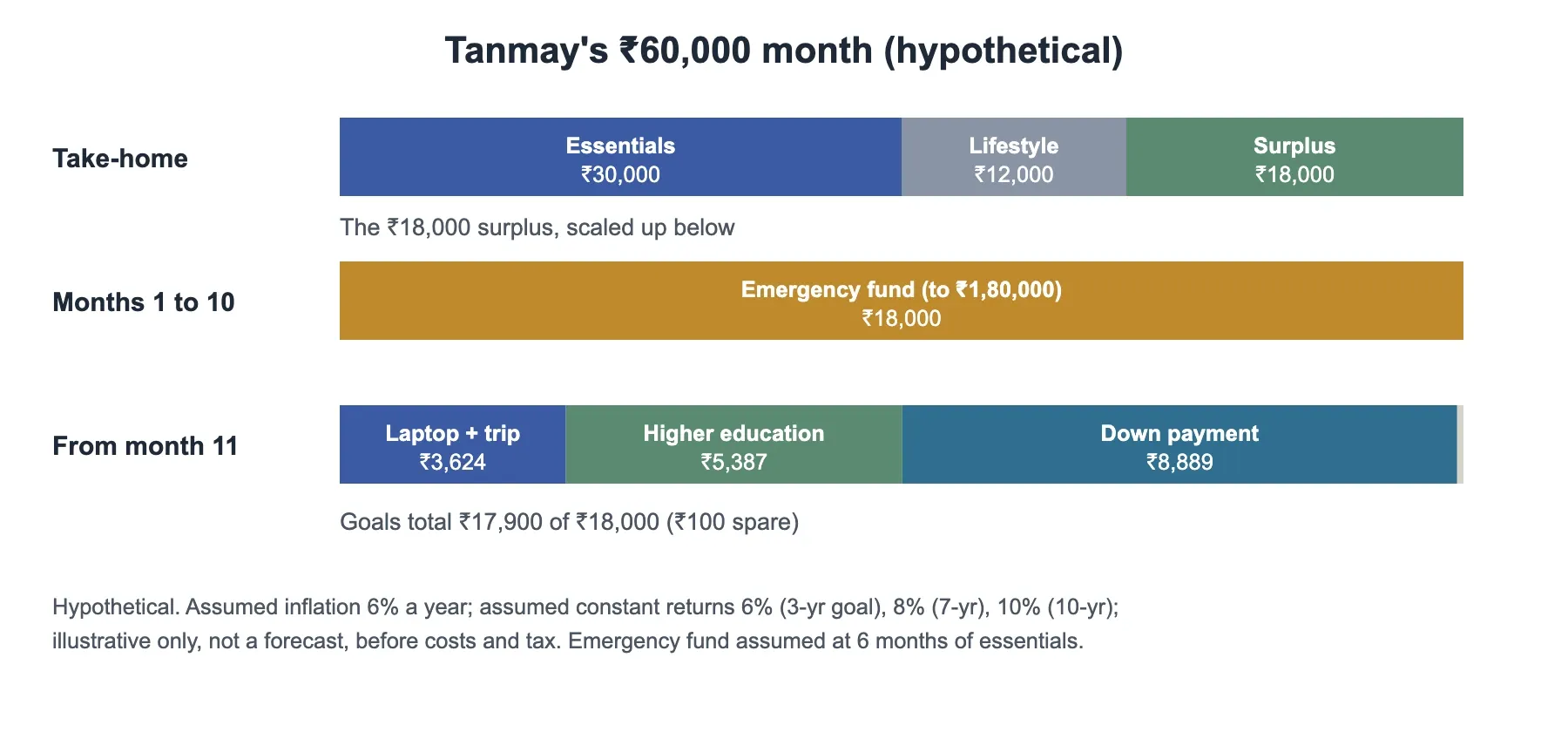
The fix came from moving dates, not a higher assumed return. Waiting has a cost: the down-payment target rises from about ₹15.9 lakh to about ₹17.9 lakh.
Lever 2: trim the target. The table inflates prices over the saving years only. Add inflation during the 10 emergency-fund months and each target is about 5% higher; the total becomes ₹18,792, ₹792 over the surplus. A smaller trip or down-payment target closes that gap.
Lever 3: raise the surplus. Or move ₹792 from lifestyle (₹12,000) to surplus, or use part of a future raise.
Which lever to pull is a personal choice; the sheet makes the trade-off visible.
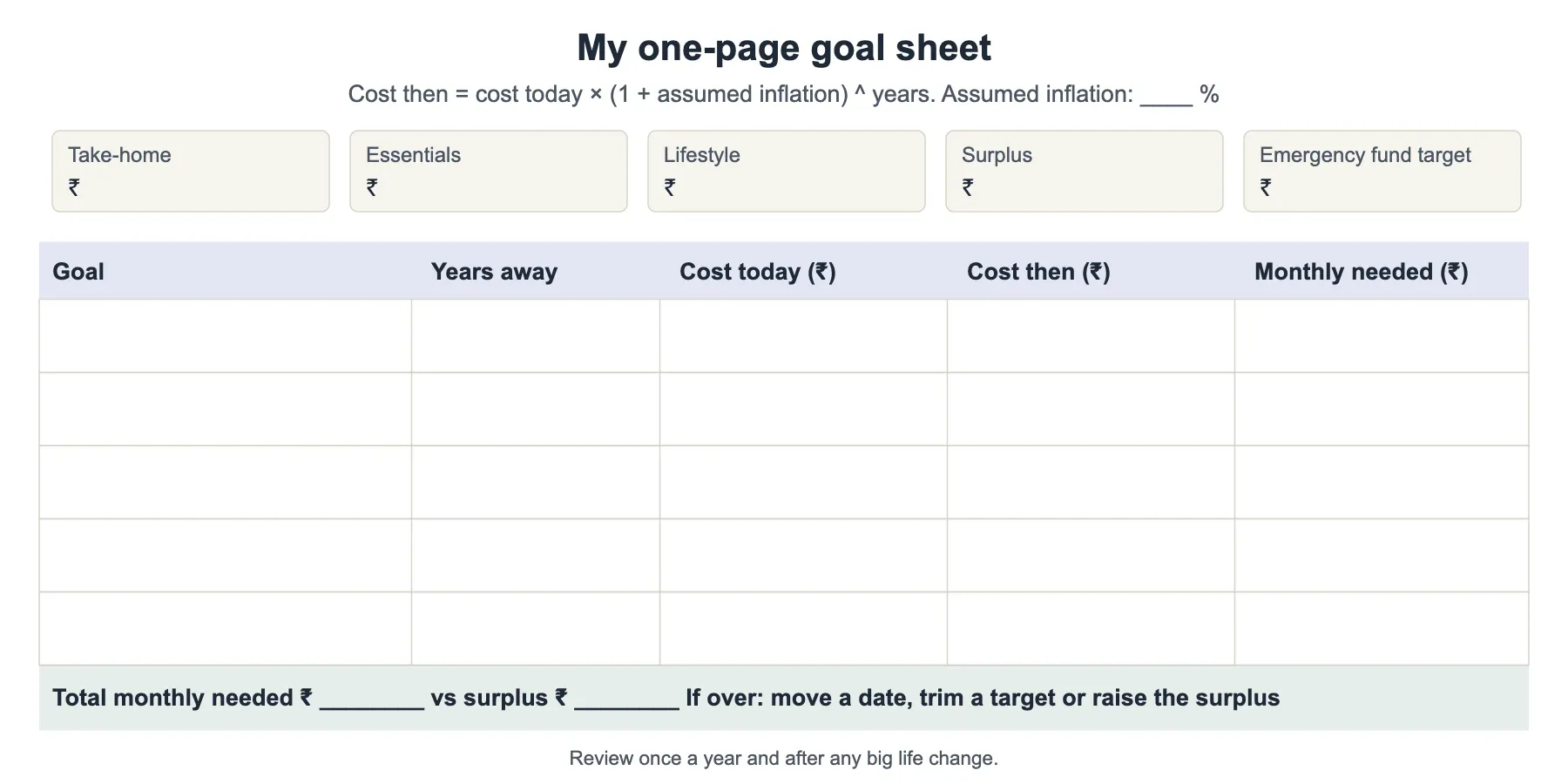
Your one-page goal sheet
Copy this template and fill in your own numbers.
Review once a year
Revisit the sheet once a year, and when your salary changes, a new goal appears or a life event (marriage, a child, a move, a job loss) changes your cash flow. Re-run it with current prices. How long each SIP runs should follow its goal's date, as how long to continue an SIP explains.
Frequently asked questions
What are the steps of financial planning for beginners?
Five, in order: list goals with dates and today's cost; map take-home, essentials, lifestyle and surplus; build an emergency fund; check health and, if needed, life cover; then fund each goal separately, matched to its horizon.
How do I set financial goals? (Financial goals kaise set kare?)
Write each goal with a date, today's cost and its future cost at an assumed inflation rate. For example, ₹10 lakh needed in 8 years at an assumed 6% becomes about ₹15.94 lakh. Hinglish mein: har goal ke saath date, aaj ki keemat aur future keemat likhiye; phir har goal ka alag monthly amount tay kariye.
Should I build an emergency fund before investing?
For most beginners, yes: it keeps a surprise expense from breaking a goal or forcing a sale at a bad time. A common rule of thumb is several months of essential spending.
What if my goals need more money than I can save?
Use three levers: move the date, trim the target or raise the surplus. In the example, moving dates by a year took the total from ₹23,601 to ₹17,900 a month, within an ₹18,000 surplus. Raising the assumed return to make it fit only hides the gap.
Do I need a financial planner to make a financial plan?
Not to draft one; the five steps above are enough to start. For personalised advice, use a SEBI-registered investment adviser. SEBI's FAQs say the list of registered advisers is on its website under Intermediaries, Recognised Intermediaries, and advisers must display their registration number.
Save this plan
Save the one-page goal sheet, fill in your own numbers this month and review it a year from today.