How to Start Investing in India as a Beginner: The Order of Steps, the Accounts You Need, and a First SIP of ₹500
Start investing in India in six steps: surplus, emergency money, cover, KYC, the right account, then a ₹500 SIP. Mutual funds need no demat account.
Summarize this article with AI





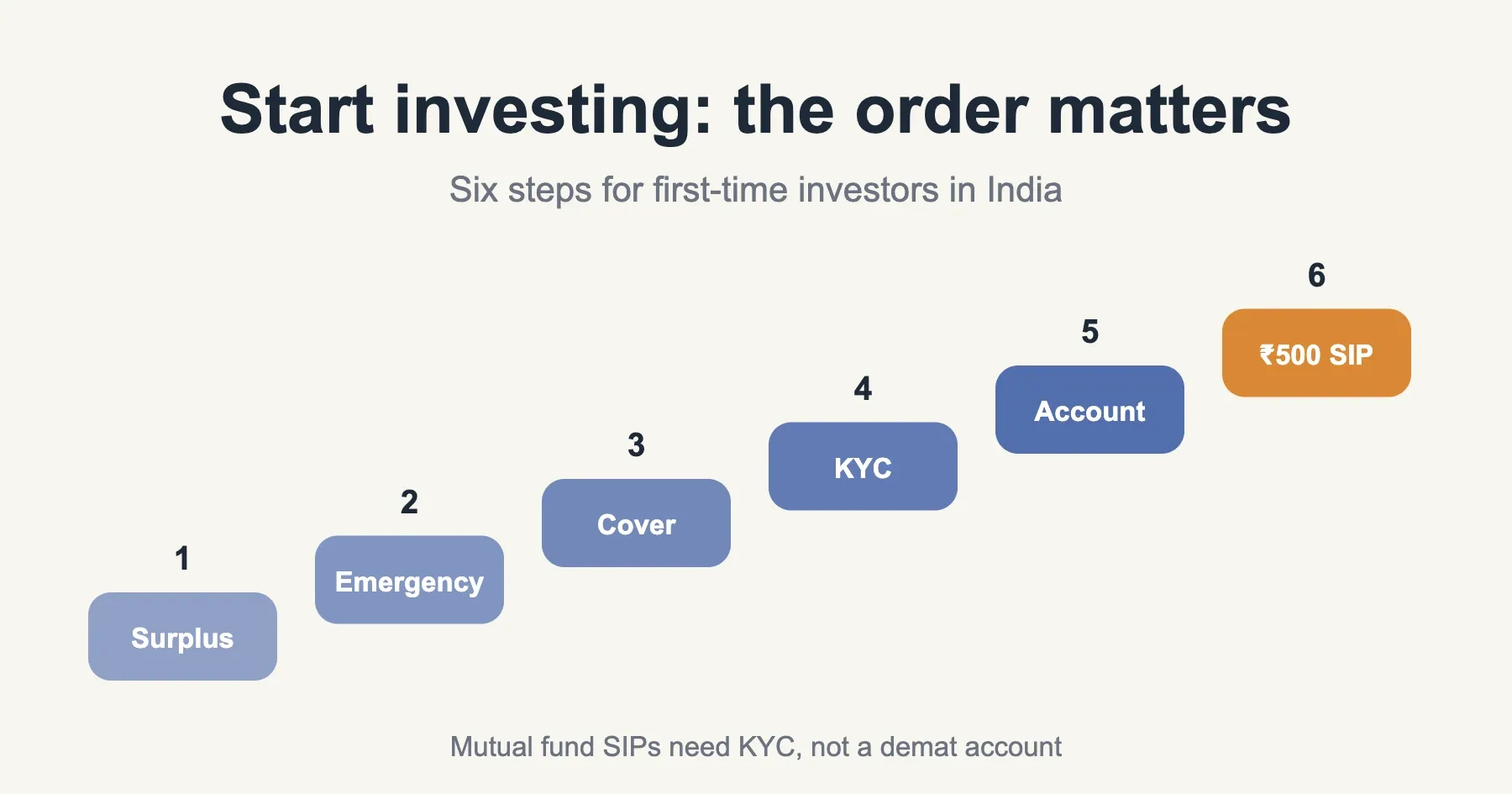
The short version
- Starting is mostly order and paperwork: surplus, emergency money, cover, KYC, the right account, then a small first investment.
- Mutual funds need KYC and a bank account, not a demat account. Shares and ETFs need demat plus trading accounts.
- KYC is done once with a KYC Registration Agency; a validated record works across fund houses, so check the status before you invest.
- In the hypothetical example, a ₹500 SIP alongside the emergency fund moves its finish from month 10 to month 11; ₹1,500 moves it to month 14.
- No one can promise mutual fund returns. SEBI's investor FAQ notes that even capital protection-oriented schemes offer no guaranteed returns or capital.
As of 22 November 2026: to start investing in India you need a PAN, an Aadhaar linked to it, a bank account in your name and a one-time KYC. A mutual fund SIP can begin with a few hundred rupees, subject to each scheme's minimum, and it does not need a demat account; shares and ETFs do. Before any of that, set aside some emergency money and check whether you need insurance cover.
Siddhant, 27, in Nagpur, takes home ₹35,000 a month. He has a bank account and a PAN, has never done KYC, and assumes he needs a demat account first. For mutual funds, he doesn't. What he needs is the order of steps.
The six steps, and how you know each one is done
| Step | What you do | Done when |
|---|---|---|
| 1. Surplus | Take-home minus essentials, EMIs and planned spending | You have one monthly number you can set aside without borrowing |
| 2. Emergency money | Park about 3 to 6 months of essentials somewhere you can reach quickly | The target is reached, or money goes to it every month and you know the month it fills |
| 3. Cover | Check health cover; consider term cover if someone depends on your income | You know what cover you have and whether you need more |
| 4. KYC | Complete KYC once with a KYC Registration Agency (KRA) | Your KRA status allows new investments |
| 5. Account | Open the account your product needs | Folio, demat, PPF or PRAN is active in your name |
| 6. First investment | Start a small SIP, then raise it later | The first instalment is debited and you've set a date to review the amount |
Step 1: Find your monthly surplus
Your surplus is what's left after essentials, EMIs and spending you know is coming. Siddhant's essentials are ₹20,000 and other spending ₹9,000, so his surplus is ₹6,000 a month. If it swings, use the lower month. A budget split such as the 50/30/20 rule on an Indian salary can help you find it.
Step 2: Emergency money before market-linked money
Market-linked investments can be down exactly when you need cash, so emergency money comes first: a common guideline is 3 to 6 months of essentials, kept in a savings account or a deposit you can break quickly. For Siddhant, 3 months is ₹60,000. Our guide on how much emergency fund you need shows how to count your essential months.
You don't have to finish this before step 6; the worked example shows what running both together costs.
Step 3: Check your cover
One hospital bill can wipe out both your emergency fund and your investments. If your only health cover comes through your employer, check its size and what happens when you change jobs. Term cover is a separate question: whether you need it depends on whether anyone relies on your income.
Step 4: Do your KYC once
KYC (Know Your Customer) is a one-time identity check. SEBI's investor FAQ states that a first-time mutual fund investor must submit KYC documents. You will usually be asked for:
- your PAN, which should be active and linked to Aadhaar (you can check the link status on the Income Tax e-filing portal)
- an address proof such as Aadhaar
- a photo, a signature and your bank details
- an in-person or video verification step if you do it online
Once your record with a KYC Registration Agency (KRA) is validated (this includes the PAN-Aadhaar link check), you generally don't redo KYC for each fund house. Check your status on any KRA's website before you invest. If it shows on hold or rejected, fix that first. Our walkthrough of mutual fund KYC online and each status explains what each status lets you do.
Step 5: Open the account your product needs
Each product lives in a different place:
| Product | Where you open it | What you need | Minimum to start |
|---|---|---|---|
| Mutual fund (including SIP) | A folio with the fund house: directly, through its registrar, through an AMFI-registered distributor or a registered online platform | KYC, bank account, nominee choice | Set by each scheme (see its scheme documents) |
| Shares and ETFs | A demat account with a depository participant, plus a trading account with a SEBI-registered stock broker | KYC, bank account | The price of one share or unit, plus charges |
| PPF | A post office or an authorised bank | KYC with that bank or post office | A small yearly minimum under the scheme rules; confirm at the branch |
| NPS | A PRAN through a PFRDA-registered point of presence, or online | PAN, KYC, bank account | Check PFRDA's current rules |
| Bank FD or RD | Your bank | Your existing account | Set by the bank |
SEBI's investor FAQ says a fund issues units in demat form on the investor's request, so a folio works without demat. ETFs differ: buying and selling them needs a demat and a trading account, per the same FAQ. More in investing in mutual funds without a demat account, and how to open a demat account if you want shares too.
Step 6: Make the first investment small, then raise it
The first SIP tests your KYC, sets up the bank mandate and starts the habit; the amount matters less. Many schemes accept a few hundred rupees a month; check the scheme's minimum. Some first-time investors may qualify for SEBI's ₹250 chhoti SIP, which comes with conditions: see who can start a ₹250 chhoti SIP. When your income rises, increase the SIP rather than waiting for a large sum (how much to step up an SIP).
Worked example: ₹6,000 a month, three ways to split it
Hypothetical. Siddhant has a ₹6,000 surplus and a ₹60,000 emergency-fund target (3 months of ₹20,000 essentials). Once the fund is full, the whole ₹6,000 goes to the SIP. No returns are assumed on either part: these are contributions only.
| Split of ₹6,000 | To emergency fund each month | Emergency fund reaches ₹60,000 | Total put into SIP by month 24 |
|---|---|---|---|
| Emergency fund first, then ₹6,000 SIP | ₹6,000 | Month 10 | ₹84,000 |
| ₹500 SIP from month 1 | ₹5,500 | Month 11 (10.91 months of saving) | ₹83,500 |
| ₹1,500 SIP from month 1 | ₹4,500 | Month 14 (13.33 months of saving) | ₹81,000 |
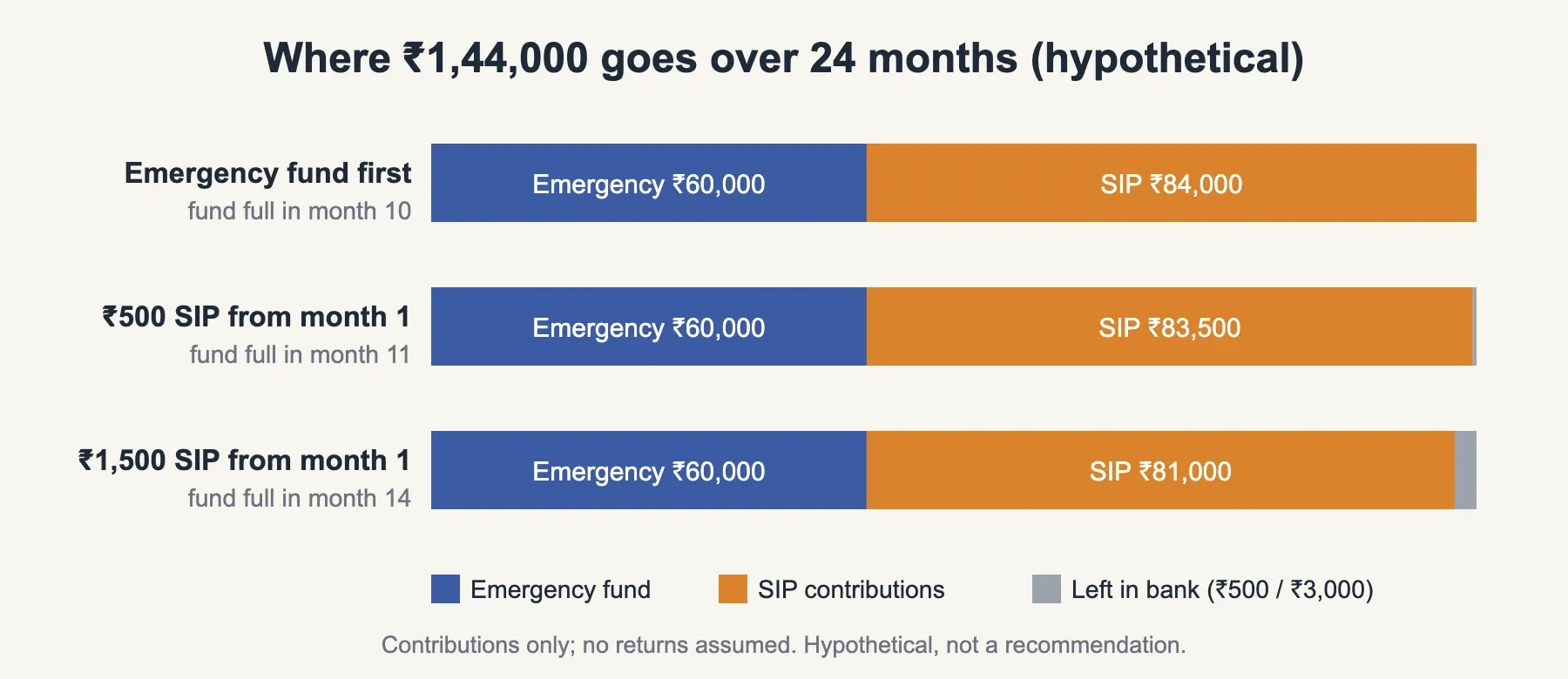
In the month the fund fills, the extra stays in the bank: ₹500 in the ₹500 case and ₹3,000 in the ₹1,500 case. Every row adds up to the same ₹1,44,000 over 24 months.
A ₹500 start costs about one month on the emergency fund, and gets KYC, the mandate and the habit done early. A ₹1,500 start leaves the safety net incomplete for four extra months. All three are reasonable; which fits depends on how secure your job feels.
Three checks before you send money
- Is it registered? Every mutual fund must be registered with SEBI before it collects money, and SEBI's FAQ asks investors to use AMFI-registered distributors. For an adviser or broker, look them up in the registered-intermediary lists on SEBI's website (sebi.gov.in).
- Where is the money going? Pay only the mutual fund scheme, your broker or your bank, from your own account; not a person's account or UPI ID.
- Is anyone promising returns? SEBI's FAQ notes that even in capital protection-oriented schemes, investors "are neither offered any guaranteed/indicated returns nor any guarantee on repayment of capital by the scheme". Treat a "sure returns" tip on WhatsApp as a warning sign.
Frequently asked questions
How do I start investing in India as a beginner?
Get four things in place: a PAN, an Aadhaar linked to it, a bank account in your name and a one-time KYC. Before investing, work out your monthly surplus, build some emergency money and check your insurance cover. Then open the account your product needs and start small; a mutual fund SIP does not need a demat account.
How can I start investing with little money?
Start with whatever the scheme's minimum allows. Each mutual fund scheme sets its own minimum SIP amount in its scheme documents, and some first-time investors may be able to use SEBI's ₹250 chhoti SIP route, which has conditions. Raising a small SIP later is easier than finding a large amount on day one.
Do I need a demat account to start investing?
Not for mutual funds. Units sit in a folio with the fund house, and SEBI's investor FAQ says a fund issues demat units only when the investor asks for them. You do need a demat and a trading account to buy shares or ETFs.
What documents do I need to start investing in India?
Usually your PAN, an address proof such as Aadhaar, bank account details, a photo and a signature for KYC, plus your nominee's details. Check your PAN-Aadhaar link and your KYC status before you begin, so nothing stalls at the payment step.
Investment kaise shuru kare?
Pehle dekhiye har mahine kitna bachta hai, phir thoda emergency fund banaiye aur health cover check kijiye. Uske baad ek baar KYC kijiye; mutual fund SIP ke liye demat account zaroori nahi hai. Shuruaat ₹500 jaisi chhoti SIP se ho sakti hai, aur salary badhne par amount badhaiye.
Save this list
Save the six-step table and tick off each "done when" line as you go.