How Much Retirement Corpus Do You Need in India? Work It Out in Three Steps From Today's Expenses
Work out your retirement corpus in three steps from today's expenses, with a worked example and a sensitivity table.
Summarize this article with AI





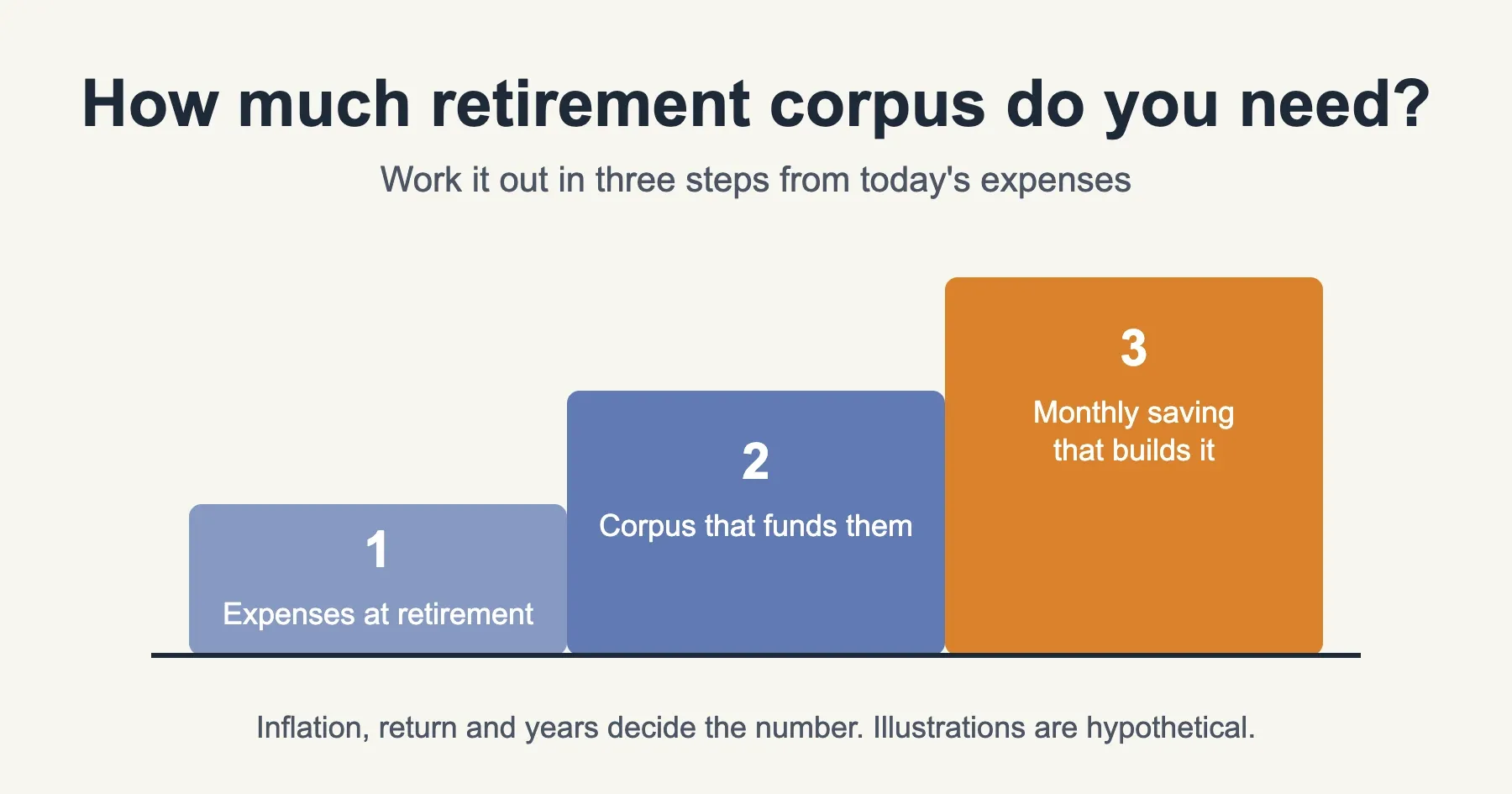
The short version
- Your retirement corpus comes from three inputs: today's yearly expenses, the inflation you assume, and the return you assume after retiring.
- Hypothetical example: ₹40,000 a month today, 30 years from retirement, 6% inflation and a 7% return need about ₹6.17 crore for 25 years (₹7.24 crore for 30).
- One point of inflation moves the corpus more than one point of return; the same example ranges from about ₹3.78 crore to ₹10.25 crore.
- The 25x / 4% shortcut comes from US research; the rate that lasts depends on your return-minus-inflation gap and your years in retirement.
- EPF, NPS and other savings already count toward the total; plan with a range and redo the three steps every three to five years.
As of 22 November 2026, there is no single right number. Your retirement corpus is the money that can pay your expenses, rising with inflation, for every year after you stop working, at a cautious return. For a hypothetical 30-year-old who spends ₹40,000 a month today, that comes to about ₹6.2 crore at 60, and modest changes in the assumptions move it from about ₹3.8 crore to ₹10.3 crore.
Kabir, 30, in Pune, has seen headlines quote ₹3.75 crore one week and far bigger figures the next. He does not need a headline. He needs three inputs he can write down and a method he can redo every few years. Here it is, with his numbers.
Step 1: Your expenses at retirement
Start with what you spend in a year today, not your salary.
- Add up today's spending: essentials (food, rent or maintenance, utilities, transport) plus lifestyle spending you expect to keep.
- Remove costs that will end: home loan EMIs that finish before 60, children's school fees, commuting.
- Add costs that grow with age: health insurance premiums and medical bills.
- Inflate it: expenses at retirement = today's yearly expenses × (1 + inflation)^years to retirement.
Kabir spends ₹4.8 lakh a year and assumes 6% inflation for 30 years. That is an assumption for illustration, not a forecast. For context, the Government renewed RBI's inflation target of 4% with a ±2% tolerance band through March 2031 (Gazette notification of 25 March 2026), and MOSPI reported retail CPI inflation of 6.09% for October 2026. Your own inflation, especially for health and education, can differ from the headline CPI.
Kabir's yearly expenses at 60 (hypothetical, 6% inflation): ₹4.8 lakh × 1.06^30 = about ₹27.57 lakh, or about ₹2.30 lakh a month. That looks alarming because it is in 2056 rupees; in today's money it is still ₹40,000 a month.
Step 2: The corpus that funds them
The corpus must pay ₹27.57 lakh in the first year of retirement, then a little more each year as prices rise, while the rest stays invested.
| Input | Kabir's assumption (hypothetical) |
|---|---|
| Years in retirement | 25 (age 60 to 85) |
| Inflation during retirement | 6% a year |
| Return on the corpus after retiring | 7% a year |
| Timing | Each year's money withdrawn at the start of the year |
In words: the corpus is the present value, at the post-retirement return, of 25 yearly withdrawals that each grow by inflation. A spreadsheet with one row per year, or any calculator that asks for both rates, will do it.
Kabir's corpus at 60 (hypothetical): about ₹6.17 crore, about 22.4 times his first-year expenses. Planning for 30 years in retirement (to 90) raises it to about ₹7.24 crore. Because the assumed 7% return barely beats 6% inflation, the corpus has to hold almost every rupee he will spend.
Step 3: The monthly saving that builds it
Now work backwards from ₹6.17 crore. This is arithmetic only: 8% and 10% are assumptions, not expected returns from any fund or product.
| Plan (hypothetical, investing at the start of each month) | Assumed 10% a year | Assumed 8% a year |
|---|---|---|
| Flat SIP from 30 to 60 | about ₹29,700 a month | about ₹43,500 a month |
| SIP raised 10% every year, from 30 | starts at about ₹10,300 | starts at about ₹13,400 |
| Flat SIP from 35 to 60 | about ₹49,600 a month | not shown |
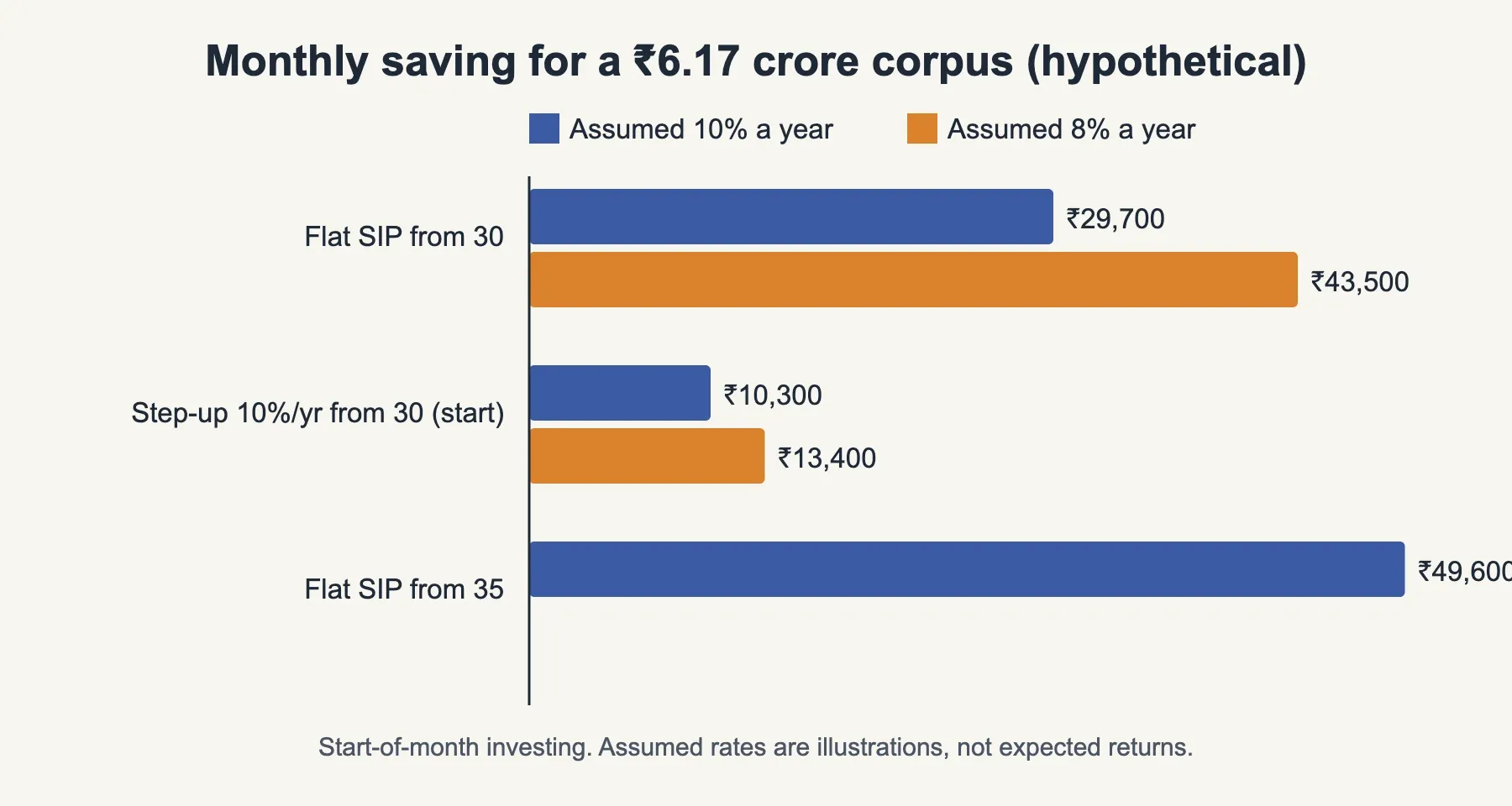
A yearly step-up lets the starting amount fit today's salary; see how much to step up an SIP. Starting five years later raises the flat amount by about two-thirds at the same assumed return, because the money gets 25 years to grow instead of 30.
Why headline numbers differ: the sensitivity table
Here is Kabir's corpus recalculated for other assumptions. Everything else stays the same: ₹40,000 a month today, retiring at 60, 25 years in retirement.
| Inflation (before and after retiring) | Return after retiring: 6% | 7% | 8% |
|---|---|---|---|
| 5% | ₹4.64 crore | ₹4.17 crore | ₹3.78 crore |
| 6% | ₹6.89 crore | ₹6.17 crore | ₹5.56 crore |
| 7% | ₹10.25 crore | ₹9.13 crore | ₹8.19 crore |
One point of inflation moves the answer more than one point of return, because inflation compounds for 30 years before retirement and 25 after. So two honest articles can quote figures crores apart. Some headline figures, such as ₹3.75 crore, simply divide a yearly expense by a withdrawal rate (₹15 lakh ÷ 4%) without stating an inflation or return assumption.
The 4% rule and the 25x shortcut: where they come from and their limits in India
The 4% rule says you can withdraw 4% of your corpus in the first year and raise the amount with inflation after that. Flipped around, the corpus should be about 25 times your first-year expenses. It traces to research by US financial planner William Bengen in the 1990s, which tested withdrawal rates against historical US market returns and US inflation.
For Kabir, 25x gives ₹6.89 crore: above his 25-year need of ₹6.17 crore and below his 30-year need of ₹7.24 crore. In his maths, the first-year withdrawal that lasts exactly 25 years is about 4.5% of the corpus; for 30 years it is about 3.8%.
So the sustainable rate is not a fixed number. It depends on the gap between what the corpus earns and how fast expenses rise, and on how long it must last. Your inflation and post-retirement return in India may look quite different from the US data behind the original research. Treat 25x as a quick check, not a plan.
What already counts toward the corpus, and what to subtract
The corpus is the total you need, not the amount SIPs alone must build.
- EPF: your and your employer's contributions are already building a balance. EPF interest for FY 2025-26 was set at 8.25%, with EPFO crediting it from July 2026. In Kabir's example, every ₹1 crore that EPF is projected to hold at 60 cuts the flat SIP by about ₹4,800 a month at an assumed 10%.
- NPS: the balance counts, but part of it may have to buy an annuity at exit. PFRDA last amended its NPS exit regulations on 16 December 2025, so check its current lump-sum and annuity rules before counting it; see NPS vs SIP.
- PPF and other savings: count what you expect to hold at 60; see PPF vs SIP.
- Subtract what will not exist: a paid-off home, a pension or rental income lowers the yearly amount the corpus must cover.
What the maths leaves out
- Health costs can rise faster than headline inflation. Health insurance and a separate medical buffer reduce pressure on the corpus.
- Sequence-of-returns risk: a market fall in the first years of retirement hurts more than the same fall later, because you withdraw while prices are low. A steady 7% hides this.
- Taxes on withdrawals: capital gains on mutual fund redemptions and the tax treatment of EPF and NPS payouts reduce what you can spend. The example ignores tax.
- Living past 85: the 30-year figure is a cushion for a longer life.
For a ₹1 crore target, see how much SIP for ₹1 crore; for what returns mean after inflation, see SIP returns after inflation.
Note your three inputs
Write down today's yearly spending, your inflation assumption and your post-retirement return assumption, and redo the three steps every three to five years. Save this page as your checklist.
Frequently asked questions
How much money do I need to retire in India?
It depends on three inputs: today's spending, inflation and the return after you retire. For ₹40,000 a month today, 30 years from retirement, at 6% inflation and a 7% return, it is about ₹6.17 crore (hypothetical). Across 5 to 7% inflation and 6 to 8% returns, it ranges from about ₹3.78 crore to ₹10.25 crore.
How do I calculate my retirement corpus?
Inflate today's yearly expenses to your retirement year, then find the present value of those expenses rising with inflation for each retirement year, at your assumed return. A spreadsheet with one row per year works.
Is ₹1 crore enough for retirement?
At 6% inflation, a 7% return and 25 years, ₹1 crore supports about ₹37,200 a month in the first year (hypothetical). If retirement is 30 years away, that is about ₹6,500 a month in today's money.
Does the 4% rule work in India?
It is a US-based shortcut. Whether 4% lasts depends on the gap between your return and your inflation. In Kabir's example, about 4.5% lasts 25 years and about 3.8% lasts 30.
How much SIP do I need per month for retirement?
For a ₹6.17 crore target over 30 years: about ₹29,700 a month flat at an assumed 10%, or a start of about ₹10,300 with a 10% yearly step-up. Starting at 35 raises the flat amount to about ₹49,600. These are illustrations, not return promises.