Multi asset allocation fund meaning: SEBI's three-asset rule and how it differs from a BAF
A multi asset allocation fund must hold at least 3 asset classes, 10% each. See how mixes differ, how it compares with a BAF, and how tax follows equity.
Summarize this article with AI





The short version
- As of 19 November 2026, SEBI requires a multi asset allocation fund to hold at least three asset classes, with at least 10% in each.
- The rule sets a floor, not a mix: the remaining 70% can tilt heavily towards equity or towards debt.
- A balanced advantage (Dynamic Asset Allocation) fund shifts between equity and debt only; a multi asset fund must keep three classes.
- Tax follows the equity share: 65% or more in listed Indian equity means equity-oriented treatment under the Income-tax Act, 2025.
- Read the factsheet for the actual mix and the riskometer for risk before comparing two funds with the same label.
A multi asset allocation fund is a hybrid mutual fund that must invest in at least three asset classes, such as equity, debt and gold, with at least 10% in each. That is SEBI's rule as of 19 November 2026. The label promises three asset classes, not lower risk; the equity share drives how the fund moves and how it is taxed.
Mutual fund investments are subject to market risks, read all scheme related documents carefully.
Ritu, 27, a physiotherapist in Amritsar, is setting up a ₹8,800 monthly SIP and has two fund pages open. Both say "Multi Asset Allocation Fund". One holds about two-thirds in shares; the other less than a third. This page explains the rule behind the label and what to check before treating two such funds as alike.
What SEBI's rule for multi asset allocation funds says
SEBI's circular "Categorization and Rationalization of Mutual Fund Schemes", dated 26 February 2026, lists Multi Asset Allocation as one of seven hybrid categories (paragraph 2.6.3, part C). The rule, quoted from the circular:
The scheme must also name its three asset classes in its description, so that is the first place to look. Our map of all categories is in SEBI's map of mutual fund categories.
Which asset classes count
Equity and debt are the usual two. The third is often a commodity such as gold. The circular adds two points:
- Foreign shares are not a separate asset class. Paragraph 2.6.3.17 says "Foreign securities will not be treated as a separate asset class." Indian and overseas shares together still count as equity.
- Fund-of-funds versions are narrower. For the multi asset fund-of-funds category, the circular notes that only gold- and silver-based passive schemes are currently allowed as commodity schemes.
Whether REITs or InvITs can count as one of the three classes depends on the scheme's documents. For the gold part on its own, see gold ETF vs gold mutual fund.
Same label, different mixes
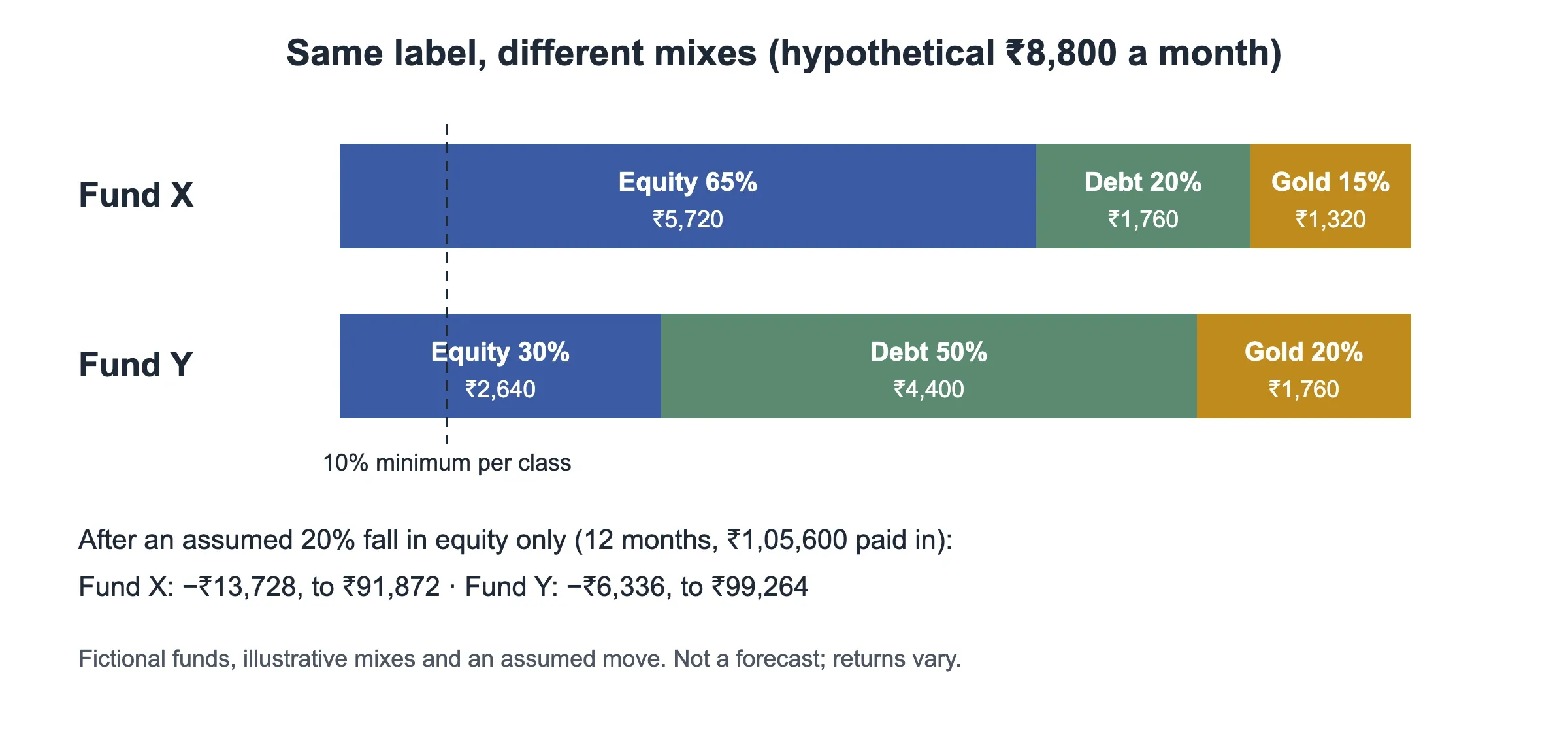
The 10% floor fixes only 30% of the portfolio. The other 70% is the fund's choice, within its scheme information document, so two funds in this category can behave very differently.
Worked example in ₹ (hypothetical)
Take a hypothetical SIP of ₹8,800 a month for 12 months, which adds up to ₹1,05,600. Compare two fictional funds with illustrative mixes:
| Monthly ₹8,800 split | Equity | Debt | Gold |
|---|---|---|---|
| Fund X (65 / 20 / 15) | ₹5,720 | ₹1,760 | ₹1,320 |
| Fund Y (30 / 50 / 20) | ₹2,640 | ₹4,400 | ₹1,760 |
After 12 instalments, valuing every part at cost, Fund X holds ₹68,640 in equity and Fund Y holds ₹31,680.
Now assume, for illustration only, that equity falls 20% while debt and gold stay flat. This is an assumed move, not a forecast.
- Fund X: equity goes from ₹68,640 to ₹54,912, a drop of ₹13,728. The whole holding falls to ₹91,872, about 13% lower.
- Fund Y: equity goes from ₹31,680 to ₹25,344, a drop of ₹6,336. The whole holding falls to ₹99,264, about 6% lower.
Both funds meet the same rule. The difference comes from the equity share. Fund X's equity share also slips to about 59.8% after the fall, which matters for tax (see below). (Hypothetical mixes and an assumed 20% equity fall; not a prediction; actual returns vary and can be negative in every asset class.)
Multi asset fund vs balanced advantage fund
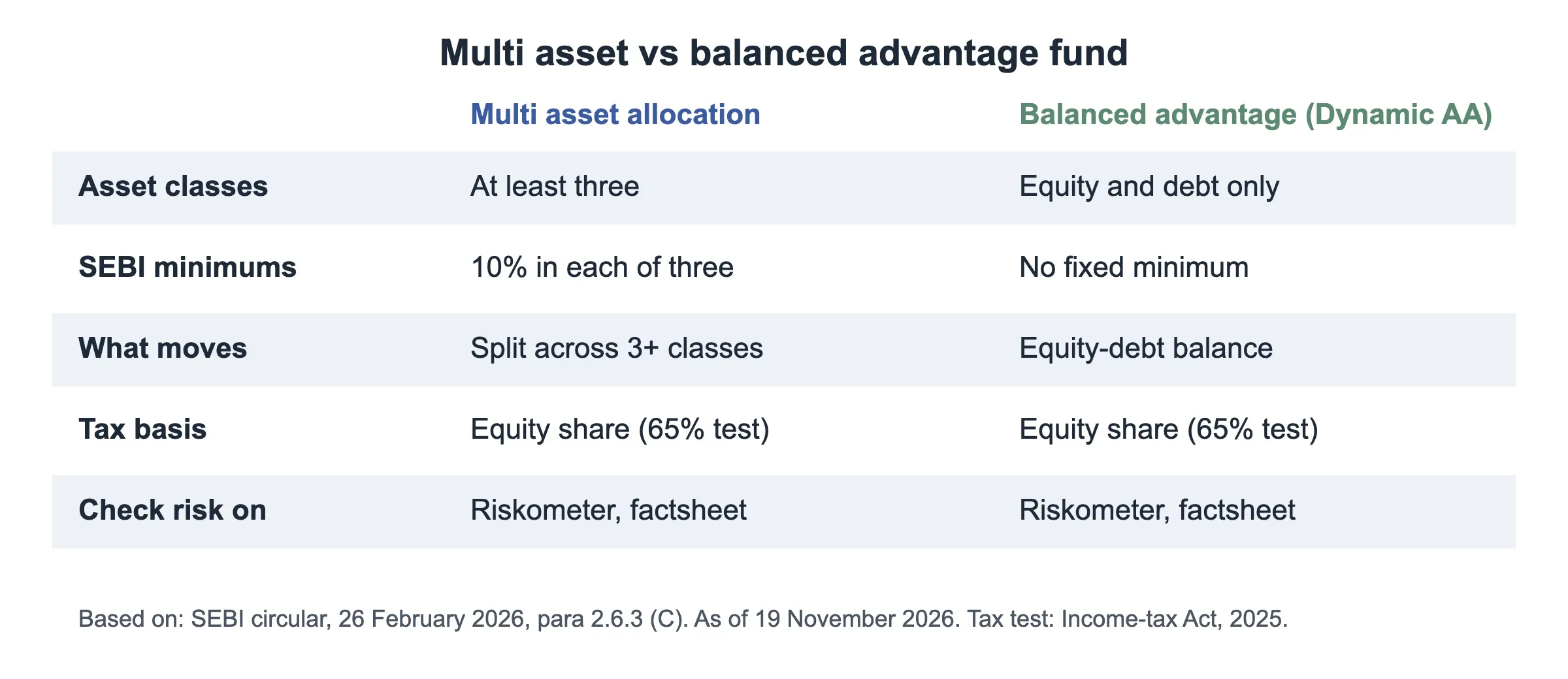
"Balanced advantage fund" is the common name for what SEBI's 2026 circular calls a Dynamic Asset Allocation Fund: "Investment in equity/ debt that is managed dynamically", in "debt and equity instruments only". See what a balanced advantage fund is.
| Multi asset allocation fund | Balanced advantage fund (Dynamic Asset Allocation) | |
|---|---|---|
| Asset classes | At least three | Equity and debt only |
| SEBI minimums | At least 10% in each of the three | No fixed minimum in either |
| What moves | Split across three or more classes, within the scheme's ranges | Equity-debt balance, managed dynamically |
| Tax basis | Depends on the equity share (see below) | Depends on the equity share (see below) |
In short: a balanced advantage fund adjusts how much equity it holds; a multi asset fund must also hold something besides equity and debt.
How a multi asset allocation fund is taxed
Tax follows the mix, not the category name. The points below are stated as of 19 November 2026, FY 2026-27, under the Income-tax Act, 2025.
- Equity-oriented funds. A fund that invests at least 65% of its proceeds in equity shares of listed domestic companies is an equity-oriented fund. Short-term gains are taxed at 20% (Section 196) and long-term gains above ₹1,25,000 at 12.5% (Section 198), where securities transaction tax applies. Units are usually long-term after 12 months.
- Funds with more than 65% in debt and money market instruments are generally treated as specified mutual funds, with gains taxed at your slab rate whatever the holding period.
- Funds in between, like Fund Y at 30% equity, follow the general capital gains rules for other units, with a different holding period and rates.
A fund near 65% equity, like Fund X, may or may not meet the test, so check how the scheme describes its own tax treatment. Foreign shares don't count towards the 65%, because the test refers to listed domestic companies. More by fund type: how mutual funds are taxed in India.
Tax rules change; consult a tax professional for your situation.
Lower volatility? What diversification can and can't do
Holding assets that don't always move together can soften swings in some periods. It doesn't remove risk. Equity, debt and gold can all fall in the same period; debt can lose value when rates rise or a borrower defaults; and a fund with a high equity share will still behave much like an equity fund. "Multi asset" describes structure, not safety. The riskometer, shown on every scheme, gives SEBI's standard risk label; see what the riskometer levels mean.
What to check before comparing two multi asset funds
- The three named asset classes in the scheme description.
- The actual mix in the latest factsheet ( how to read a factsheet).
- The equity share against 65%, for tax.
- The riskometer level.
- The expense ratio and exit load.
- Your time horizon against the fund's equity share.
What to be clear about before considering this category
This category may interest someone who wants equity, debt and a commodity in one scheme and will check the actual mix. It may not match someone who expects the label to mean low risk, or who already holds gold and debt separately. These are criteria, not a recommendation.
Frequently asked questions
What is a multi asset allocation fund in simple words?
It is a hybrid mutual fund that must spread its money across at least three asset classes, such as equity, debt and a commodity like gold, with at least 10% in each. That is SEBI's rule as of 19 November 2026; the rest of the mix is the fund's choice.
How is a multi asset fund different from a balanced advantage fund?
A balanced advantage fund, which SEBI now calls a Dynamic Asset Allocation Fund, moves money between equity and debt only, and SEBI sets no fixed minimum for either. A multi asset allocation fund must hold at least three asset classes with at least 10% in each.
How are multi asset allocation funds taxed, like equity or debt?
It depends on the mix, not the label. A fund with at least 65% in listed Indian equity shares is an equity-oriented fund under the Income-tax Act, 2025, with 20% tax on short-term gains and 12.5% on long-term gains above ₹1.25 lakh. Many multi asset funds hold less equity than that and are taxed differently. Tax rules change; consult a tax professional for your situation.
Is a multi asset fund good for a first-time investor who wants less volatility?
Check criteria rather than the name: the equity share in the latest factsheet, the riskometer level, and how long you plan to stay invested. Spreading across assets can soften swings in some periods, but every part of the fund can fall, sometimes together.
What does a 10% minimum in each asset class mean?
Out of every ₹100 in the fund, at least ₹10 must sit in each of the three asset classes the scheme names. On a hypothetical ₹8,800 monthly SIP, that is at least ₹880 a month in each class. It is a floor, not a target.
Learn more
Learn how the other hybrid categories compare in SEBI's map of mutual fund categories, or how a balanced advantage fund shifts its mix in balanced advantage funds explained.
— Laabh



