Investing for a 3-Year Goal With Mutual Funds: How to Pick a Category When the Deadline Can't Move
Mutual fund for a 3-year goal: pick the category by how firm your deadline is, see the SIP for ₹3.6 lakh, and how debt funds are taxed.
Summarize this article with AI





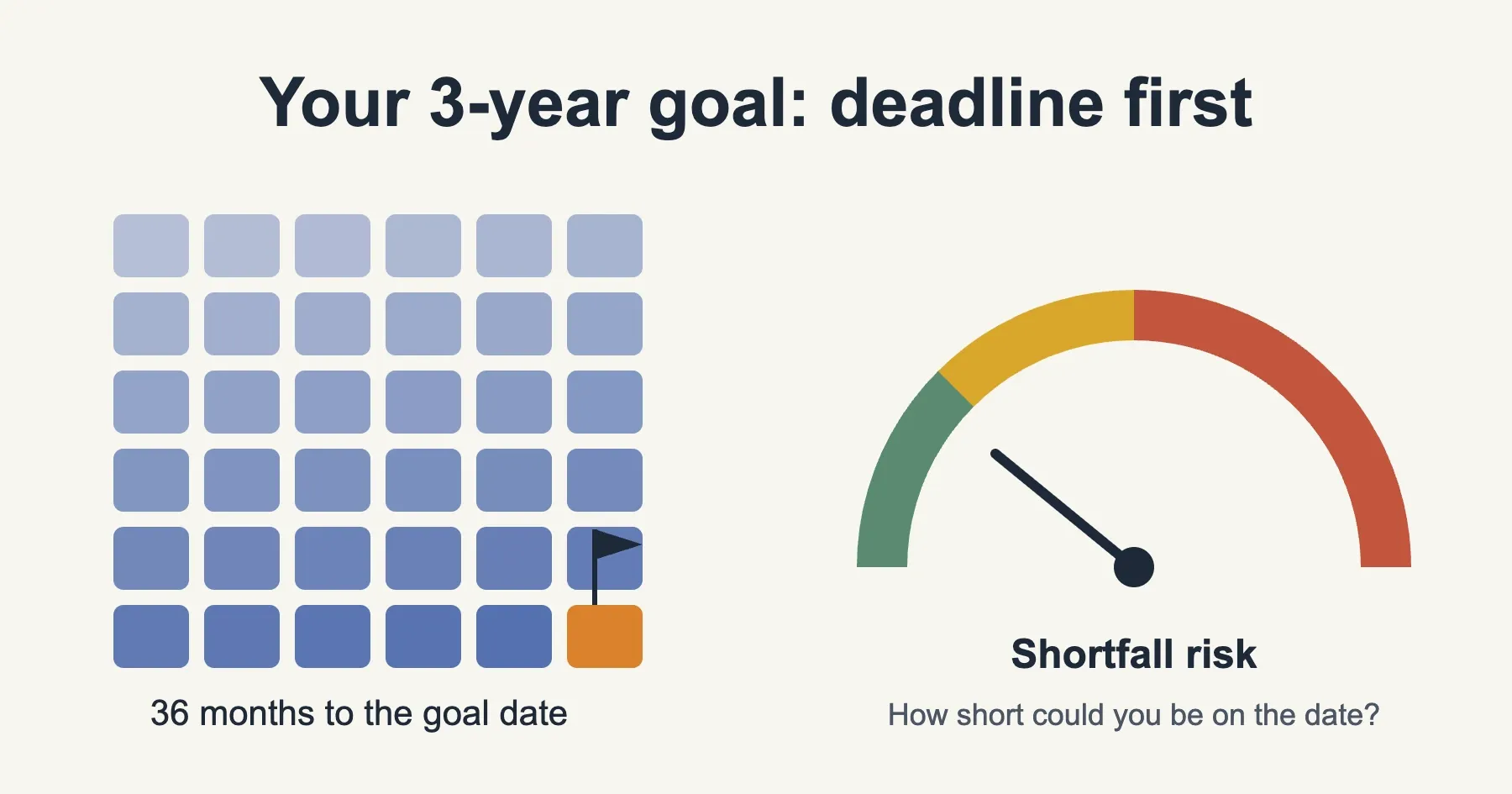
The short version
- Decide how firm the date is and how much shortfall you can tolerate before choosing a category.
- Over three years, equity carries real shortfall risk.
- For firm deadlines, people mostly consider liquid, money market and short duration funds; check the riskometer and PRC matrix.
- At hypothetical rates, ₹3,60,000 in 36 months needs ₹10,000 (0%), ₹9,106 (6%) or ₹8,822 (8%) a month.
- Debt fund units bought on or after 1 April 2023 are taxed at slab rates (Income-tax Act, 2025, section 76), as of 22 November 2026.
As of 22 November 2026: choosing a mutual fund for a 3-year goal starts with how much shortfall you could live with on the date, not with past returns. If the deadline cannot move, most of the money usually sits in lower-volatility debt categories, and equity, if used at all, is a small share that leaves well before the date. Debt fund units bought on or after 1 April 2023 are taxed at your slab rate.
Kriti, 27, in Nagpur, needs ₹3,60,000 in 36 months for a two-wheeler and the deposit on a bigger flat. Friends say an equity SIP "beats FDs". Over three years, that may or may not hold. Here is her decision, step by step.
Start with the goal: amount, date, and how firm the date is
Write down three facts first:
- Amount: what the goal costs on the date. Kriti's is ₹3,60,000.
- Date: her investment horizon is 36 months.
- Firmness: could the date slip by six months if markets were weak? A wedding or a course fee deadline usually cannot. A vehicle upgrade often can.
Then ask what falling short would cost. If a 15% gap would mean a high-interest loan or a cancelled plan, the goal is firm; if it would just mean waiting, it is flexible. That judgement drives everything below.
Why 3 years is short for equity
Equity funds can fall sharply and stay down for a while. What counts is the value on your date, not the long-run average: that is shortfall risk.
A hypothetical illustration, not a prediction: Kriti's pot reaches ₹3,60,000 in month 33, all in equity, and the market then falls 20%. She has ₹2,88,000, ₹72,000 short with three months left. A flexible goal could wait for a recovery of unknown timing; a firm one sells at the low.
So an equity SIP is not ruled out, but it can arrive short. Where people use equity here, it is usually a minority share and only when the date can move. Our guide on how long to continue an SIP explains why time matters so much for equity.
Categories people consider for 1–3 years, and what each risks
Every scheme carries SEBI's riskometer. Debt schemes also disclose a Potential Risk Class (PRC) matrix: interest-rate risk (how much the value moves when rates change) against credit risk (the chance a borrower doesn't pay). Check both before choosing. New to debt funds? Start with what a debt mutual fund is.
| Category | What it holds (SEBI categorisation) | Main risk for a 3-year goal | Tax on units bought now |
|---|---|---|---|
| Liquid fund | Debt and money market instruments maturing within 91 days | Returns track short-term rates; credit risk depends on holdings | Slab rate |
| Money market fund | Money market instruments maturing within 1 year | Low rate risk; credit risk depends on holdings | Slab rate |
| Short duration fund (being renamed short term fund) | Debt with portfolio Macaulay duration of 1–3 years | More rate risk: NAV can dip when rates rise | Slab rate |
| Arbitrage fund | At least 65% in equity, hedged through arbitrage | Returns depend on cash-futures price gaps, which can shrink | Equity-oriented rates |
| Conservative hybrid | 75–90% debt, 10–25% equity | The equity part can pull the NAV down in a fall | Usually slab rate |
For a firm deadline, most people look at the first three rows, using liquid and money market funds for money needed soonest (see what a liquid fund is). None is "safe": debt funds can lose value if a borrower defaults or rates rise sharply. Suitability depends on your situation. For how the arbitrage row works, see arbitrage fund meaning.
How much SIP to reach ₹3,60,000 in 36 months
For an SIP paid at the start of each month:
SIP = Target ÷ { [ (1 + i)^n − 1 ] ÷ i × (1 + i) }
where i is the assumed annual rate ÷ 12 and n is 36 months.
| Assumed annual rate (hypothetical) | Monthly SIP | Total you put in | Growth the plan relies on |
|---|---|---|---|
| 0% | ₹10,000 | ₹3,60,000 | ₹0 |
| 6% | ₹9,106 | ₹3,27,816 | ₹32,184 |
| 8% | ₹8,822 | ₹3,17,592 | ₹42,408 |
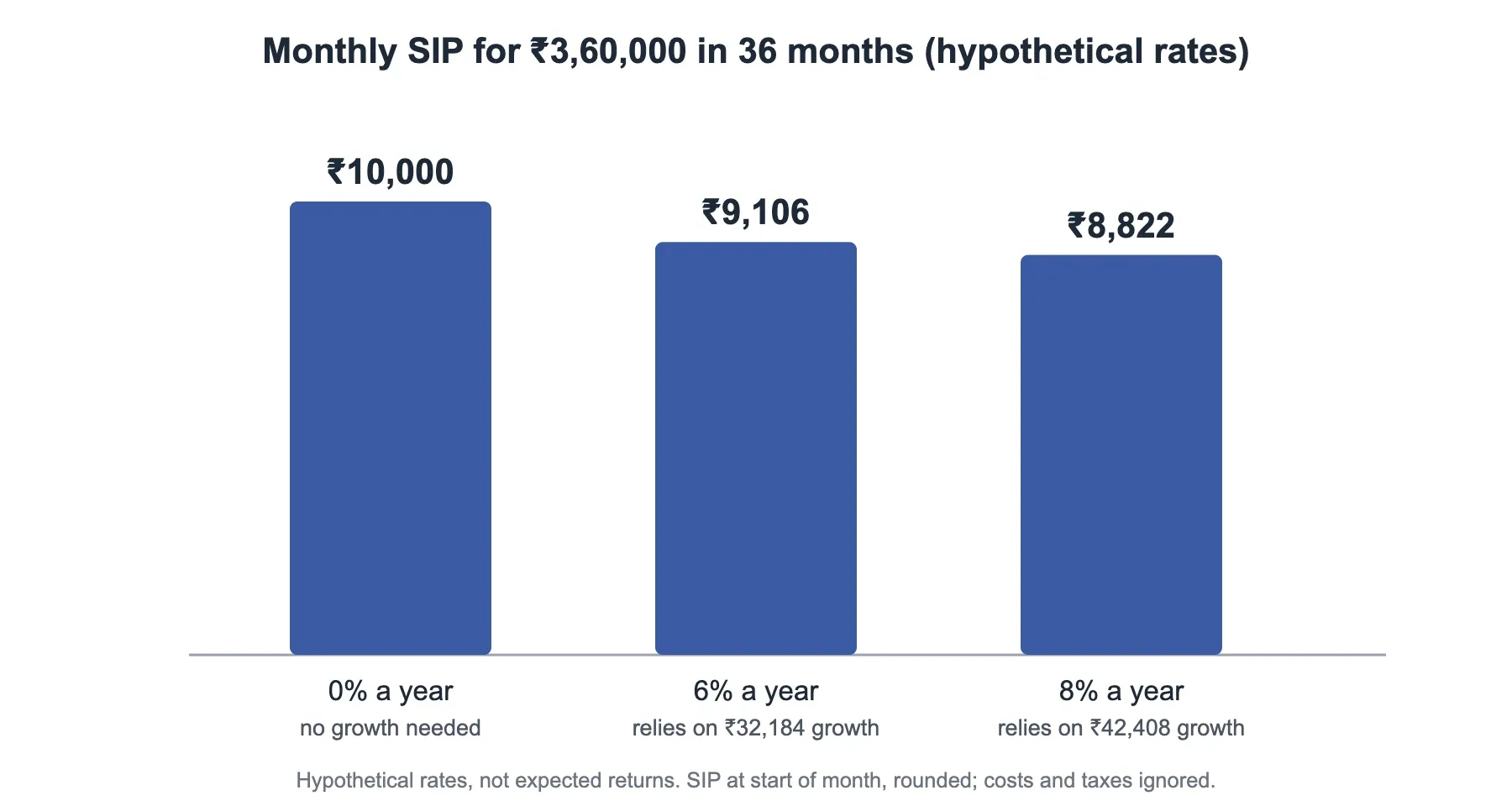
Read the last column as the risk you take. At 8%, ₹42,408 of the goal depends on returns; at a zero return, Kriti would be that much short. The gap between ₹8,822 and ₹10,000 is ₹1,178 a month, and for a firm goal it buys a margin no return assumption can.
Tax on each option, as of 22 November 2026
For tax year 2026-27, the Income-tax Act, 2025 applies. Its section 76 treats gains on units of a "Specified Mutual Fund" acquired on or after 1 April 2023 as short-term capital gains. A Specified Mutual Fund invests more than 65% of its proceeds in debt and money market instruments. The same rule sat in section 50AA of the Income-tax Act, 1961.
- Liquid, money market and short duration funds: gains on units bought now are taxed at your slab rate, even after three years.
- Conservative hybrid funds: with 75–90% in debt, usually the same slab treatment; check the scheme's tax note.
- Arbitrage funds: with at least 65% in equity, they are generally treated as equity-oriented. For tax year 2026-27, gains on units held over 12 months are taxed at 12.5% above ₹1.25 lakh of such gains a year (section 198, Income-tax Act, 2025); 12 months or less, at 20% (section 196). In a 36-month SIP, the last year's instalments will be under 12 months old on the goal date.
FD or mutual fund for a short-term goal?
An FD locks a known rate, so its maturity value is known in advance. A debt fund's NAV moves daily, but you can redeem any amount and tax falls due on redemption. Our comparison of SIP vs FD vs RD goes through the trade-offs by goal.
The last 12 months: moving money as the date approaches
If any goal money is in equity or hybrid funds, plan its exit in advance. One illustrative glide path for a flexible goal:
| Months to goal | Growth categories (equity, hybrid) | Stable categories (liquid, money market, short duration) |
|---|---|---|
| 36 to 25 | Up to 30% | 70% or more |
| 24 to 13 | Up to 15% | 85% or more |
| 12 to 0 | 0% | 100% |
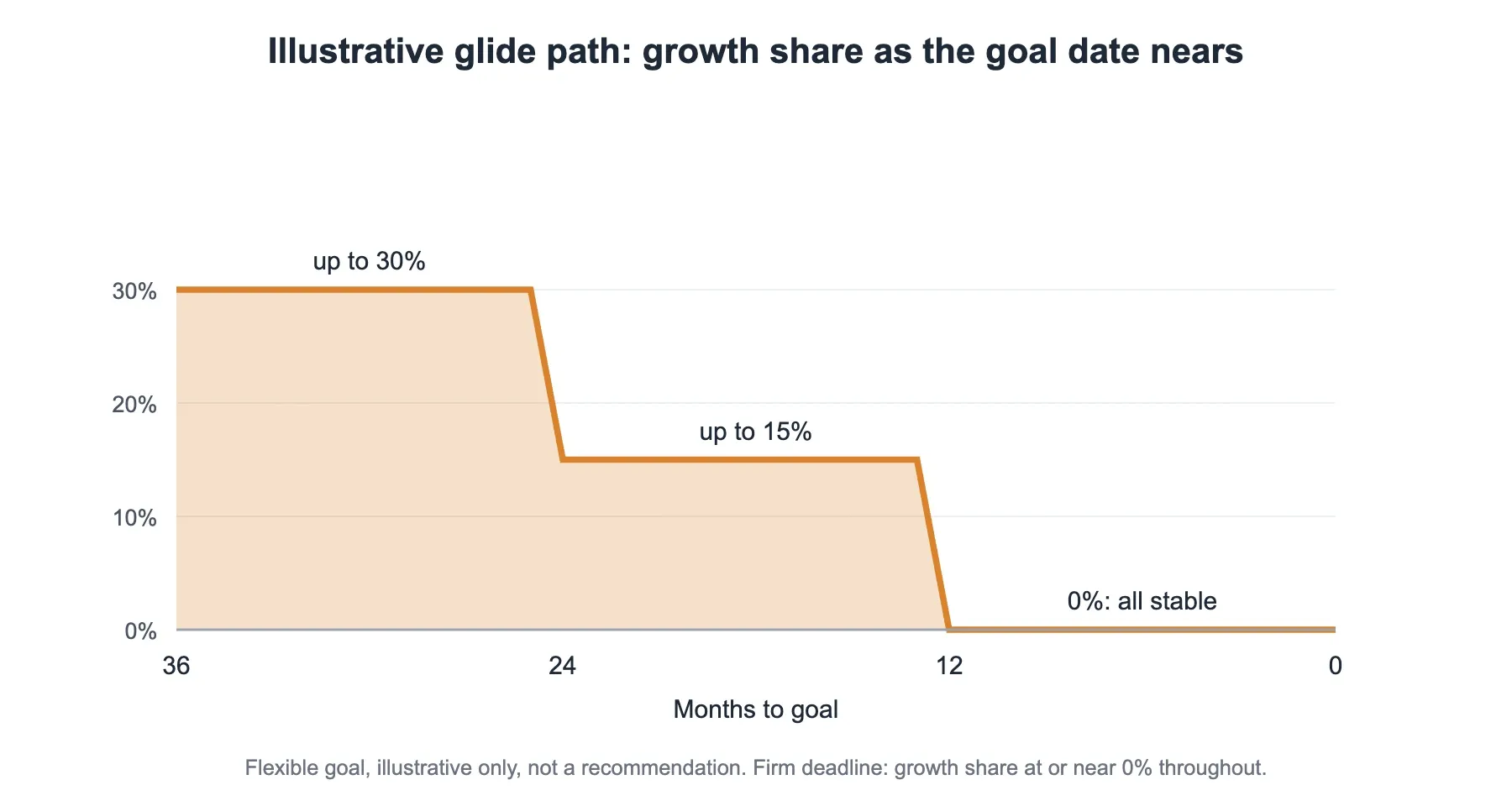
Move in monthly steps, check exit load and tax before each switch (a switch is a redemption; see exit load in mutual funds), and point new SIP instalments at the stable category.
Frequently asked questions
Which mutual fund is good for 3 years?
It depends on how firm your date is. For a fixed deadline, people mostly look at liquid, money market and short duration categories, checking the riskometer and PRC matrix. A flexible goal can take a small growth portion.
Is SIP in equity good for a 3-year goal?
It can be used, but a fall close to your date can leave you below target with little time to recover, which matters most when the date is firm.
How much SIP do I need for ₹3.6 lakh in 3 years?
₹10,000 a month at 0%; about ₹9,106 at 6% and ₹8,822 at 8% (hypothetical rates). The lower figures rely on returns that may not happen.
How are debt funds taxed for a 3-year holding now?
As of 22 November 2026, gains on units of funds with over 65% in debt and money market instruments, bought on or after 1 April 2023, are taxed at your slab rate whatever the holding period (section 76, Income-tax Act, 2025).
Should I keep a short-term goal in FD or mutual fund?
An FD gives a known maturity value; a debt fund's value moves but allows flexible withdrawals, with tax on redemption. Choose by how much certainty you need on the date.
Save this plan
Note your goal's amount, date and firmness, your SIP from the table and your glide-path dates.



