Is This the Right Time to Start a SIP? What Waiting for a Fall Actually Gains You, in Rupees
Start your SIP now or wait for a fall? A hypothetical ₹5,000 SIP shows what three kinds of waiter end up with, in rupees. No forecasts. As of 22 Nov 2026.
Summarize this article with AI





The short version
- There is no 'right time' to start an SIP that can be seen in advance; nobody knows whether a high will be followed by a fall.
- In a hypothetical ₹5,000 SIP over 10 years, a perfectly timed 12-month wait gained ₹25,484 if a 30% fall came and lost ₹7,552 if it didn't.
- The common waiter, who only starts the SIP later, ended ₹1,15,993 to ₹1,49,029 behind because 12 instalments never went in.
- The real test is year one: could you keep going if ₹60,000 invested showed ₹49,192?
- Wait for your own reasons (goal under about 3 years, no emergency fund), not the index level.
As of 22 November 2026, nobody can tell you whether today's market level will be followed by a fall, so there is no "right time" to start an SIP that you can see in advance. For an SIP meant for 7 years or more, the starting level has mattered far less than how long you stay invested. The question you can actually answer is whether your goal is far enough away for you to sit through a fall in the first year.
Kunal, 27, a software tester in Lucknow, finished his KYC last week and planned a ₹5,000 monthly SIP in an equity fund for a goal ten years out. Then he saw headlines about markets being high, and he paused. Should he start now or wait for a correction? This page puts his choice in rupees, for three kinds of waiter, without predicting anything.
Why "is the market high?" is the wrong first question
A systematic investment plan (SIP) buys units on many dates, not one. Kunal's 120 monthly instalments will buy at 120 different prices. His first instalment is less than 1% of what he plans to invest over ten years, so the level on the day he starts sets the price for a very small slice of his money.
The level also tells you little about what comes next. AMFI's investor education site puts it plainly: "Mutual Funds do not have a fixed rate of return and it is not possible to predict the rate of return." An all-time high (the highest level an index has ever closed at) can be followed by a market correction (a meaningful fall from a recent peak), or by more highs. You only find out afterwards.
Where markets stand today
Index levels change every trading day, so we don't quote one here. You can see the latest Nifty 50 closing level on the NSE website (nseindia.com) and the Sensex on the BSE website (bseindia.com). Whatever the level, it describes the past, not what comes next, and the reasoning below does not depend on it.
Worked example: start now vs wait 12 months, in two possible markets
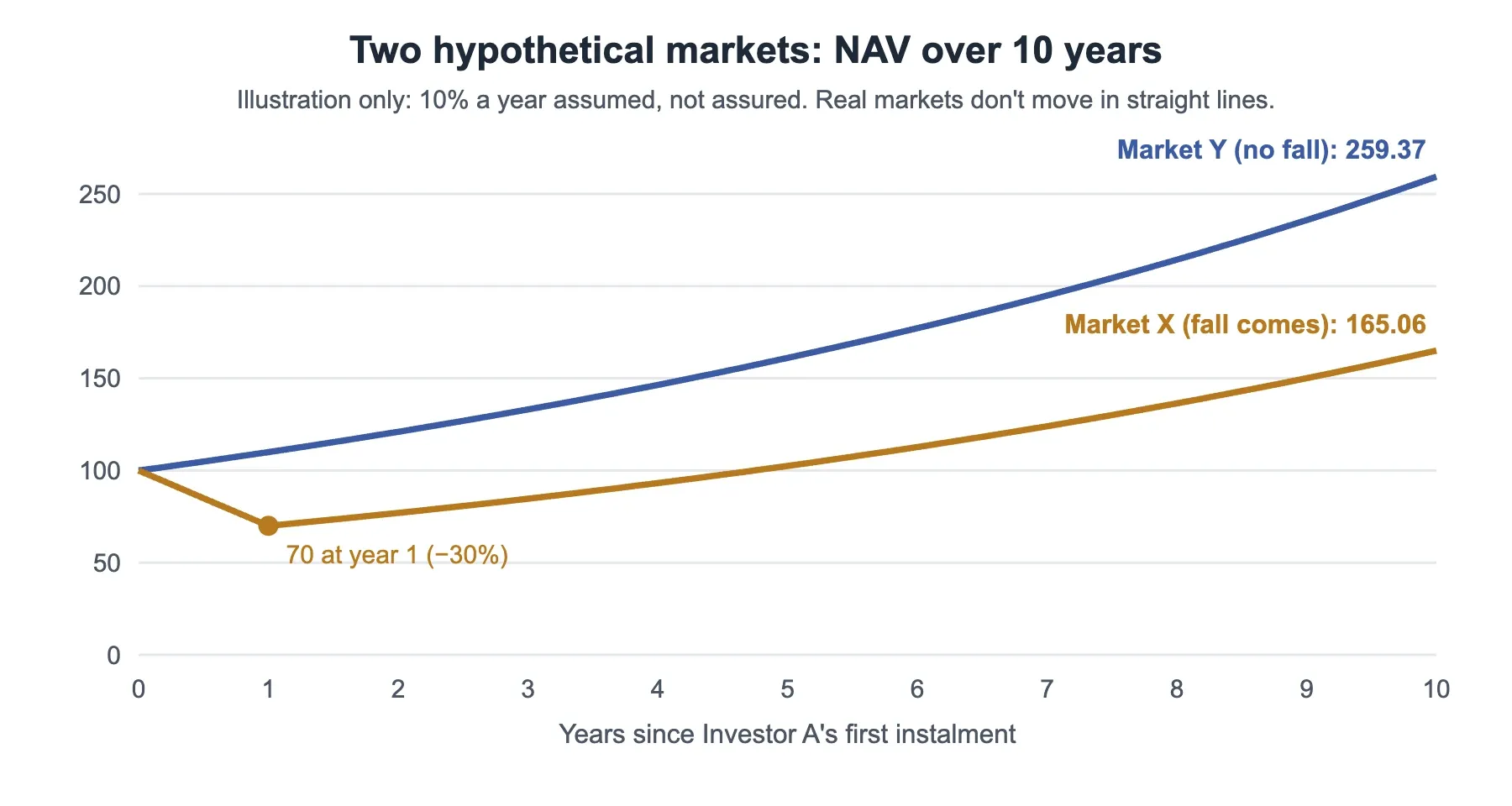
Here is a hypothetical ₹5,000 monthly SIP for 10 years (120 instalments), valued at month 120. The fund's NAV starts at 100. Both market paths are invented for illustration and assume a growth rate of 10% a year, which is not assured:
- Market X (the fall comes): NAV falls 30% in a straight line over 12 months to 70, then grows 10% a year. NAV at month 120: 165.06.
- Market Y (no fall): NAV grows 10% a year from day one. NAV at month 120: 259.37.
Three investors:
- A starts now and invests every month from month 0.
- B waits 12 months, then starts the SIP. The ₹60,000 he held back is not invested.
- C waits 12 months, invests the held-back ₹60,000 in one go at month 12, then runs the SIP.
| Investor | Invested | Market X value | Market Y value |
|---|---|---|---|
| A: starts now | ₹6,00,000 | ₹9,74,252 | ₹10,07,288 |
| B: waits, then starts the SIP only | ₹5,40,000 | ₹8,58,259 | ₹8,58,259 |
| C: waits, invests ₹60,000 at month 12, then SIPs | ₹6,00,000 | ₹9,99,736 | ₹9,99,736 |
How to read it:
- C, the waiter who gets everything right, ends ₹25,484 ahead of A if the fall comes, and ₹7,552 behind A if it doesn't. Even a perfect wait buys a modest edge, and only in one of the two markets.
- B, the more common waiter, ends behind A by ₹1,15,993 in Market X and ₹1,49,029 in Market Y. The cost is not the timing. It is the 12 instalments that never went in.
- B and C show the same value in both markets because, from month 12, both markets grow at the same rate in this example.
The decision that moves the result most is not "now or later". It is whether the money actually gets invested, and for how long.
What the year-one fall feels like
The table hides the hard part. In Market X, by month 12 Kunal would have put in ₹60,000, and it would be worth ₹49,192: a paper loss of about 18%. That is the moment many people stop an SIP.
So the real test before starting is this: if your ₹60,000 showed ₹49,192 a year from now, would you keep going? If the answer is yes, the starting level matters little to you. If the answer is no, that is useful to know before you start, and the last two sections are for you.
In the same fall, every instalment buys more units at the lower NAV. Those units are what lift A's final value in Market X. For what to do when a fall arrives after you have started, see what happens to your SIP when the market falls.
What long-run data has shown
A Value Research study (Mutual Fund Insight, June 2026) tested an SIP started in every month from April 2003 to April 2026 in an average regular large-cap fund. It counted a month as overvalued when the Sensex price-to-earnings (P/E) ratio was 10% or more above its five-year trailing average; there were 100 such months, and 64 months counted as undervalued.
Its findings, in its own words: starting when markets are expensive "raises your chance of a loss in year one to 28 per cent", and "over 15 years, the average return is nearly identical to someone who started cheap." The excerpt we read did not give the figures for undervalued starts.
This is past data for one index and one fund category, not a guarantee of future outcomes. It matches what the worked example shows: an expensive start mostly changes how the first year feels, not the long-run result.
When waiting, or a different product, does make sense
In the example and the study above, the market level alone changed the long-run result little. Your own situation can be a better reason to wait:
- Your goal is under about 3 years away. An equity SIP is a mismatch for that goal at any market level, because a year-one fall may not have time to recover. A shorter-horizon category fits better; see mutual funds for a 3-year goal.
- You don't have an emergency fund yet. If a job loss or hospital bill would force you to redeem in a fall, build that buffer first.
- You know you would stop in a fall. Start smaller, say ₹2,000 instead of ₹5,000, so the paper loss is something you can watch without acting. You can raise the amount later.
Before you choose a fund, check the riskometer shown in its scheme documents so you know the risk level you are signing up for. For why an SIP lowers some risks but not market risk, see is SIP risk free?.
If you start now: three habits
- Keep the SIP running in falls. The instalments in a falling market are the ones that buy more units.
- Don't judge it in year one. A loss in the first year is a normal possibility, not a verdict. The compounding that matters happens in the later years; see power of compounding in an SIP.
- Review against your goal, not the index. Check once or twice a year whether you are on track; see how long to continue your SIP.
Frequently asked questions
Is this the right time to start an SIP?
No one can identify the right time in advance, because nobody knows whether today's level will be followed by a fall. For goals 7 or more years away, the starting level has mattered less than the time invested. Check your horizon and whether you could hold through a fall in the first year.
Should I start an SIP when the market is at an all-time high?
In our hypothetical example, starting now ended within about ₹25,500 of a perfectly timed wait if a 30% fall came, and about ₹7,600 ahead if it didn't. Value Research's June 2026 study found expensive starts had a higher chance of a year-one loss but near-identical 15-year average returns. That is past data, not a promise.
Is it better to wait for a market correction before starting an SIP?
Waiting helps only if the fall comes and you then invest the money you held back. If you only start the SIP late, you lose the missed instalments: ₹1.16 lakh to ₹1.49 lakh less in our example. If the fall never comes, even the ideal waiter ends behind.
What happens if the market falls right after I start my SIP?
Your early instalments show a paper loss; in our example, ₹60,000 invested shows ₹49,192 after a 30% fall. Your later instalments buy more units at lower prices.
Abhi SIP shuru kare ya nahi?
Market kab girega, yeh pehle se koi nahi bata sakta, isliye "sahi time" pehle se pata nahi chalta. 7 saal ya usse lambe goal ke liye, shuru karne ka level utna matter nahi karta jitna ki kitne saal invested rahe. Bas yeh dekhiye ki pehle saal ki girawat me aap SIP chalu rakh paayenge ya nahi.
Save this check
Before you start, write down your goal year, your monthly amount, and the number you could see in year one without stopping. Save this page and come back to it the next time a headline says "record high".



