Open-Ended vs Closed-Ended Mutual Funds: How You Get Your Money Out of Each, Under SEBI's 2026 Rules
Open-ended funds redeem at NAV any business day; closed-ended funds pay at maturity or via an exchange sale, often below NAV.
Summarize this article with AI





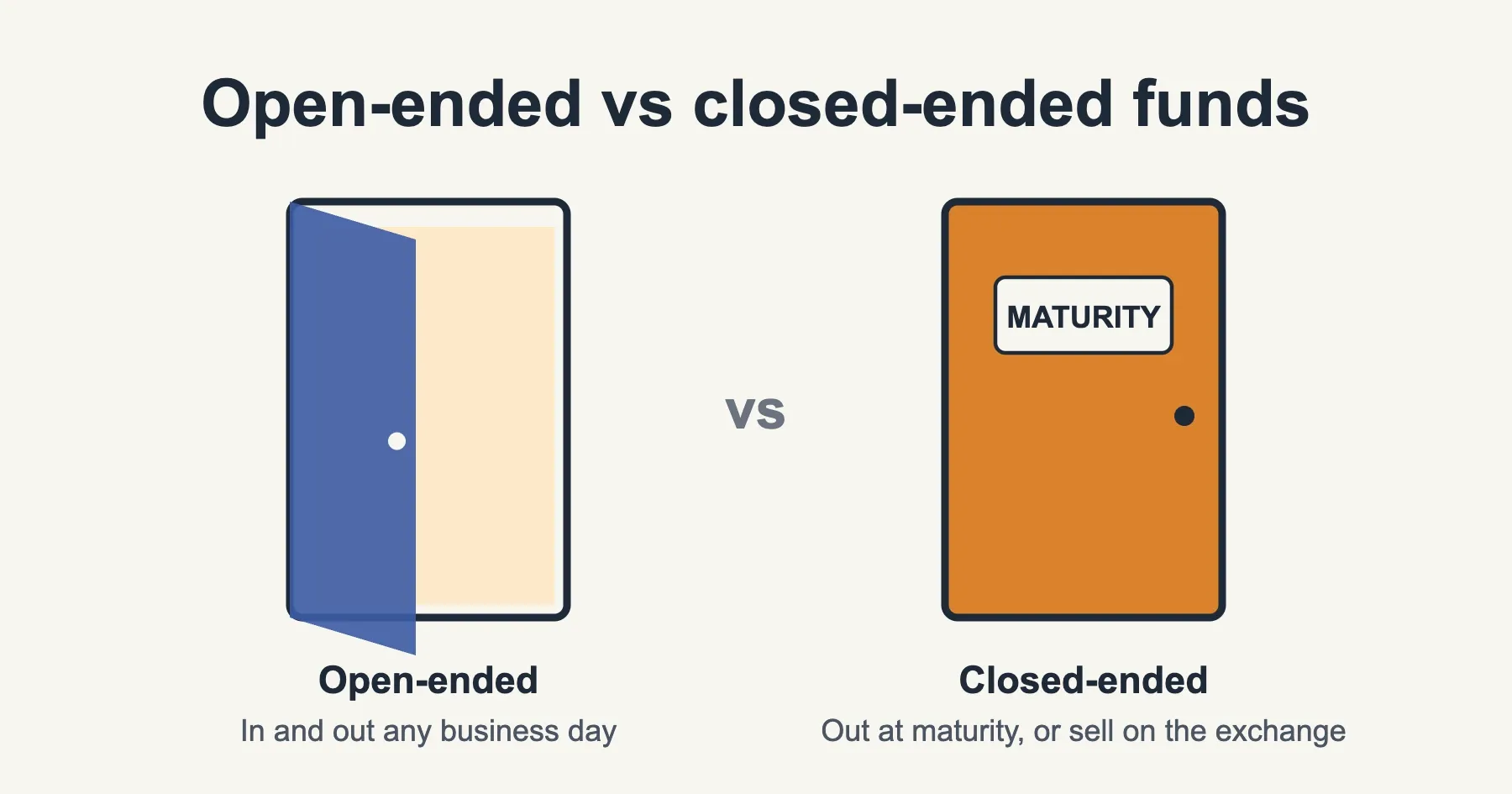
The short version
- Open-ended: buy and redeem with the fund house on any business day at NAV; no maturity date.
- Closed-ended: fixed maturity, money in mainly at the NFO, units listed; early exit means selling on the exchange, often below NAV.
- Interval: buy and redeem at NAV only in set windows; the exchange is the route in between.
- A lock-in (ELSS), an exit load or an NFO launch does not make a fund closed-ended.
- The SID's "type of scheme" line settles the question for any real scheme.
As of 22 November 2026: an open-ended mutual fund lets you buy units from the fund house and redeem them back on any business day at that day's NAV. A closed-ended mutual fund (SEBI's text says "close ended") has a fixed maturity date, takes your money mainly during its new fund offer (NFO), and has its units listed on a stock exchange, so before maturity you usually get out by selling to another investor there, often below NAV. An interval fund sits in between: you can buy or redeem only in the transaction windows set in its scheme documents.
Ritika, 27, in Indore, has seen an NFO advertisement saying "close ended scheme". Her real question: if she needs the money in a year, can she get it, and at what price?
What the labels mean under SEBI's rules
Mutual funds in India now run under the SEBI (Mutual Funds) Regulations, 2026. They were published in the Gazette of India on 15 January 2026, they came into force on 1 April 2026 (Regulation 1(2)), and they have since been amended on 3 July 2026 and 8 October 2026. They replaced the SEBI (Mutual Funds) Regulations, 1996; our explainer on SEBI's 2026 mutual fund regulations covers what changed.
The 1996 Regulations defined a close ended scheme as one "in which the period of maturity of the scheme is specified", and an open ended scheme as one that "offers units for sale without specifying any duration for redemption".
The 2026 Regulations keep both definitions word for word (Regulation 2(1)(h) and 2(1)(nn)). They also require schemes without daily buying and redemption to be listed on a recognised stock exchange (Regulation 29(2)), and bar close ended schemes from buying back units before maturity (Regulation 30(1)). For any real scheme, the first page of its scheme information document (SID) states the type in one line. Read that line first.
Open-ended funds: money in and out on any business day
An open-ended fund has no maturity date. It sells new units and buys back (redeems) existing ones every business day, at the NAV that applies to your transaction time, which is why SIPs fit easily here. If NAV itself is new to you, see what NAV means in a mutual fund.
What you receive is NAV on the day, minus any exit load: a percentage some schemes charge if you redeem within a set period. It is a cost, not a lock; see exit load in mutual funds. The money reaches your bank account within the timeline in the SID, typically a few working days. For a step-by-step view of withdrawals, see can you withdraw your SIP money anytime.
Closed-ended funds: fixed maturity, NFO entry, exchange exit
A closed-ended fund raises money during its NFO, invests it, and runs until a stated maturity date. After the NFO, the fund house does not sell or redeem units every day. To give investors a way out before maturity, the units are listed on a stock exchange. Fixed maturity plans (FMPs) are the closed-ended category most beginners meet.
Exiting before maturity: selling on the exchange
To sell, you need the units in a demat account and a broker. The price is whatever a buyer will pay, not NAV. Listed closed-ended units often trade below NAV, and on a quiet day there may be few buyers.
Here is a hypothetical example for Ritika. The NAV, trade price and exit load are assumptions, not data for any real scheme.
| Hypothetical: 5,000 units, NAV ₹11.80, money needed 9 months before maturity | Amount |
|---|---|
| Value at NAV (5,000 × ₹11.80) | ₹59,000 |
| Closed-ended: sold on the exchange at the last traded price of ₹11.20 (5,000 × ₹11.20) | ₹56,000 |
| Shortfall versus NAV value | ₹3,000 (5.08%) |
| Same units in an open-ended scheme, redeemed at NAV with an assumed 1% exit load (₹590) | ₹58,410 |
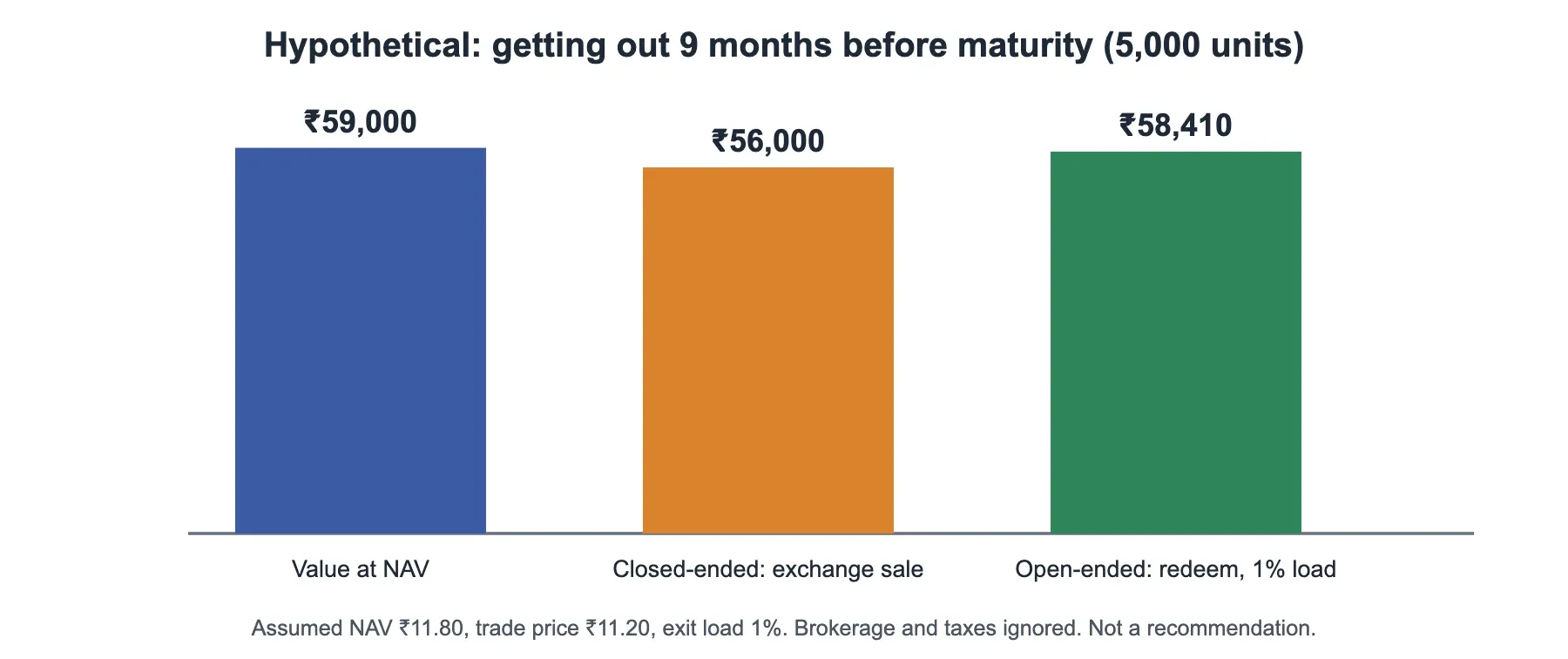
₹11.20 is only the last traded price: if buyers for 5,000 units are not there, she may sell in parts or accept less, and the discount can differ on any day.
At maturity: the fund pays out
Hold to the maturity date and the fund redeems your units at NAV and pays your bank account, so the exchange discount stops mattering. A rollover applies only to unitholders who consent in writing; if you do not consent, your units are redeemed in full on the maturity date (Regulation 30(4)).
Interval funds: windows instead of every day
An interval fund combines the two structures. It allows purchases and redemptions with the fund house only during specified transaction periods, and its units stay listed in between. The SID sets out how often those windows open and for how many days. In Ritika's case, an interval scheme would let her redeem at NAV, but only in the next window; if one has just closed, the money waits unless she sells on the exchange.
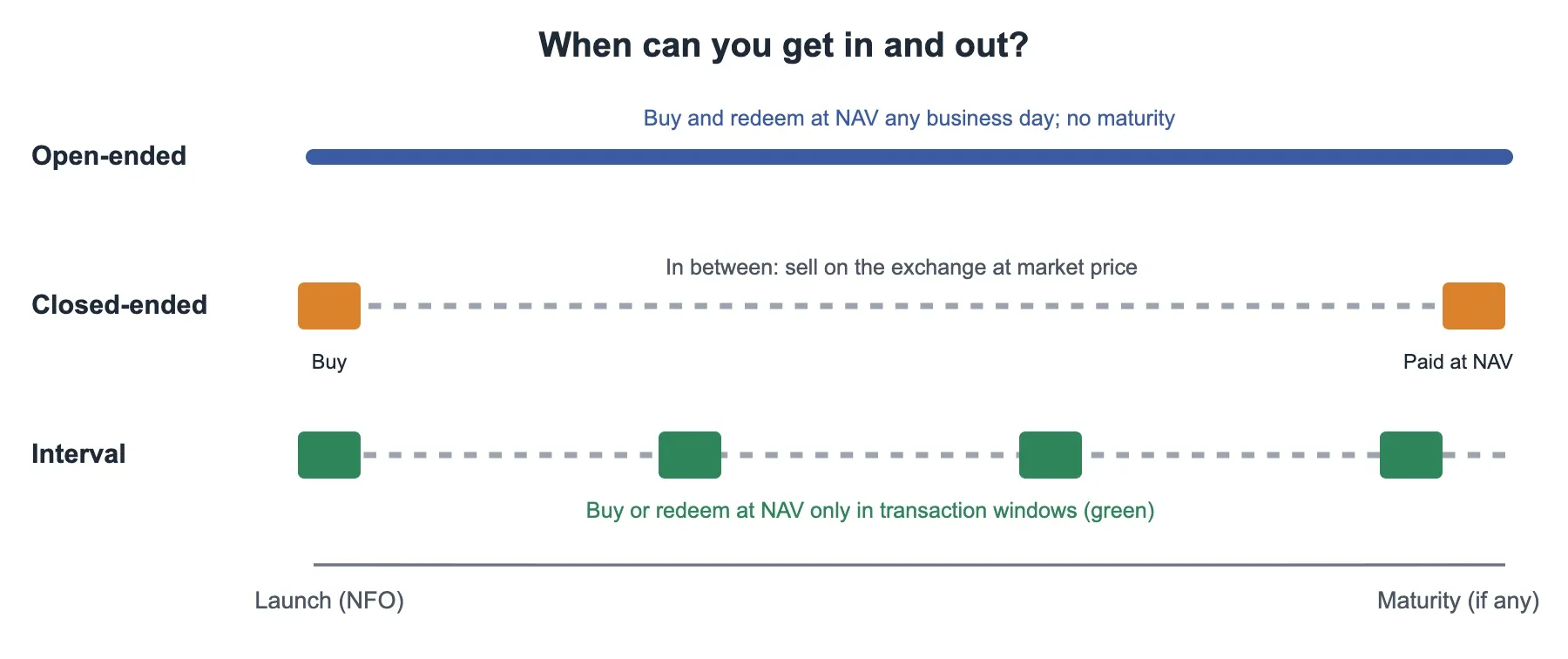
Side by side: open-ended vs closed-ended vs interval
| Open-ended | Closed-ended (SEBI: close ended) | Interval | |
|---|---|---|---|
| When you can invest | Any business day, lump sum or SIP | Mainly during the NFO | During transaction windows |
| When you can get money out | Any business day | At maturity; before that, by selling on the exchange | During transaction windows; in between, on the exchange |
| Price you get | NAV, minus any exit load | Exchange price before maturity; NAV at maturity | NAV in a window; exchange price in between |
| SIP | Usually available | Not available; lump sum only | Check the SID |
| Maturity date | None | Yes, stated at launch | As set in the SID |
| Demat needed to exit early | No | Yes | Only for exchange sales |
| Category examples | Equity, debt, hybrid, index funds, ELSS | Fixed maturity plans | Some debt schemes |
Three common mix-ups
"ELSS has a lock-in, so it must be closed-ended." SEBI's scheme categories (circular of 26 February 2026) describe ELSS as an open-ended scheme. Each investment carries a lock-in (three years as of 22 November 2026), a holding rule on your units, not a closed structure; see the ELSS lock-in on SIPs.
"This fund has an exit load, so my money is locked." You can still redeem; you just pay the load if you are inside its period.
"It's an NFO, so it must be closed-ended." Open-ended schemes also launch through an NFO and then reopen for daily buying and selling. See NFO or existing mutual fund for what the ₹10 NFO price does and does not mean.
Before you put money into a closed-ended NFO, ask yourself
- When will I need this money? If before maturity, plan on the exchange price, not NAV.
- Can I hold to maturity if plans change? A job change or a medical bill can arrive early.
- How actively do similar listed units trade? Thin volumes mean slow or cheaper exits.
- Do I have a demat account? Without one, an early exchange sale is not open to you.
For SEBI's wider scheme map, see mutual fund categories explained.
Frequently asked questions
What is the difference between open-ended and closed-ended mutual funds?
An open-ended fund sells and buys back units on any business day at NAV and has no maturity date. A closed-ended fund has a specified maturity, takes money mainly in its NFO, and lists its units on a stock exchange, so before maturity you exit by selling to another investor.
Can I withdraw from a closed-ended mutual fund before maturity?
Not by redeeming with the fund house in the usual way. You sell your units on the stock exchange through your demat account, at whatever price buyers offer. In our hypothetical example, units worth ₹59,000 at NAV fetch ₹56,000 at ₹11.20 each.
What is an interval fund?
An interval fund lets you buy or redeem units with the fund house only during specified transaction periods, and keeps its units listed in between. The SID lists how often those windows open and how long they last.
Is ELSS an open-ended or closed-ended fund?
SEBI's scheme categories (circular of 26 February 2026) describe ELSS as an open-ended scheme: you can invest on any business day. Each investment carries a lock-in (three years as of 22 November 2026), which is a holding rule, not a closed-ended structure. Confirm the type and lock-in in the scheme's SID.
Can I start an SIP in a closed-ended fund?
A closed-ended fund collects money in its NFO and then does not sell new units daily, so it accepts lump sums, not SIPs, as AMFI's investor education site explains. SIPs are offered by open-ended schemes. A scheme's SID lists how it accepts investments.
Save this checklist
Before your next NFO, save the four questions above and check them against the scheme's SID.



