SIP stoppage ratio: what AMFI's number measures, and what above 100% does and doesn't tell you
The SIP stoppage ratio divides SIPs ended in a month by new SIPs registered. See why it can top 100% and what it can't tell you about your own SIP.
Summarize this article with AI





The short version
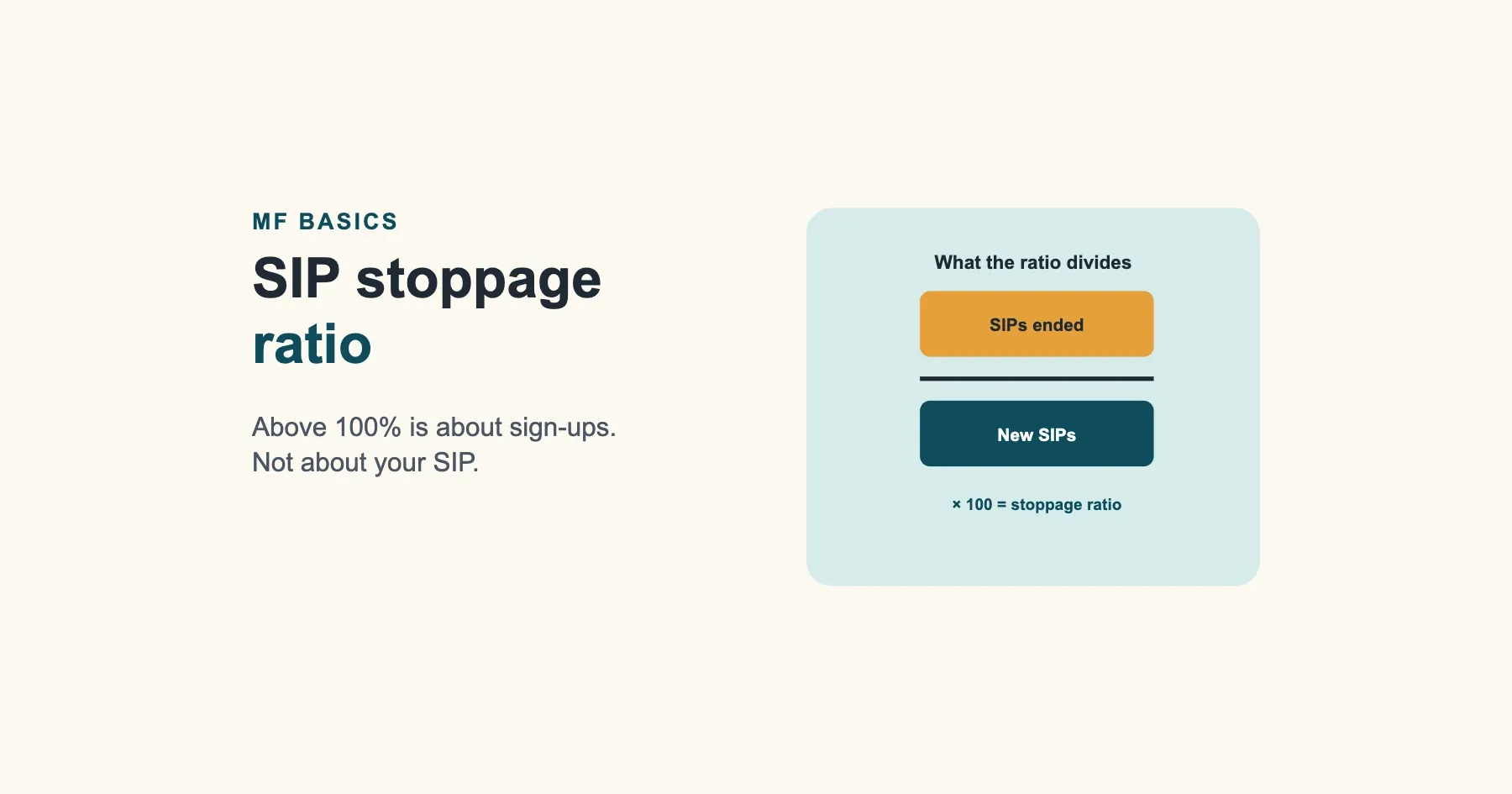
- The SIP stoppage ratio is SIPs discontinued or tenure completed in a month, divided by new SIPs registered that month, times 100.
- The denominator is new registrations, not all live SIPs, so a dip in sign-ups can push the ratio above 100% on its own.
- Matured SIPs and record clean-ups are counted as stoppages in the headline figure.
- Figures for October 2026 range from about 115% to 117% because writers count AMFI's rows differently.
- Your own SIP decision rests on your goal, horizon and cash flow, not on an industry ratio.
The SIP stoppage ratio compares the SIPs that were discontinued or reached the end of their tenure in a month with the new SIPs registered that month, as a percentage. Above 100% means more SIPs ended than started that month. On its own, it doesn't show how many existing investors are quitting, because matured and cleaned-up SIPs are counted too.
Ananya, 27, works in Thane and has a ₹2,600 monthly SIP that she started last year. In November 2026 her feeds filled up with one number: the SIP stoppage ratio for October 2026, above 115%. Here is what that number is built from, and what it can and can't show.
What is the SIP stoppage ratio, and how is it calculated?
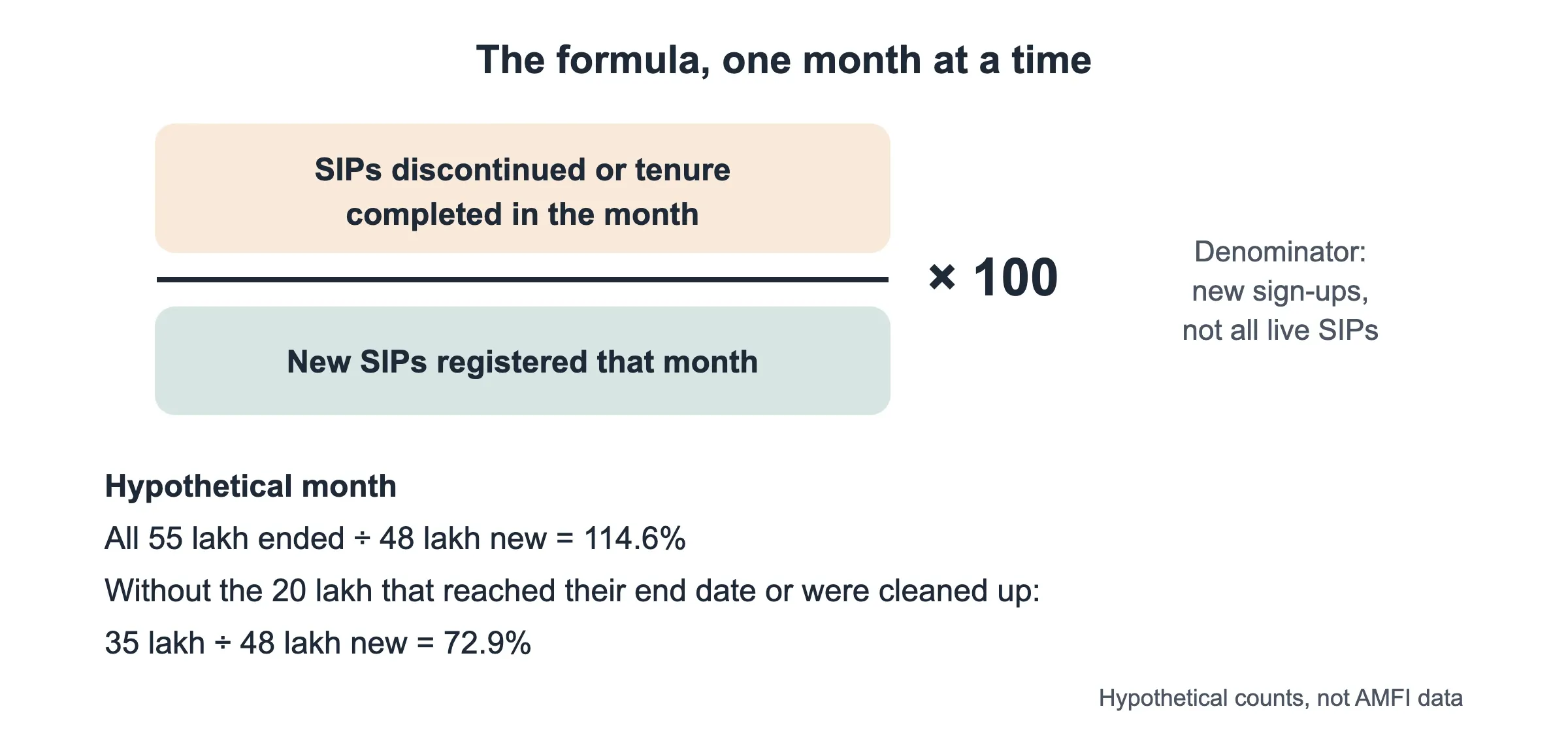
It is a ratio of two monthly counts. The top of the fraction is the number of SIPs that ended during the month. AMFI's data groups these as SIPs "discontinued/tenure completed", so it includes SIPs that were cancelled early and SIPs that simply reached the end date set when they were registered. The bottom of the fraction is the number of new SIPs registered in that same month.
The denominator matters most. It is new registrations, not all the SIPs that are running. With crores of live SIP accounts, a month's stoppages are a small slice of the whole even when they outnumber that month's sign-ups.
AMFI publishes the counts. The stoppage ratio is a calculation that analysts and news reports make from those counts, and different writers count slightly different rows. That is one reason you will see more than one figure for the same month.
How can more SIPs stop than start in a month?
Because the two counts move for different reasons. Stoppages depend on SIPs registered months or years ago: their end dates, failed debits and investors' own choices. New registrations depend on how many people sign up this month. When sign-ups dip, the ratio rises even if stoppages stay flat.
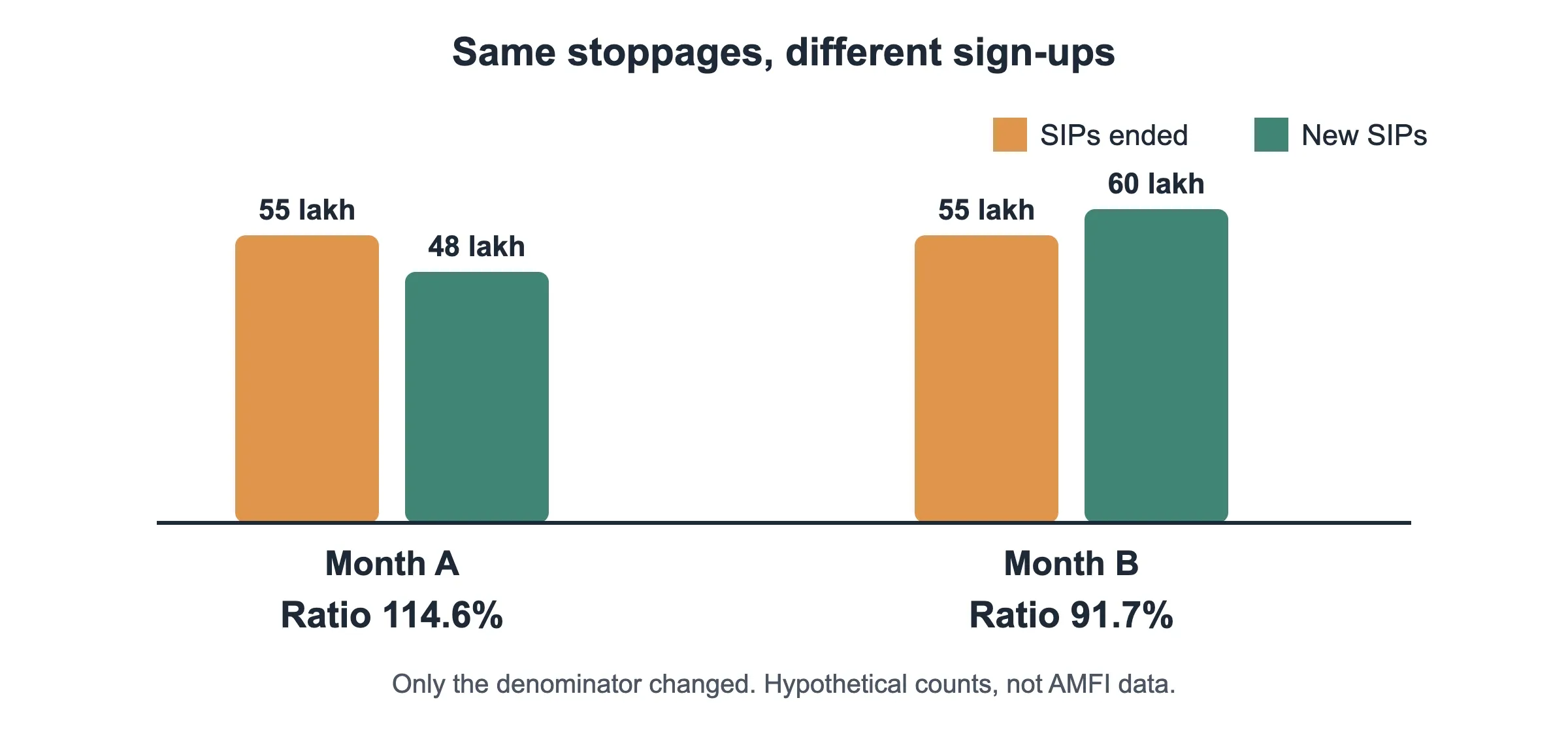
Here is a hypothetical example (hypothetical counts, not AMFI data):
| Month A | Month B | |
|---|---|---|
| SIPs discontinued or tenure completed | 55 lakh | 55 lakh |
| New SIPs registered | 48 lakh | 60 lakh |
| Stoppage ratio | 114.6% | 91.7% |
The number of SIPs that ended is the same in both months. Only the sign-ups changed, yet the ratio moved from 91.7% to 114.6%. Seen alone, the ratio can't tell you which of the two counts moved.
The ratio was reported above 115% in October 2026. What does that mean for my SIP?
Figures quoted for October 2026 range from about 115% to 117%. They differ because each calculation counts slightly different rows of AMFI's data, for example whether domestic fund of funds schemes are included. What they agree on is that, in October 2026, the SIPs that ended outnumbered the new SIPs registered.
What the number does tell you: in that month, fewer new SIPs were registered than ended, across the whole industry.
What it doesn't tell you:
- how many of the ended SIPs simply reached their end date
- why any investor stopped
- anything about your fund, its NAV or your goal
Ananya's ₹2,600 SIP is the same SIP it was before the number came out. A ratio about the industry's sign-ups and stoppages says nothing about her fund, her units or her plan. Instead of reacting to the headline, she can check her own situation:
- Goal: Is the goal this SIP was set up for still the same?
- Horizon: When will she need the money? Is that date still years away, or has it moved closer?
- Cash flow: Can she still pay ₹2,600 a month comfortably after rent, bills and her emergency fund?
If the answers haven't changed, the ratio adds nothing new about her plan. If something has changed, such as a job move, that is a reason to look at her options. If you're worried because markets have fallen, read what happens to your SIP when the market falls.
Do SIPs that finished their tenure, or were cleaned up by registrars, count as "stopped"?
Yes, in the headline ratio they usually do. AMFI's grouping is "discontinued/tenure completed", which brings together several different events:
- Tenure completed: many SIPs are registered with an end date. When that date arrives, the SIP ends on schedule.
- Cancelled by the investor: someone chose to stop.
- Cancelled after failed debits: fund houses can cancel an SIP after repeated failed instalments, under the terms in the scheme documents. See what happens when you miss an SIP instalment.
- Record clean-ups: registrars and fund houses may close mandates that are no longer active.
Go back to the hypothetical month (hypothetical counts, not AMFI data). Of the 55 lakh SIPs that ended, suppose 20 lakh simply reached their end date or were cleaned up. The remaining 35 lakh, divided by 48 lakh new registrations, gives 72.9%, well below the headline 114.6%. The headline ratio counts all 55 lakh as stoppages.
Where can I see AMFI's SIP numbers myself every month?
AMFI, the industry body for mutual funds in India, posts its monthly data and monthly notes at amfiindia.com, usually in the second week of the following month. The monthly note reports figures such as the number of new SIPs registered, SIP contributions for the month and the number of contributing SIP accounts.
Read two terms carefully:
- SIP registrations: new SIPs set up during the month. This is the denominator of the stoppage ratio.
- Contributing SIP accounts: SIP accounts from which an instalment was actually collected in the month. AMFI's February 2026 note reported 9.44 crore contributing accounts, down from 9.92 crore in January 2026, and linked part of the dip to February being a shorter month, with some instalments processed in early March.
Before reading meaning into any monthly figure, check what was counted and what the calendar did.
Frequently asked questions
Is the stoppage ratio the same as SIP outflows?
No. The ratio counts SIP accounts, not rupees, and says nothing about money redeemed. AMFI reports SIP contributions separately.
What are contributing SIP accounts?
They are SIP accounts from which an instalment was actually collected during the month. The count can dip for reasons like a shorter month, which AMFI noted in February 2026.
Does pausing an SIP count as stopping it?
A pause is meant to be temporary, and the SIP restarts after the pause ends, while a stop cancels the SIP. How a pause shows up in the industry counts isn't spelled out in the monthly note. Read what each one does in Pause or Stop Your SIP?
Should I stop my SIP when the market falls?
That depends on your goal, horizon and cash flow, not on the market or an industry ratio. Our guide on what happens to your SIP when the market falls walks through it.
Read next
Before you change anything, read what pausing and stopping each do: Pause or Stop Your SIP?
- Common SIP mistakes beginners make
- How long should you continue your SIP?
- What is an SIP in mutual funds?
— Laabh



