What Is an AMC in a Mutual Fund? Who Manages Your Money, Who Watches Them, and Where AMFI Fits In
An AMC is the SEBI-approved company that runs mutual fund schemes. See who does what: trustee, custodian, RTA, distributor, SEBI, AMFI.
Summarize this article with AI





The short version
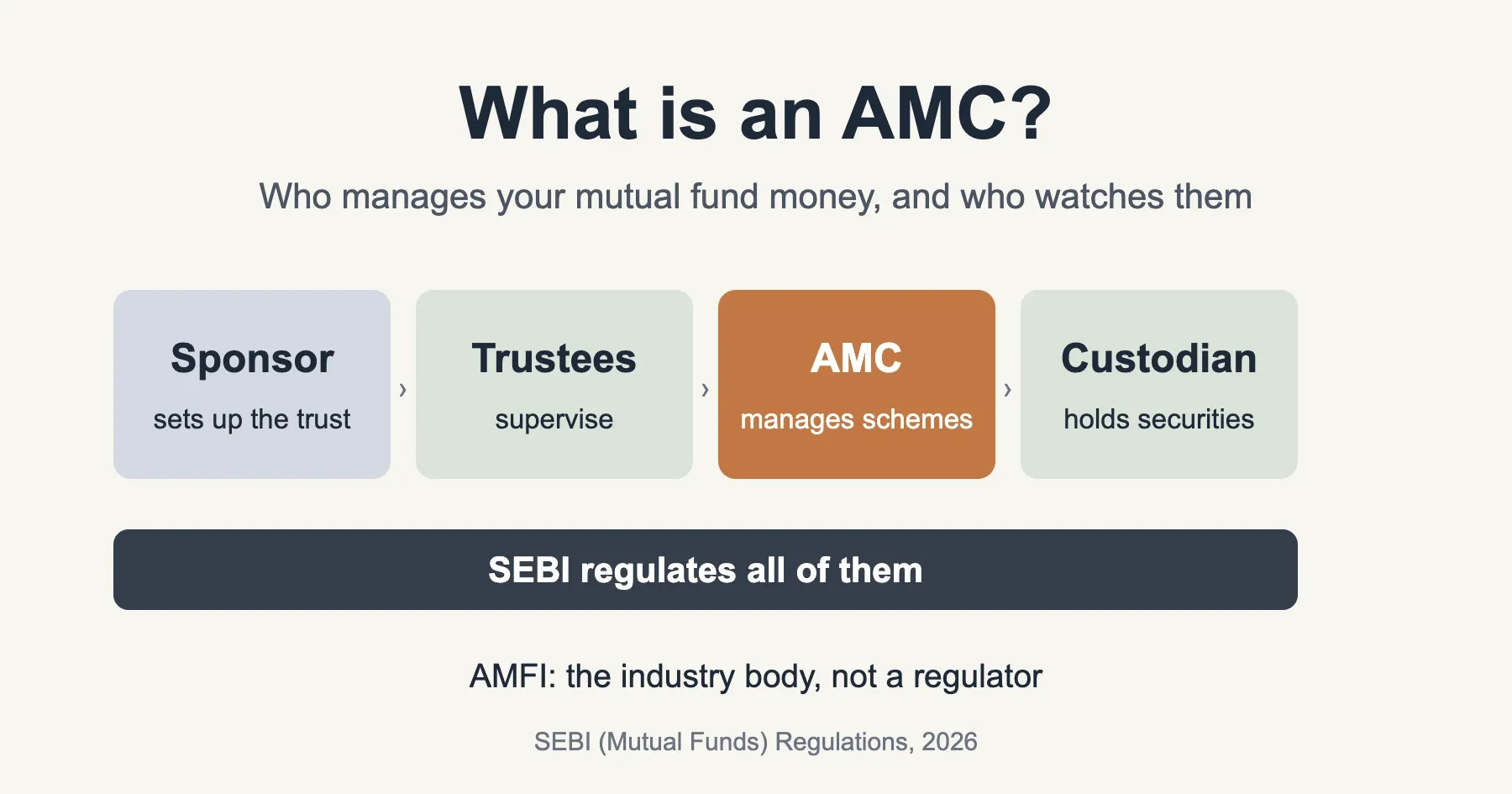
- An AMC is the SEBI-approved company that manages a mutual fund's schemes and computes NAV; it does not own the fund's assets.
- Under the SEBI (Mutual Funds) Regulations, 2026, the fund is a trust: the trustee company holds the property for unit holders and supervises the AMC.
- SEBI is the regulator. AMFI is a non-profit industry body that registers distributors (ARN) under responsibility delegated by SEBI.
- An ARN shows registration and certification, not a recommendation of any fund.
As of 22 November 2026: an asset management company (AMC) is the SEBI-approved company that runs a mutual fund's schemes. It decides what to buy and sell within each scheme's stated rules, works out the NAV every day and is paid through the scheme's expense ratio. Trustees supervise the AMC, SEBI regulates everyone in the chain, and AMFI (Association of Mutual Funds in India) is the industry body, not a regulator.
Aarav, 24, has just got his first salary in Nagpur and is about to start a ₹5,000 SIP. One fund page shows a fund house name, "AMFI-registered mutual fund distributor" and a SEBI footer. Who is responsible for his money? This page maps each name.
The AMC in one paragraph: what it does every day
Under the SEBI (Mutual Funds) Regulations, 2026, in force from 1 April 2026, a mutual fund is set up as a trust, and the asset management company is a company approved by SEBI to manage that trust's schemes (Reg 2(1)(e), Reg 9(1)). The AMC (informally, the "fund house") employs the fund managers and research team, decides what each scheme holds, computes each scheme's NAV daily (Reg 43), discloses purchase and redemption prices (Reg 44) and issues the scheme documents. Two limits matter. The AMC cannot act as a trustee of a mutual fund (Reg 21(a)), and the scheme's investments are not the AMC's own money: the trustee company holds the fund's property in trust for unit holders (Reg 2(1)(bbb)).
Who does what: the six names behind every scheme
| Entity | What it does | Who appoints it | You contact it for |
|---|---|---|---|
| Sponsor | Sets up the mutual fund by executing a registered trust deed and seeking SEBI registration | Not appointed; it establishes the fund | Rarely, if ever |
| Trustee company | Holds the fund's property for unit holders; supervises the AMC | Named in the trust deed; SEBI approves its directors | Rarely |
| AMC | Manages schemes, computes NAV, issues disclosures | Trustee company (or sponsor, if the trust deed allows), with SEBI approval | Scheme questions, complaints |
| Custodian | Holds the securities the scheme buys | The trustees; must be SEBI-registered | Not usually |
| RTA | Keeps your folio records and processes transactions | The AMC; must be SEBI-registered | Statements, KYC and folio changes |
| Distributor (MFD) | Sells regular plans, helps with transactions | Registered with AMFI (ARN); empanelled by the AMC | Forms, if you use one |
Some checks built into the rules: At least two-thirds of a trustee company's board must be independent directors, and its chair must be independent (Reg 11(5), 11(2)). At least half of the AMC's directors must not be associates of the sponsor (Reg 16(2)(c)). A custodian where half or more of the directors represent the sponsor cannot normally be appointed for that sponsor's fund (Reg 13(4)). The AMC must also keep a minimum net worth: ₹50 crore under one route in Reg 5(1)(e), or ₹150 crore at registration and at least ₹100 crore after that under the other. The trustees review it every quarter.
RTAs get their own explainer: what CAMS and KFintech do.
SEBI vs AMFI: regulator vs industry association
| SEBI | AMFI | |
|---|---|---|
| What it is | The securities market regulator | A non-profit industry body of AMCs |
| Legal basis | Regulates mutual funds under the SEBI (Mutual Funds) Regulations, 2026 | Incorporated on 22 August 1995 under Section 25 of the Companies Act, 1956 (now Section 8 of the 2013 Act) |
| Key job for you | Registers funds, approves AMCs, writes rules | Registers distributors, publishes NAV data |
So "AMFI regulates mutual funds" is not accurate. For what SEBI's 2026 rulebook changed, see SEBI's mutual fund regulations 2026.
What AMFI does
Per AMFI's own page, it acts as the registering (licensing) body for mutual fund distributors under responsibility delegated by SEBI, requires distributors to follow the AMFI Code of Conduct, publishes daily NAVs and scheme performance data, and runs the "Mutual Funds Sahi Hai" awareness campaign, started in 2017 under SEBI's guidance. Its members are the AMCs of SEBI-registered mutual funds.
"AMFI-registered mutual fund distributor" and the ARN
ARN stands for AMFI Registration Number. To get one, an individual must pass the NISM Series V-A mutual fund distributors certification (or its one-day continuing-education programme) and complete Know Your Distributor (KYD) checks. AMFI also gives each distributor employee an EUIN (Employee Unique Identification Number). Per AMFI's master circular of 14 January 2026, an ARN and EUIN are valid for 3 years and must be renewed online.
What it means: the person is certified and registered with AMFI. What it does not mean: an endorsement of the advice you get or the fund you pick. An ARN alone does not give the right to sell a scheme; the distributor must also be empanelled with that AMC. A distributor may not use the title "Independent Financial Adviser" or "IFA" without SEBI registration as an investment adviser. Distributors quote their ARN and EUIN on regular plan transactions, which links them to commission; see direct vs regular mutual funds.
Follow one ₹5,000 SIP instalment
Here is one instalment in a hypothetical "XYZ Flexi Cap Fund - Direct Plan - Growth Option". The NAV, the fund and every rupee figure below are hypothetical.
| Step | What happens | Who does it |
|---|---|---|
| 1 | ₹5,000 is debited from Aarav's bank through his SIP mandate and reaches the scheme's collection account | Bank, then AMC and RTA |
| 2 | The day's NAV is worked out (hypothetical ₹48.62) | AMC |
| 3 | ₹5,000 ÷ ₹48.62 = 102.838 units are credited to his folio, and a statement follows | RTA |
| 4 | The fund manager invests the money in line with the scheme's rules | AMC |
| 5 | The securities bought are held for the scheme | Custodian |
| 6 | The AMC's compliance, net worth and related-party dealings are reviewed | Trustees |
One simplification: a small stamp duty is deducted on purchases and is left out here. Actual units may be slightly fewer.
How the AMC gets paid: the expense ratio
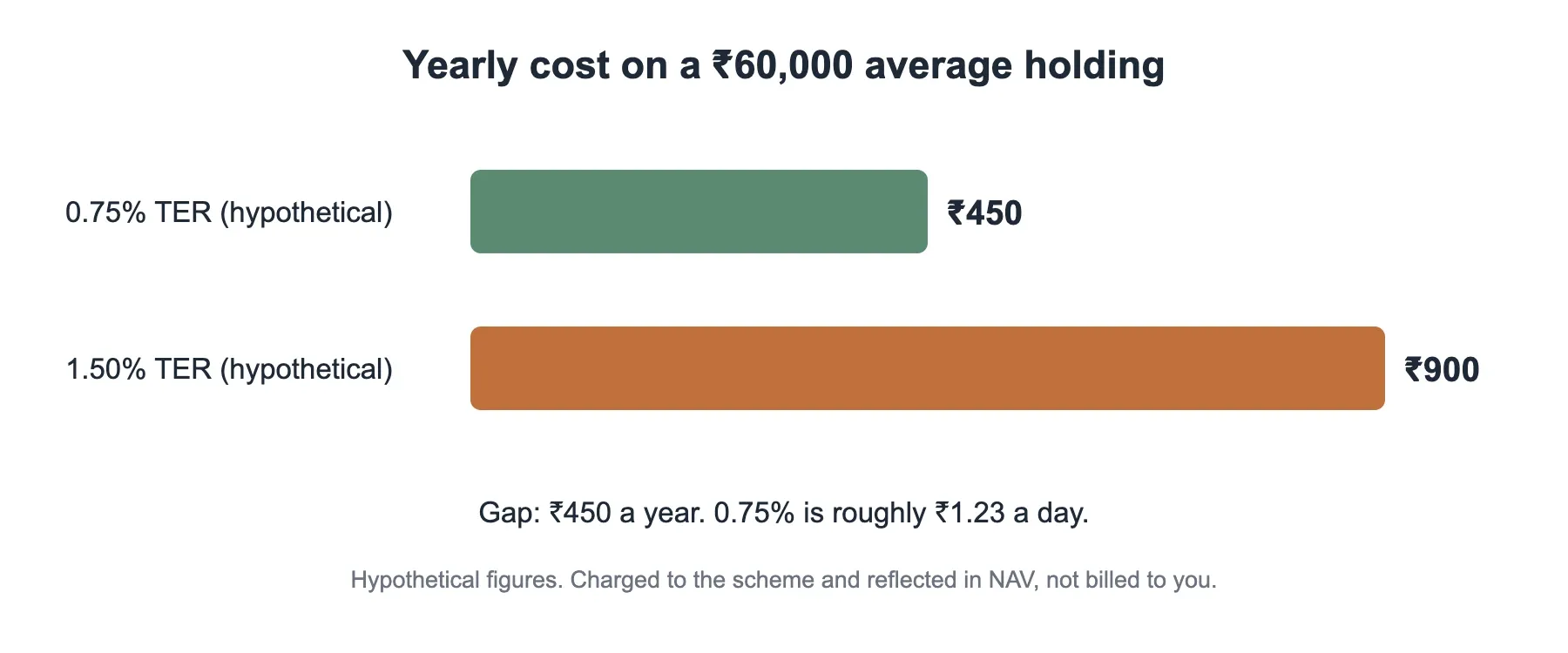
The AMC is paid out of the scheme's total expense ratio (TER), within limits SEBI specifies (Reg 2(1)(aaa)). You do not get a bill: the cost comes out of the scheme and shows up as a slightly lower NAV. Suppose Aarav's average holding over a year is ₹60,000. At a hypothetical 0.75% TER, that is about ₹450 a year (roughly ₹1.23 a day); at a hypothetical 1.50%, about ₹900, a gap of ₹450. The full picture is in our expense ratio guide.
Reading a scheme name
Take the hypothetical "XYZ Flexi Cap Fund - Direct Plan - Growth Option":
- XYZ: the mutual fund, and so the AMC that manages it.
- Flexi Cap Fund: the scheme's category, which sets what it may invest in.
- Direct Plan: bought without a distributor. Regular Plan transactions are the ones linked to distributor commission.
- Growth Option: gains stay in the NAV instead of being paid out.
The AMC's name tells you who manages the money, not whether the scheme fits your goal. An AMC's size or age does not make a scheme safer.
What if the AMC has a problem?
If trustees find substantial irregularities, they must review whether the AMC should continue and must not let it launch new schemes until the issues are fixed (Reg 12(5)(e)(ii)). What happens to your units if an AMC closes or is replaced is covered in are mutual funds safe if an AMC shuts down.
How to check an AMC and a distributor
- The mutual fund and AMC: look the mutual fund up in the recognised-intermediaries section of SEBI's website, and match the name to your scheme documents. AMFI's members are the AMCs of SEBI-registered mutual funds.
- The distributor: ask for the ARN and check it through the distributor search linked from AMFI's website, including its validity date.
- The RTA: your account statement names the RTA that keeps your folio.
For how the whole structure fits together, see what a mutual fund is and how it works.
Frequently asked questions
What is an AMC in mutual funds?
The SEBI-approved company that manages a mutual fund's schemes, makes investment decisions and computes NAV daily. It does not hold your money in its own books: the trustee company holds the fund's property in trust for unit holders.
What is the difference between AMC and AMFI?
The AMC manages schemes. AMFI is the non-profit industry association of AMCs that registers distributors and publishes NAV data. SEBI is the regulator over both.
Who regulates mutual fund companies in India?
SEBI, under the SEBI (Mutual Funds) Regulations, 2026, in force from 1 April 2026. Inside each fund, the trustee company supervises the AMC and reports to SEBI every half year.
What does "AMFI-registered mutual fund distributor" mean?
The distributor holds an ARN (AMFI Registration Number), which needs NISM certification and KYD checks and is valid for 3 years. It confirms registration, not the quality of advice.
How does an AMC make money from my SIP?
Through the expense ratio, charged to the scheme and reflected in the NAV. On a hypothetical ₹60,000 average holding, a 0.75% expense ratio is about ₹450 a year.
Save this map
Save the six-entity table above for the next time a fund page lists a sponsor, AMC, trustee and RTA.



