What Is a Mutual Fund and How Does It Work? Follow ₹2 Lakh From Four Investors to NAV and Back
A mutual fund pools money into a SEBI-regulated trust and issues units valued at NAV. Follow ₹2 lakh from four investors to see how it works.
Summarize this article with AI





The short version
- A mutual fund is a SEBI-registered trust that pools money and issues units; NAV is net assets ÷ units.
- Everyone in a scheme gains or loses the same percentage.
- Expenses come out of the fund's assets and show in the NAV, in rising and falling years.
- Redemptions and new money happen at NAV, so they don't change others' value.
- The AMC manages, the custodian holds, the RTA records and trustees and SEBI oversee; none of them stops prices falling.
As of 22 November 2026: a mutual fund is a trust that pools money from many investors, invests it as its scheme's stated objective allows, and gives each investor units. The value of one unit, the net asset value (NAV), is the scheme's assets minus its liabilities, divided by the units outstanding, so everyone's money rises or falls by the same percentage. Mutual funds in India are registered with and regulated by SEBI, now under the SEBI (Mutual Funds) Regulations, 2026.
Asha, 23, has her first salary in Coimbatore and wants to know what she would be buying with ₹5,000. So this page runs one small, made-up fund for a year with Asha and three others in it, then shows who in the real system does each job.
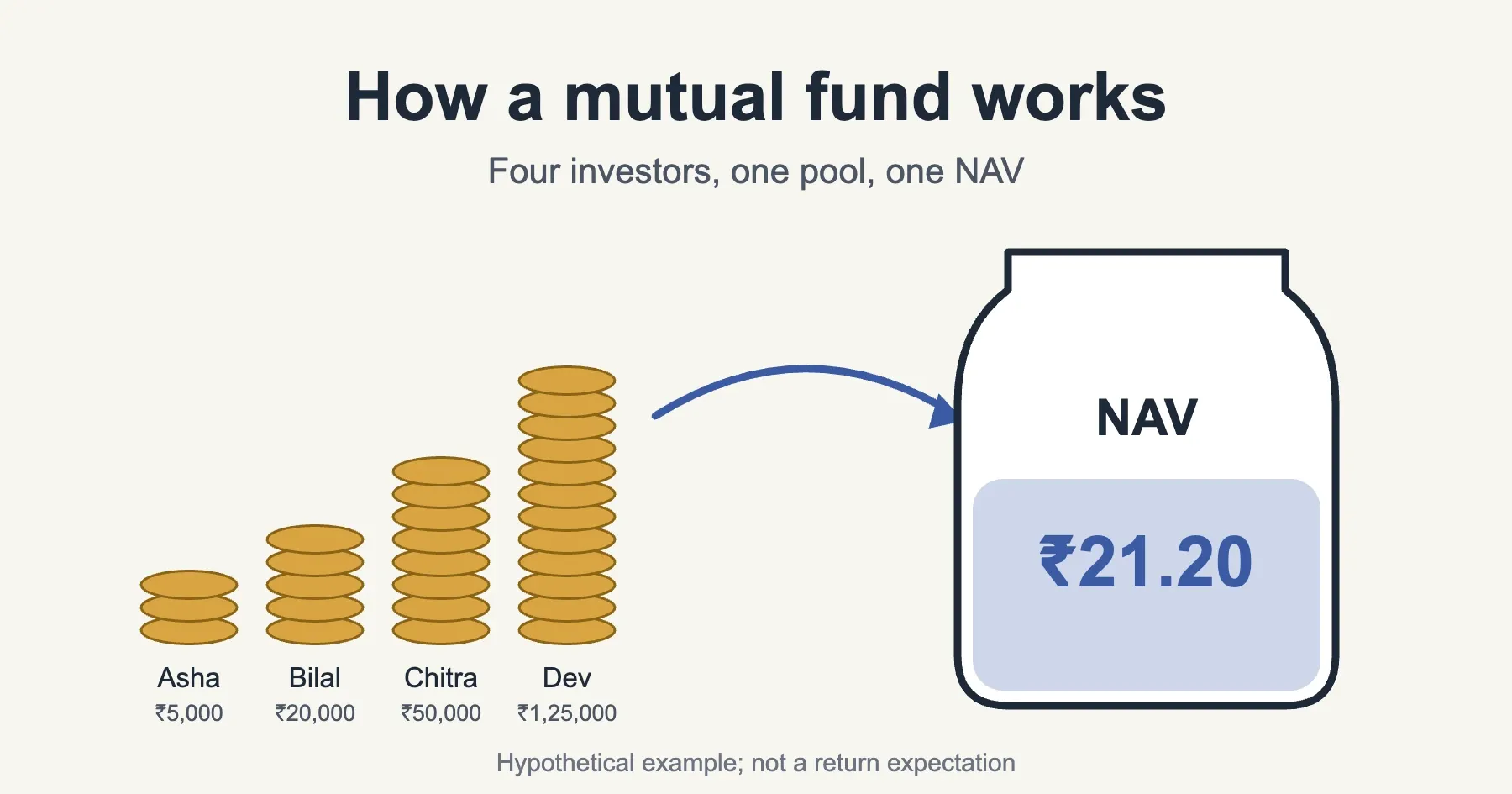
A mutual fund in one picture: money in, portfolio, units, NAV
- Money in. SEBI's investor FAQ calls a mutual fund "a mechanism for pooling money by issuing units to the investors".
- Portfolio. The asset management company (AMC) invests the pool in what the scheme's mandate allows, such as shares or bonds.
- Units. Each investor gets units at that day's NAV, in proportion to the money put in.
- NAV. Net assets divided by units outstanding, computed for each scheme daily (Regulation 43 of the 2026 Regulations).
Watch one small fund work for a year
The fund is fictional and every number is hypothetical. The 7% move could as easily be a fall.
Day 1: four investors, one NAV, different numbers of units
A new hypothetical scheme starts at an NAV of ₹20.
| Investor | Puts in | Units at ₹20 |
|---|---|---|
| Asha | ₹5,000 | 250 |
| Bilal | ₹20,000 | 1,000 |
| Chitra | ₹50,000 | 2,500 |
| Dev | ₹1,25,000 | 6,250 |
| Total | ₹2,00,000 | 10,000 |
Dev owns 25 times Asha's units because he put in 25 times the money, at the same NAV.
A year later: the market moves, expenses come out, NAV changes for everyone equally
Assume the portfolio's securities rise 7% over the year, from ₹2,00,000 to ₹2,14,000, and that expenses total ₹2,000 (1% of starting assets). Simplified: in a real scheme, expenses are taken from the fund's assets as it goes and show up in the NAV, not as a bill.
- Net assets: ₹2,14,000 − ₹2,000 = ₹2,12,000
- Units outstanding: still 10,000
- New NAV: ₹2,12,000 ÷ 10,000 = ₹21.20
| Investor | Units | Value at ₹21.20 | Change |
|---|---|---|---|
| Asha | 250 | ₹5,300 | +₹300 (6%) |
| Bilal | 1,000 | ₹21,200 | +₹1,200 (6%) |
| Chitra | 2,500 | ₹53,000 | +₹3,000 (6%) |
| Dev | 6,250 | ₹1,32,500 | +₹7,500 (6%) |
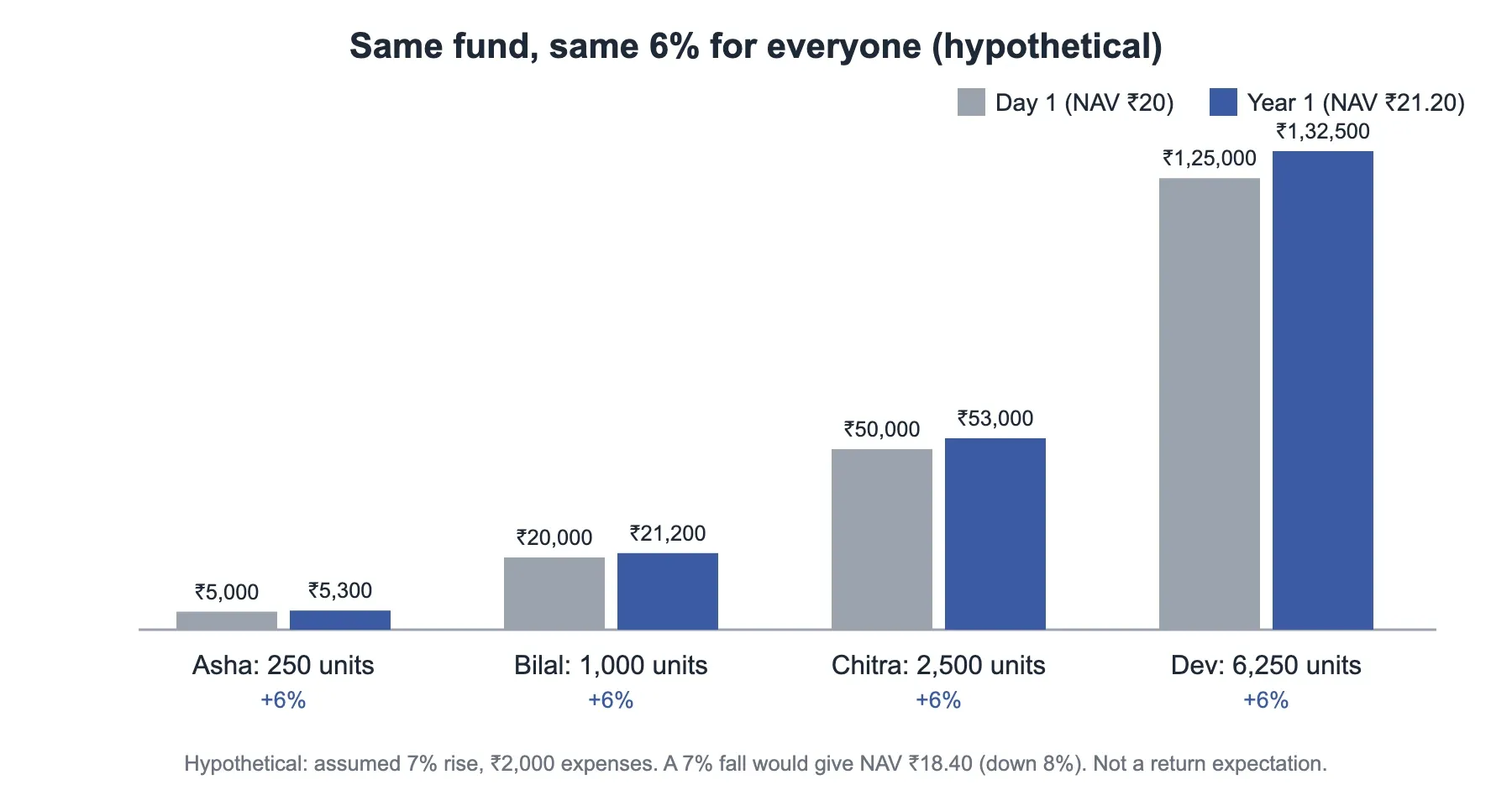
Each investor is up 6%, whatever the amount: 7% from the market, less 1% for expenses. With a 7% fall instead, NAV becomes (₹1,86,000 − ₹2,000) ÷ 10,000 = ₹18.40, and everyone is down 8%, because expenses are charged in falling years too.
Someone leaves, someone joins: why neither changes the others' value
Chitra redeems 1,000 units and receives ₹21,200, before any exit load or tax. Net assets fall to ₹1,90,800 and units to 9,000: NAV is still ₹21.20. Her remaining 1,500 units are worth ₹31,800.
Esha then puts in ₹30,000 at ₹21.20 and gets 1,415.0943 units (four decimals here; scheme documents state the rounding). Net assets become ₹2,20,800 across 10,415.0943 units: NAV stays ₹21.20 (rounded). Trading costs are ignored.
Money enters and leaves at NAV, so neither dilutes anyone else. And Esha got no worse a deal at ₹21.20 than the others at ₹20: NAV is a per-unit value, not a price tag. See why a low NAV isn't cheaper.
Who does what in a mutual fund
| Party | Its job | Where the 2026 Regulations say so |
|---|---|---|
| Sponsor | Establishes the mutual fund | Reg 2(1)(xx) |
| Trustees | The fund is a trust; trustees hold its property for unitholders | Regs 9(1), 12(3)(d) |
| AMC and fund managers | Appointed by the sponsor (or trustee, if the trust deed allows); invests the money, computes NAV | Regs 18, 43 |
| Custodian | Appointed by trustees; SEBI-registered; holds the securities | Regs 13(1), 2(1)(k) |
| RTA (registrar and transfer agent) | Appointed by the AMC; SEBI-registered; records who holds which units (e.g. CAMS, KFintech) | Regs 22(2)(v), 22(9)(a)(i) |
| SEBI | Registers mutual funds and writes the rules | Regs 2(1)(gg), 3 |
| AMFI | Industry association; publishes monthly data | Not a regulator |
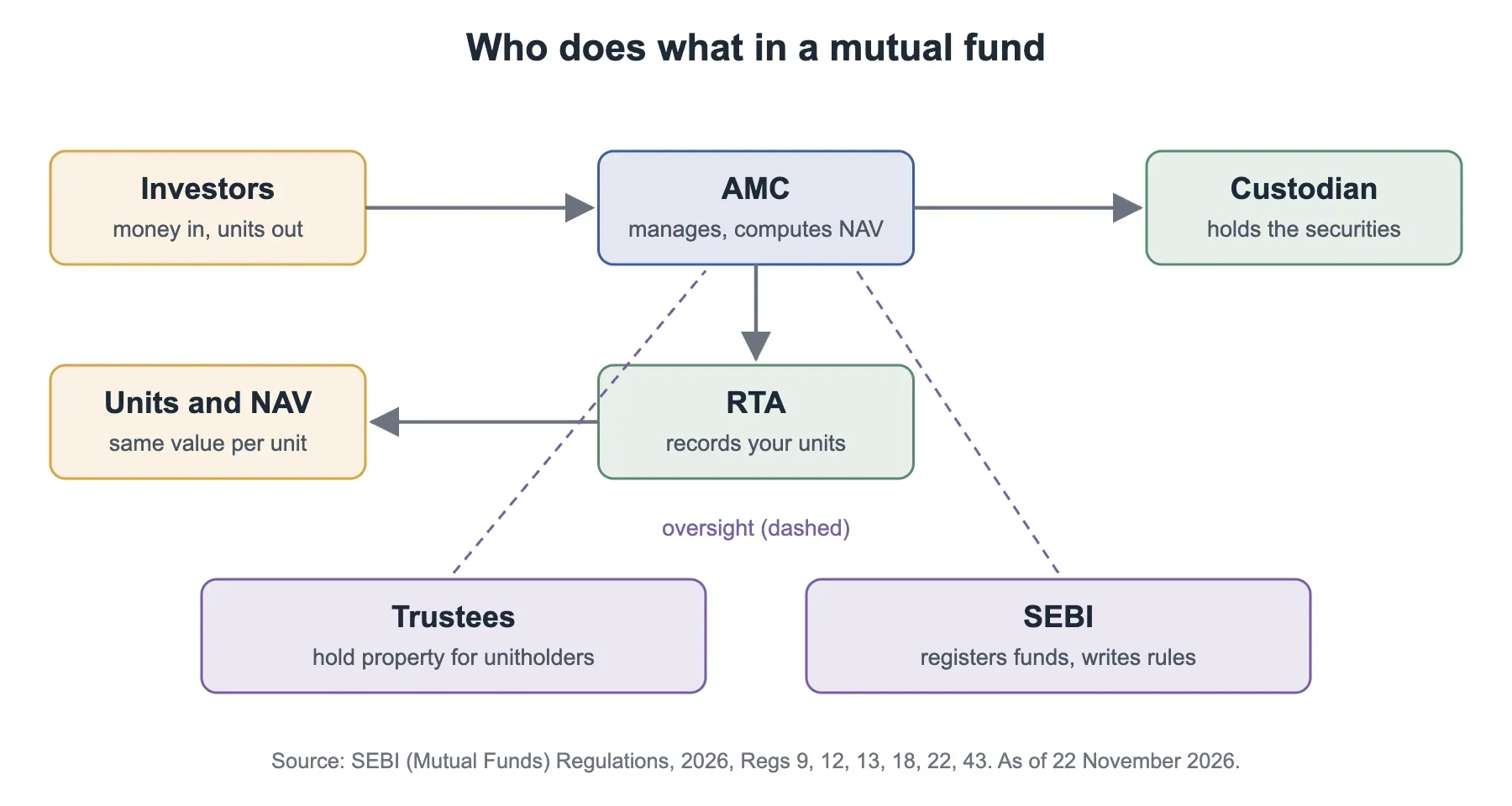
The AMC chooses investments, but someone else holds the securities and keeps the unit records, and securities are bought in the name of the mutual fund on account of the scheme (Sixth Schedule, paragraph 7). See what CAMS and KFintech do and what happens if the AMC shuts down.
What the 2026 rules mean for you
The SEBI (Mutual Funds) Regulations, 2026 came into force on 1 April 2026 (Regulation 1(2)) and repealed the 1996 Regulations (Regulation 85(1)). The structure above carries on. Expense limits are now a "base expense ratio" capped by scheme type (Regulation 66(7)). SEBI's circular "Categorization and Rationalization of Mutual Fund Schemes" (26 February 2026) updates how schemes are categorised and named. Our guide to mutual fund categories maps them, and our explainer on SEBI's 2026 regulations walks through the clauses investors notice.
How you actually earn: NAV change or payouts
- Growth option. Nothing is paid out; gains or losses stay in the NAV until you redeem.
- IDCW option. SEBI renamed the "dividend option" Income Distribution cum Capital Withdrawal (IDCW). Payouts are not fixed and, as the name says, can include part of your own capital.
Tax depends on the scheme type, holding period and option, so it is outside this page; see how mutual funds are taxed.
What a mutual fund is not
- Not a deposit. No fixed rate: SEBI's FAQ states that investors "are neither offered any guaranteed/indicated returns nor any guarantee on repayment of capital by the scheme."
- Not the bank's product because a bank sells it. Schemes marketed by banks and post offices "should not be taken as their own schemes" (SEBI FAQ).
- Not protected from price falls. The structure separates assets; it cannot stop NAV falling.
How you invest
- Lump sum or SIP: one payment, or a fixed amount at regular intervals.
- Direct or regular plan: a direct plan, which SEBI requires mutual funds to offer, pays no distributor commission, so it has a lower expense ratio and its own NAV. See direct vs regular mutual funds.
- No demat needed: units can sit in a statement of account; demat is optional. See mutual funds without a demat account.
How big this is now
AMFI's Monthly Note for October 2026: industry assets under management of ₹83,38,858 crore (about ₹83.39 lakh crore) at end-October, 28.78 crore folios, and SIP contributions of ₹32,160 crore from about 10.00 crore contributing SIP accounts. One person can hold several folios, so folios are not a count of people.
Frequently asked questions
What is a mutual fund in simple words?
A trust that pools many people's money and invests it per a stated scheme objective. Each investor gets units; one unit's value is the NAV. SEBI regulates mutual funds.
How does a mutual fund make money for investors?
Through a change in NAV. In this page's hypothetical example, NAV goes from ₹20 to ₹21.20 after a 7% rise and 1% expenses: everyone is up 6%. IDCW payouts, if chosen, can include your own capital.
Who manages and who protects the money in a mutual fund?
The AMC manages it. Under the SEBI (Mutual Funds) Regulations, 2026 (in force from 1 April 2026), trustees hold the fund's property for unitholders, a SEBI-registered custodian holds the securities and a SEBI-registered RTA keeps unit records.
Is a mutual fund safe or guaranteed?
No. SEBI's FAQ says there are no guaranteed or indicated returns and no guarantee on repayment of capital. The structure keeps scheme assets apart from the AMC, but NAV can fall with markets.
Mutual fund kya hai aur kaise kaam karta hai?
Mutual fund ek trust hai jo kai logon ka paisa jodkar securities me lagata hai. Har investor ko units milte hain; ek unit ki value NAV hai. Market ke saath NAV badalta hai, aur return pakka nahi hota.
Learn more
Save this page as your reference; the explainers linked above take each step further.



