Daily vs weekly vs monthly SIP: what frequency changes (mostly paperwork) and what it doesn't
Daily, weekly and monthly SIPs can invest the same total. See what frequency changes: debits, bounce risk and tax lots, with one ₹3,300 example.
Summarize this article with AI





The short version
- Daily, weekly and monthly SIPs can invest the same total; frequency changes how often you buy, not how much.
- We found no official study to cite showing one frequency gives better outcomes, so none is claimed here.
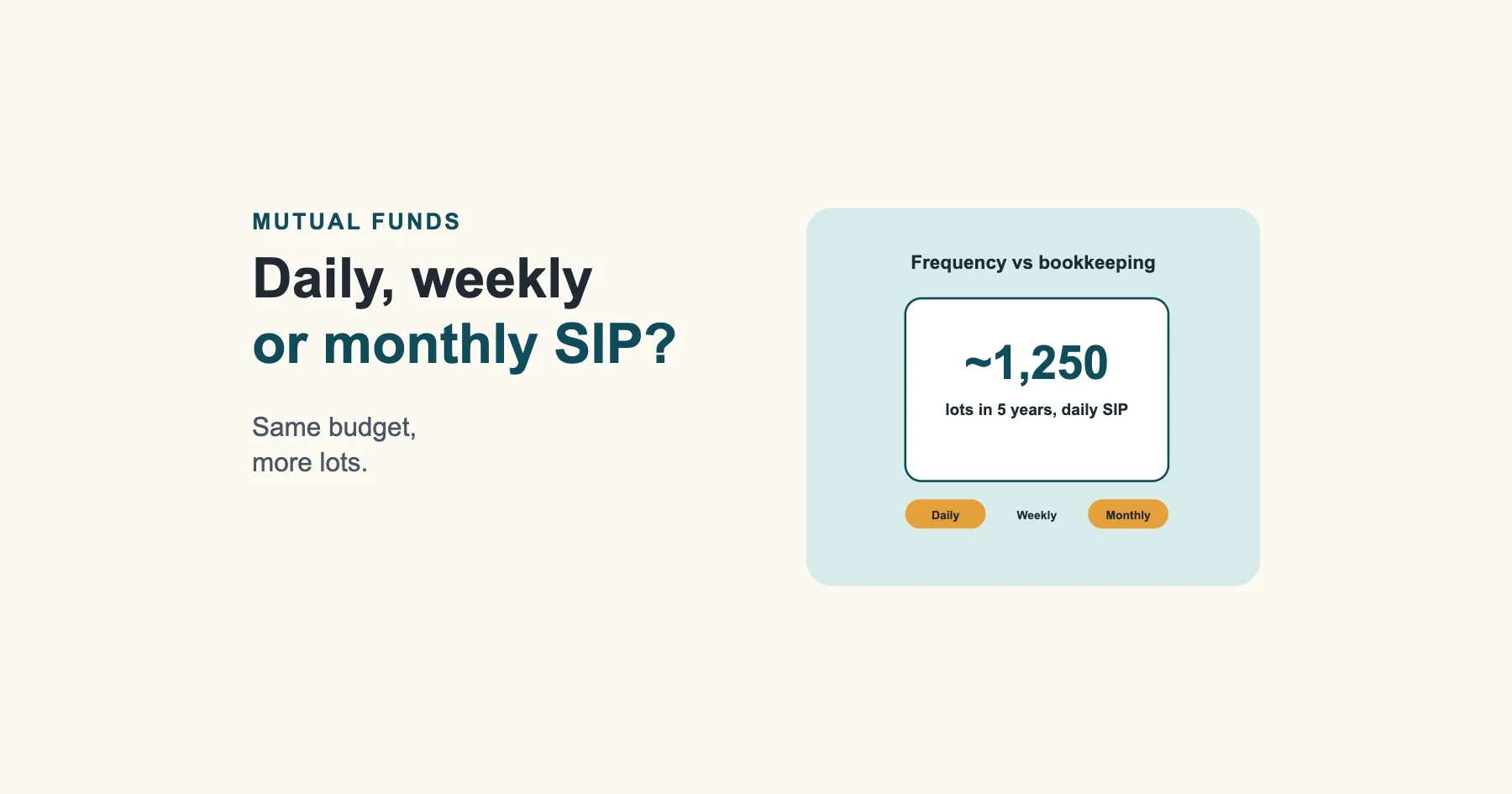
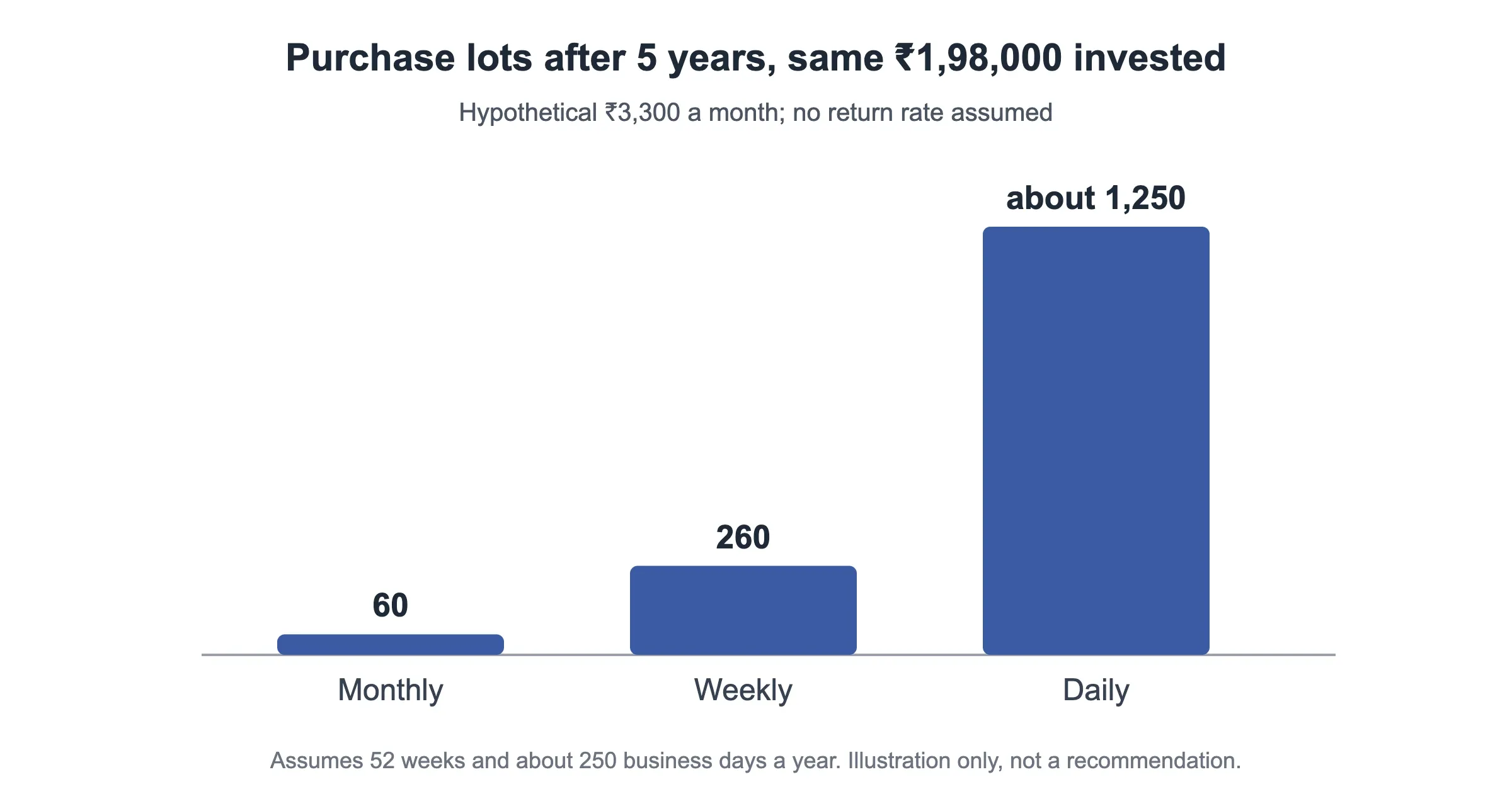
- In a hypothetical ₹3,300-a-month SIP, five years means 60 lots monthly, 260 weekly and about 1,250 daily.
- More instalments mean more debits that can bounce and more lots to track at tax time.
- Minimums, available frequencies and change rules vary by scheme and platform; read the SID.
Daily vs weekly vs monthly SIP, the short answer (as of 19 November 2026): daily, weekly and monthly SIPs can invest the same yearly amount, just in smaller or larger pieces. Frequency changes how often you buy, not the total you invest. What changes most is the paperwork: the number of bank debits, purchase records and tax lots. Fewer instalments mean fewer debits and records to track.
Mutual fund investments are subject to market risks, read all scheme related documents carefully.
Kabir, 25, in Ajmer, has ₹3,300 a month set aside for his first SIP. The order screen offers daily, weekly and monthly. A daily SIP sounds more disciplined, so he pauses. This page sets out what each choice actually changes, with one same-amount table, so he can decide on mechanics rather than on a feeling. If SIPs are new to you, start with our plain-English guide, what an SIP is.
What each SIP frequency means
An SIP (systematic investment plan) buys units of a mutual fund scheme at that day's NAV on a fixed schedule, debiting your bank account each time.
- Monthly: one instalment a month on a date you choose.
- Weekly: one instalment on a chosen weekday.
- Daily: one instalment on every business day of the scheme.
Not every scheme or platform offers every frequency, and the rules differ. As one example, a scheme information document (SID) we read on the AMFI portal lists daily, weekly, monthly and quarterly SIPs, with a minimum instalment of ₹100 for daily and weekly SIPs and ₹500 for monthly, and minimum counts of 180 daily, 24 weekly or 12 monthly instalments. Other schemes set different numbers, so read the SID of the scheme you are considering.
Same budget, three frequencies: a worked example
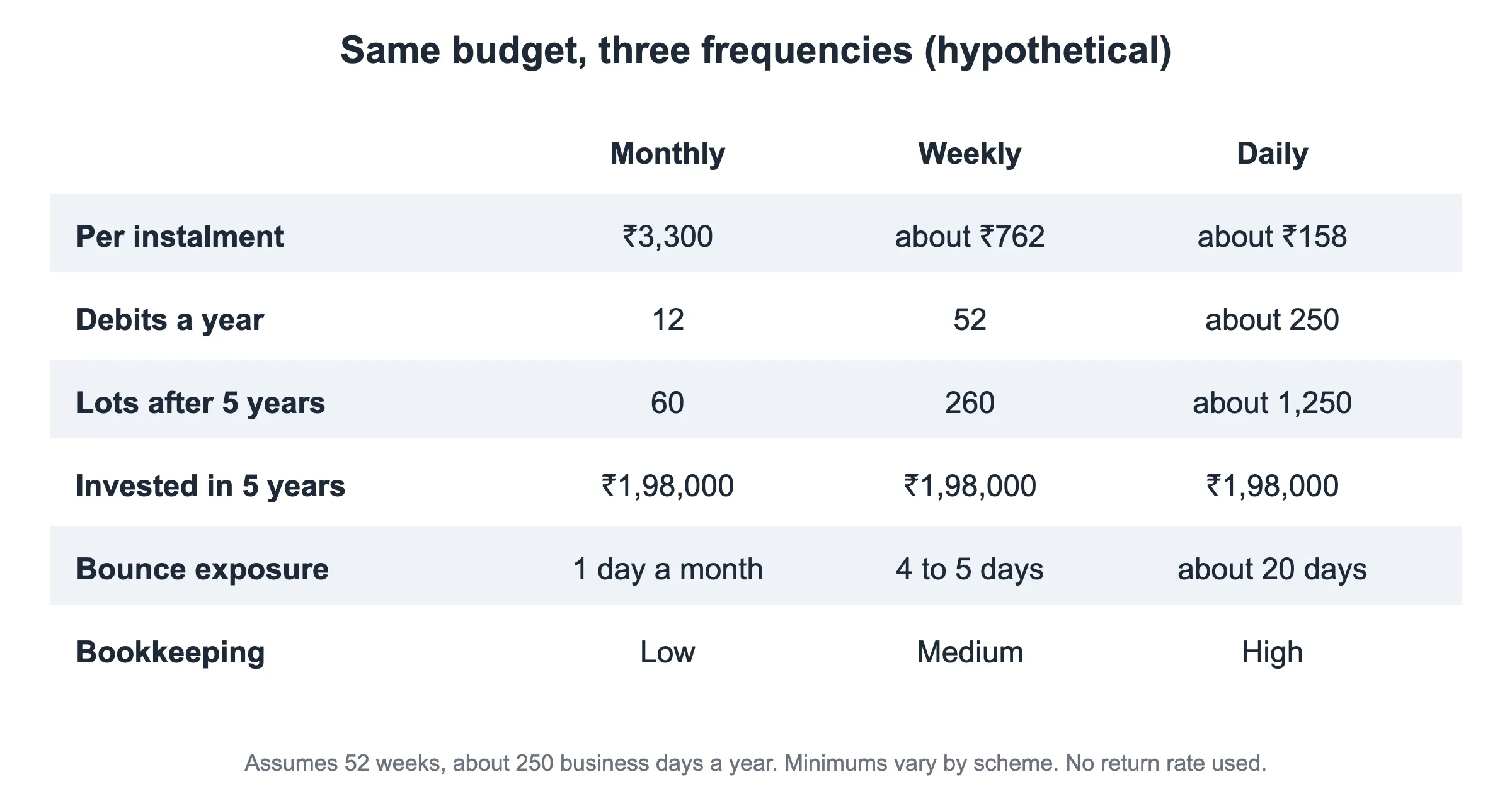
Here is a hypothetical ₹3,300 a month, or ₹39,600 a year, spread three ways. No return rate is used, because the point is the mechanics, not growth.
| Monthly | Weekly | Daily | |
|---|---|---|---|
| Per instalment | ₹3,300 | about ₹762 (₹39,600 ÷ 52) | about ₹158 (₹39,600 ÷ 250) |
| Debits and purchase lots a year | 12 | 52 | about 250 |
| Lots after 5 years | 60 | 260 | about 1,250 |
| Total invested in 5 years | ₹1,98,000 | ₹1,98,000 | ₹1,98,000 |
| Days money must be in the account | 1 a month | 4 to 5 a month | about 20 a month |
| Records to reconcile | Low | Medium | High |
Hypothetical amounts; assumes 52 weeks and about 250 business days a year (actual business days vary with holidays and the scheme's calendar). Minimums vary by scheme and platform. Not a recommendation.
Two things stand out. The money invested is identical. The number of transactions is not: a daily SIP creates roughly 20 times the records of a monthly one over the same five years.
Does frequency change returns?
An SIP spreads purchases over time, so you buy more units when the NAV is lower and fewer when it is higher. This is rupee-cost averaging, and it works at any frequency. It does not remove market risk, and it does not promise a better average price; our explainer whether an SIP is risk-free covers what an SIP can and cannot reduce.
Buying more often slices the same money into more purchase prices. Whether that ends up slightly ahead or slightly behind depends on how the market happened to move, which nobody knows in advance. We have not found an official, dated study we can cite on frequency and long-run outcomes, so we make no claim that one frequency does better than another. Choosing daily because you expect to catch dips is a form of market timing, and this page does not suggest it.
What you can control is how much you invest and for how long. Frequency mostly decides how many pieces that money is cut into.
The hidden side: debits, mandates and bounces
Each instalment is a separate debit, usually collected through a bank mandate such as NACH or UPI AutoPay, frameworks run by NPCI. Mandate limits, alerts and set-up steps depend on your bank and the mandate type, so check them when you register.
More debits mean more chances for one to fail. If your balance is short on the day, the instalment bounces. Banks may charge for a failed mandate debit; the charge varies by bank, so check your bank's schedule of charges. The fund house may also act on repeated failures: the same SID we read says the fund house may discontinue an SIP if three consecutive instalments fail. On a monthly SIP that is three months of misses. On a daily SIP, three consecutive business days could be enough under a rule like that.
So a daily SIP asks for money to sit in your account on about 20 days a month, not one. If your balance dips before payday, that matters. Our guide what happens when you miss an SIP instalment explains what the bank and the fund house each do after a missed instalment.
Many lots, more bookkeeping
Each SIP instalment buys units on its own date at its own NAV. Each of those purchases is a separate lot, with its own cost and its own holding period.
That matters when you redeem. As of 19 November 2026, FY 2026-27, under the Income-tax Act, 2025, the Income Tax Department's guidance treats units of equity-oriented mutual funds as long-term when held for more than 12 months. Because each lot has its own purchase date, a single redemption can include some long-term and some short-term units. Redemptions are generally matched first-in, first-out, oldest units first.
With 60 lots after five years, the capital-gains statement from your fund house or registrar is short. With about 1,250 lots, it runs to many pages, and checking it by hand when you file returns takes longer. Your consolidated account statement will also list every purchase; see how to read your CAS. For how each type of fund is taxed, read how mutual funds are taxed in India. Tax rules change; consult a tax professional for your situation.
Salaried? Match the SIP to your cash flow
Most salaried investors are paid once a month. A monthly SIP dated a few days after salary credit lines up one debit with one inflow. Weekly and daily SIPs spread the debits across the month, so the money for later instalments has to stay untouched until it is collected.
Some useful checks before you choose:
- When does money arrive? Monthly salary, weekly wages or irregular freelance income each fit differently.
- How steady is your balance? If your account runs low before payday, more debit days mean more bounce exposure.
- How much record-keeping will you do? More lots mean longer statements at tax time.
- What does the scheme allow? Minimum amount and minimum number of instalments differ by frequency and scheme.
Our guide to choosing a date, the best date for an SIP, goes deeper on timing within the month.
Can you change frequency later?
Often the practical route is to stop the existing SIP and register a new one with the frequency you want. Some platforms may offer a direct modify option; check before you assume either way. Cancellation notice also varies: the SID we read asks for notice at least 30 days before the next debit, and other schemes and platforms may differ. Units you already bought stay in your folio, keeping their original purchase dates. Pausing and stopping work differently; see pausing vs stopping an SIP.
Frequently asked questions
Is daily SIP better than monthly SIP for returns?
Neither frequency carries a built-in return edge. Both invest the same total if you set the same yearly amount; what differs is how many purchases you make and at which NAVs. Outcomes depend on how markets move over your holding period, which no frequency can predict. Mutual fund returns are not guaranteed.
Does SIP frequency really change long-term returns?
Frequency changes how often you buy, not the total you invest. Over many years, how much you put in and how long you stay invested are the parts you control. We have not found an official study to cite on frequency and outcomes, so this page compares only the mechanics.
I'm salaried, which SIP frequency should I pick?
Start from your cash flow. If your salary arrives once a month, a monthly SIP dated a few days after salary day means one debit, one record and one date to watch. Weekly or daily SIPs need money in the account across the month. Our guide to the SIP date is at the best date for an SIP.
Will a daily SIP create too many bank debits or transactions to track?
It creates many more. In our hypothetical ₹3,300-a-month example, a daily SIP makes about 250 debits and purchase lots a year against 12 for a monthly SIP, assuming about 250 business days. Each debit can fail if the balance is short. See what happens when you miss an SIP instalment.
Can I change my SIP from monthly to weekly later?
Often the practical route is to stop the existing SIP and register a new one with the frequency you want. Whether a direct frequency change is offered, and how much notice is needed, depends on the fund house and platform, so check the scheme documents. Units already bought stay in your folio. See pausing vs stopping an SIP.
Learn more
New to SIPs? Read what an SIP is first, then the best date for an SIP to pick a date that suits your salary cycle.
— Laabh



